Soweto Bicycle Tour

This post was pre-scheduled to publish while we are off on our self-drive safari

While staying in Joburg, we decided to spend some time in Soweto. Soweto is outside and to the southwest of Joburg. Soweto in fact is the name for the southwestern townships- the cities populated by the black population of Joburg during apartheid. It began during the 1940s when the black settlements outside Joburg were destroyed by authorities. The people were forcibly moved into Soweto.

Soweto gained its fame during the 1970s when it played a crucial role in the struggle against apartheid. It is also well known as the home of Nelson Mandela before he went to prison.

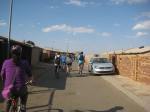
One of the best ways to see Soweto is to take a bicycle tour offered from a local hostel. We decided, despite it being a little pricier than we hoped, to do it. We were able to pick a bike (we both chose red cruisers) and, with a local guide, we headed out into the city. Soweto was really like many other cities around the world. There were some areas with clean, comfortable looking bungalows but also areas of abject poverty: people living in shacks with only shared bathroom facilities. In these areas, there was much trash and running sewage that we had to pick our way carefully over.

The people, in all areas, were unbelievably friendly. They all continually waved, calling out to us and welcoming us to Soweto. They seemed very proud of their free city and happy to share it with us. The children were adorable, running up to us hoping to give us a high five as we rode past. Many times the kids shouted for us to “shoot” them. We were a bit taken aback until we realized what they wanted was for us to take a picture of them.

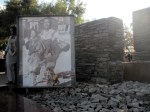
The tour wound through the many areas of town until we reached Vilakazi St. Here we stopped to reflect on the Hector Pieterson Memorial. In 1976, students of Soweto came together to protest the use of Afrikaans in their schools. There was a movement by the apartheid government to make Afrikaans (the language of the white Afrikaaners) the only language used in black schools. Students did not read or write in Afrikaans, so they wished instruction to be in English. During the large protests, police opened fire into the crowd, killing many, including the young Hector Pieterson (only 13 years old). This event led to nationwide demonstrations, mass arrests, and riots which took cost many lives. Our guide also explained that this lead to a famous picture, one of a student heroically carrying poor Hector to safety. He explained that this photo was spread on an international stage, helping to let the rest of the world know what was happening here in South Africa which helped bring new support and pressure on the apartheid government to change. It was a beautiful memorial, and we were able to spend a bit of time reflecting.

Also on Vilakazi St, we visited the old home of Nelson Mandela, which has now become a museum. A little farther down the road is the house of Desmond Tuto, making this street the only one in the world to host two Nobel Peace Prize winners. We did not see much of Desmond Tuto’s house as were told that it is actually still his Joburg residence, though he spends most of his time in Cape Town.

We found it interesting also that Vilakazi St has blossomed into a true tourist locale with large, hip restaurants and bars which look much different than the area surrounding.

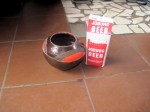
At the end of our tour, we were treated to umqombothi (the q sound is actually a click which makes this a very fun word to hear and very difficult one for us to say) which was a traditional beer served in a shebeen during apartheid. It was illegal for black people in Soweto to drink anything except beer in government established places. A shebeen was where people continued to make and serve their own traditional beer. It was very interesting – a milky white color and a sour taste. It was also drunk in a very traditional way, everyone sharing from one cup, or calabash. We sat in a circle and when it was our turn to drink we had to assume the traditional stance, which was kneeling for girls and crouching, one foot slightly in front of the other, for boys.

We very much enjoyed our tour, and learned quite a lot. We would definitely recommend it for anyone getting a chance to visit Joburg.


Johannesburg

This post was pre-scheduled to publish while we are off on our self-drive safari

Our first international stop on our trip was the city of Johannesburg, a.ka. Joburg, a.k.a. Jozi, a.k.a. The City of Gold. Joburg has a mixed reputation as a tourist destination, but we found it a fascinating place with lots of history.

As we learned more about Joburg, we were interested to discover that in many ways it is similar to Denver! Joburg was a small farming area that exploded into a boomtown in 1886 once a giant gold deposit was discovered – similar to Denver’s origins. Denver did, at least, have a water source near the city core, whereas there is none near Joburg (the water is piped in from the mountains of Lesotho). Also, the elevation of Joburg is over 5700ft – so if Denver is the Mile High City then Joburg must be the More Than a Mile High City!

Where We Stayed

Johannesburg Backpackers – The first two nights in town we stayed at this basic backpackers hostel in one of the northern suburbs. We chose this location because this part of town is considered safer. Our double room was nice and spacious with its own bathroom. The downside of it was that it had no heat (and it is winter here, with nights dipping into the 40s), but they did provide plenty of blankets. Another downside is that there isn’t much to do around the area. There is an area of bars and restaurants called Greenside a few blocks away, but it is still considered a little sketchy so you aren’t supposed to walk back from there too late at night by yourself. Also, to get to any attractions requires you to use a taxi that they will help you set up.

Lebo’s Soweto Backpackers – The second two nights we transferred to the Soweto area. This township has a rich history as the location where blacks were forcibly transferred to in order to get them away from the city center, and then as the center of apartheid resistance. These days it is a friendly, gigantic suburb. The hostel is a nice and vibrant accommodation – there is a kitchen that serves all three meals for a reasonable fee daily. There is a nice patio area outside with a self-serve honor system bar, reggae music playing, and campfires in the evening. Our double room is small but comfy, and we used a shared bathroom across a breezeway.

What We Did

Johannesburg City Tour

This is one of those bright red double decker bus tours that you see in a variety of cities around the world which allow you to hop on and off at different stops along the way. Normally this would be too high on the “typical tourist” scale for us to really consider, but it seemed like the best way to see the sights in downtown Joburg in one day since it is not very walkable.

The tour starts at Park Station downtown and winds through the Central Business District. They give you headphones to plug in and listen to a narration of what we are seeing. We drove by, but did not get off at, various sights like Gandhi Square (Gandhi lived in South Africa in the early 1900s) and the Carlton Center, one of the tallest buildings in all of Africa. We got off at the Apartheid Museum (which I’ll describe later) and spent multiple hours there, limiting our ability to stop at too many other places.

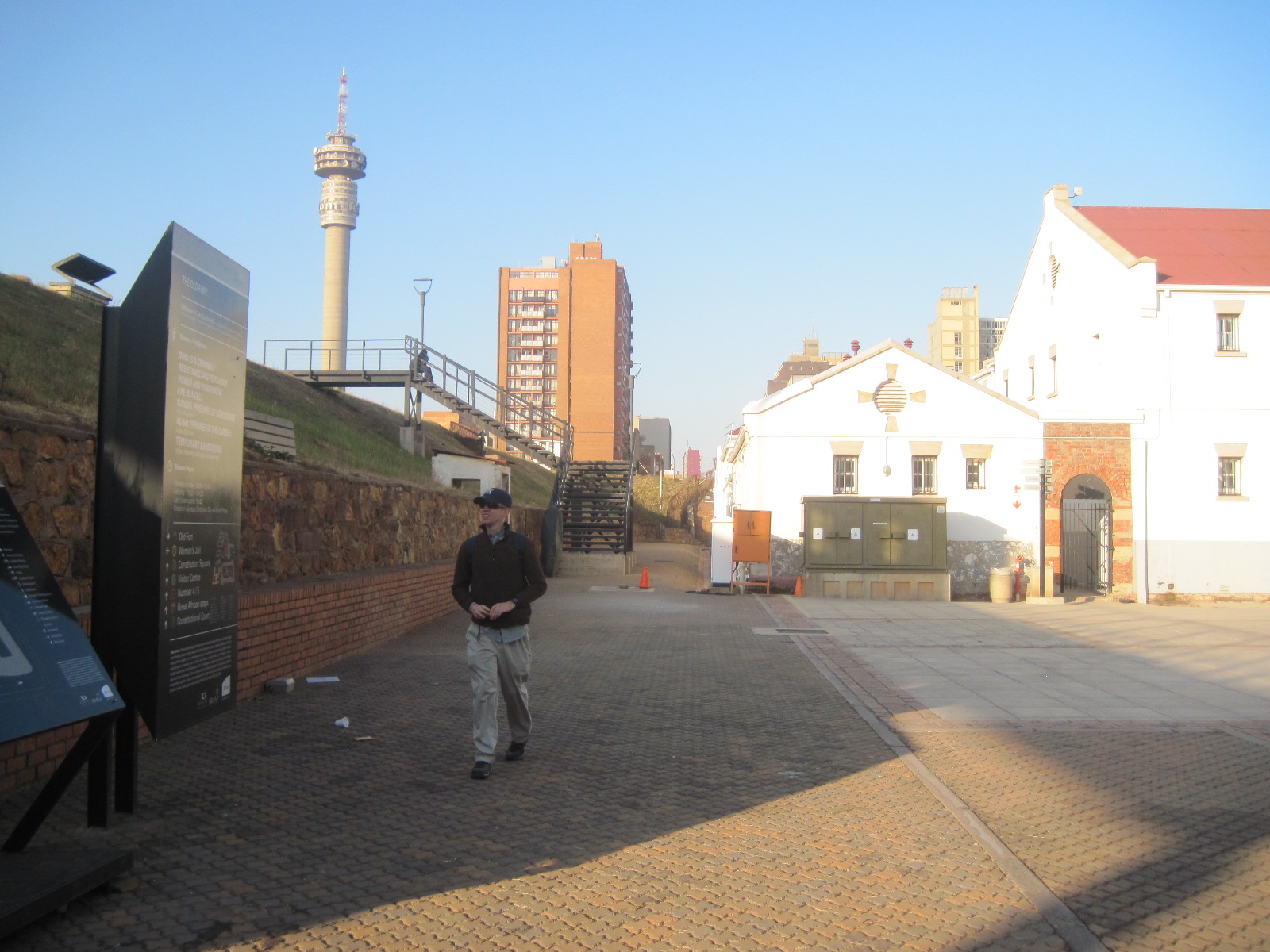
We did get off at the Mining District, where we spent 30 minutes walking through some outdoor exhibits about mining and Joburg history. We also saw Mandela’s first law office here. We also got off at Constitution Hill, where we walked around the outside of the Constitutional Court, which was established in 1994 when the new constitution was written. We also walked around the ramparts surrounded an old fort/jail and provided a 360 degree view of the city.

We missed out on the Newtown area, specifically the SAB Miller “World of Beer” museum. Maybe next time!

After we got off the bus, our taxi had to detour back into the CBD to pick up another hostel guest. This allowed us to see the packed street scene of markets, local taxis and lots of people. And the driver said this was a light crowd since it was a Saturday!

IMG_9177

Della on the bus

IMG_9993

Eric in the old Fort at Constitution Hill

IMG_9994

The hustle and bustle of the CBD

Apartheid Museum

As mentioned previously, we spent the majority of our day at the Apartheid Museum. And even then we felt like we had to rush through! There is quite a bit of history to learn here.

The tour starts with you being randomly assigned to be white or non-white, and then having to enter through the respective door. You get a different experience here at the beginning as well. Eric was assigned to be White and Della to be non-white. This first part tells you about the classification system under which the apartheid system would actually assign people to be white, black, colored (mixed race) and a few other classifications. You could even petition to have your race classification changed. There was an interesting list of all of the people who had “changed races.”

The museum started with the beginnings of Joburg as a mining town, and then went through the first attempts at segregation to the implementation of the full-fledged apartheid system in the 1940s. Then, there were displays about the realities of living under apartheid, and the first wave of resistance that led to Mandela being sentenced to life imprisonment. Then, as we went chronologically. We got into the student uprisings of the 70s. For the 1980s, there was a gripping video detailing the horrific violence that brought the apartheid movement to its breaking point. We then moved on to the 90s, which detailed Mandela’s release, then end of apartheid and the founding of the new government (and also showed how close the country came to total anarchy at the time).

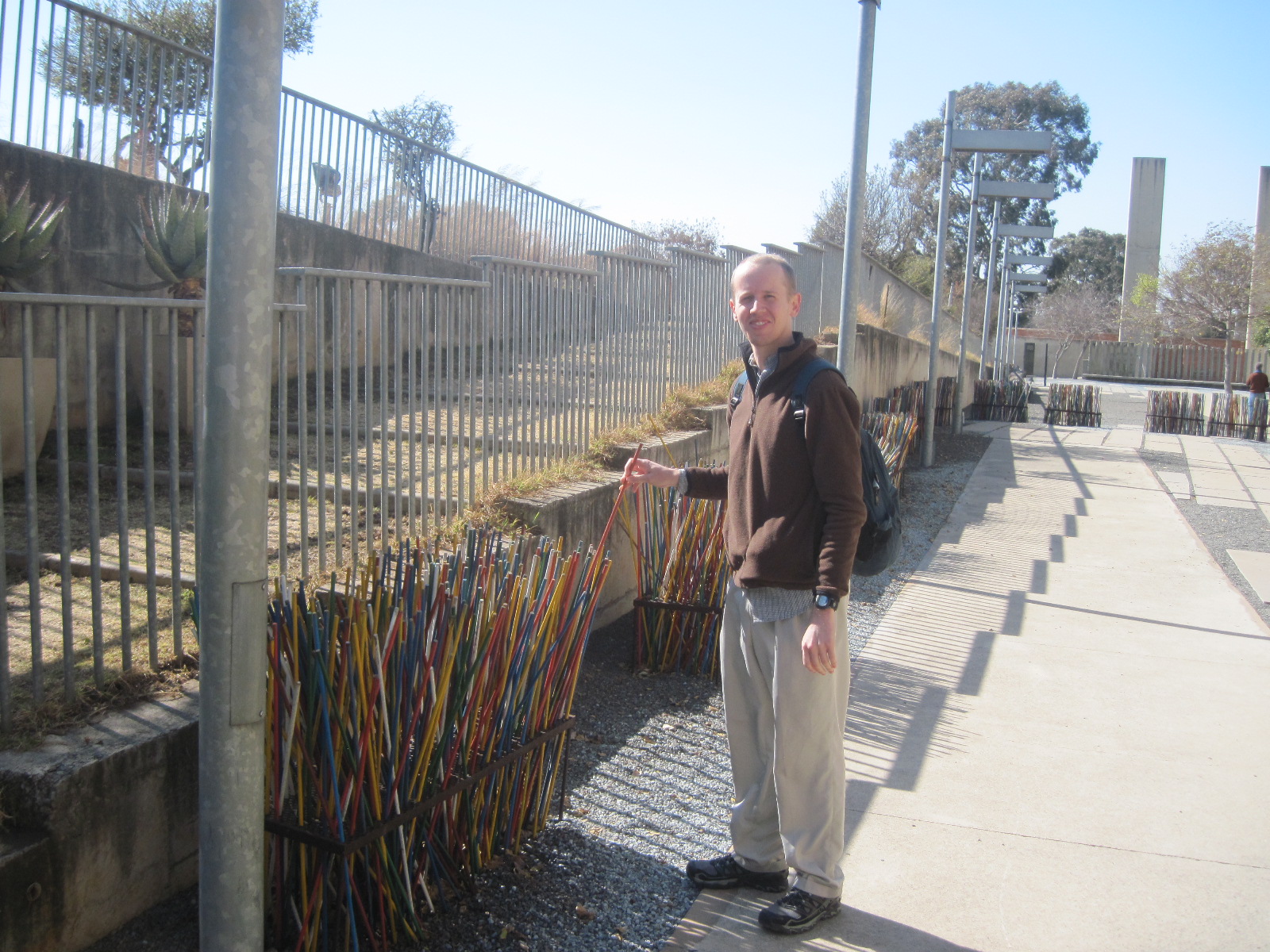
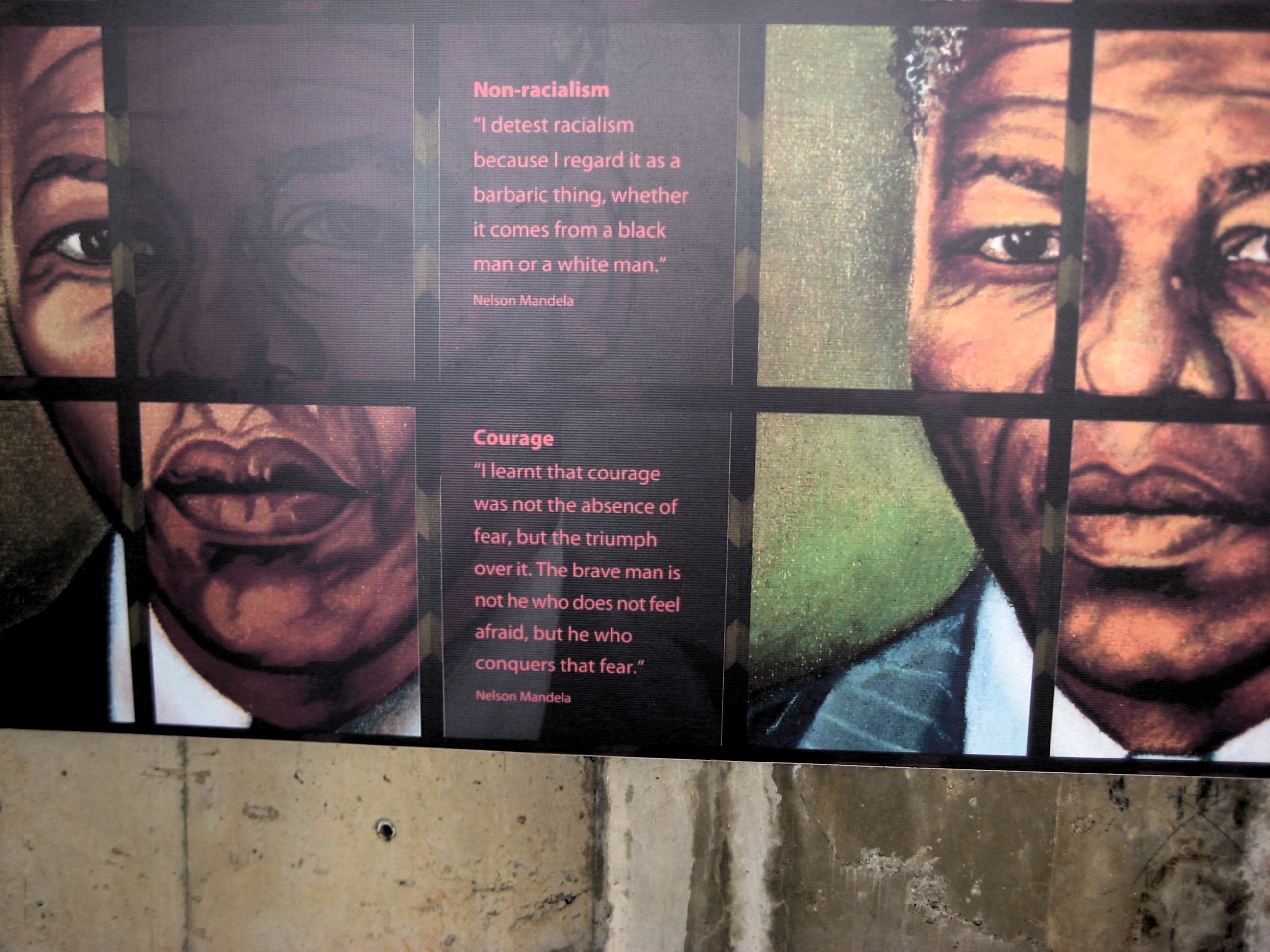
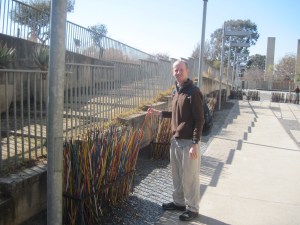
In addition to the history of apartheid, the museum also had a large exhibit on the life of Nelson Mandela. We spent quite a bit of time going through this. At the end, you were invited to choose your favorite quote of his and then place a stick of the corresponding color in a garden area.

By the end, we were overwhelmed by how much had happened – and within our lifetimes too. It is interesting to compare the racial strife in South Africa to that in the USA. Different types of issues, but still the underlying core of people in power doing horrible things to those without power. It is amazing to think about all that has gone in here in South Africa so recently, and how happy many of the people seem. But there are still many problems left to face.

IMG_9182


IMG_9186

IMG_9987

Where We Ate

Thai Restaurant – We arrived into Joburg early in the morning on July 4, and were pretty tired after two overnight flights in a row plus the time zone change. Still, we worked up to energy to meet up with a friend of a friend who lives here in Joburg. She was kind enough to drive us around to show us some sights and then take us to a Thai restaurant that was quite good.

Doppio Zero – After our city bus tour, we had the tax driver drop us off at the Greenside restaurant area for dinner. The hostel guest we were sharing the taxi with was going to this Italian bistro because she knew it had free wi-fi, so we decided to join here. We had some nice pasta dishes while we caught up on email and facebook on our phones.

Planning Our Self-Drive Safari

Why Self-Drive?

When setting out our overall itinerary, we decided that we wanted our first stop to be South Africa.We also know we wanted to do some sort of safari to see some of the amazing wildlife and sights that Africa has to offer. But what kind of safari should we do?

First, we had to figure out where we wanted to go. Some people just go out to Kruger National Park in South Africa. While that sounded like an excellent destination, once we saw pictures of places like Sossusvlei and Victoria Falls, we decided to focus on getting to both Botswana and Namibia out of Johannesburg.

A quick glance at the prices or the luxury guided safaris let us know that was a no-go. Another option that a lot of “backpackers” do is to do a group “overland” tours through a large tour operator. This would have allowed us to see a lot the highlights, but the downside seemed to be to us that we wouldn’t be able to set our own pace.

Then, we stumbled across a blog by Traveling 9 to 5 about a self-drive safari. Intrigued, we looked into this further and thought it sounded pretty cool. You rent a truck with camping equipment and drive yourself on your own itinerary. This seemed like it would allow us to see exactly what we wanted while not breaking the bank. So, we started planning for this option.

Picking a Truck

There are many operators in Johannesburg that will rent you the standard self-drive safari vehicle: a four-wheel-drive pickup (always white for some reason) with a tent mounted on top and camping supplies included. We wanted to find a good deal, but also wanted to go with someone that seemed responsive to our concerns.

We got quotes from a few different places, then made a spreadsheet to compare their daily costs, insurance options and other fees. In the end, we went with Bushlore. Their costs were on the lower end of the spectrum, and they were very responsive in answering questions. From their selection of trucks, we chose the Toyota Hilux with Safari Camper.

Choosing the Route

The next step was to figure out where the truck was going to take us. July is part of the high season for safaris, so we couldn’t afford to dawdle. Conveniently, Bushlore offers a service to help plan the itinerary and book accommodations along the way. So, we got in touch with the booking department and started making plans.

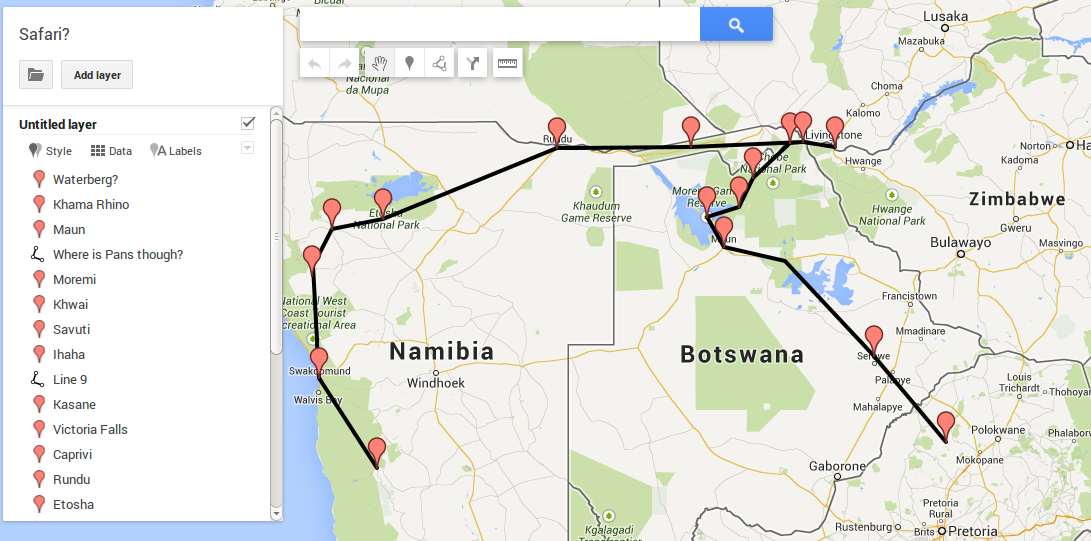
The agent came up with a day-by-day plan and quoted us a price to book the whole thing. However, we felt like we needed a little more information. First, we mapped out the itinerary ourselves to see if the number of days could be condensed. Then, we researched all of the proposed campsites (cross-referencing against Lonely Planet and Trip Advisor, of course) to see if any of them could be booked by us directly.

Our first attempt at mapping out the destinations

Our first attempt at mapping out the destinations

It required a little back and forth, but eventually we settled on a route and cost with the agent. We came up with a 25 day itinerary, which doesn’t allow for a lot of downtime but hopefully won’t be too hard to get done. It turned out that it was easier and almost as cheap for Bushlore to book the campsites for all but one of the destinations…

The Time We Wired Money to Africa

The website for Etosha National Park in Namibia seemed petty straightforward, and the price they were requesting for a campsite was about half of what Bushlore quoted. So,we decided to try and book it on our own. Things seemed to be going pretty smoothly until it got to the whole payment part of it.

We had thought we could pay by credit card, but it turned out the only option was to wire money. We hadn’t really done that before, so it took a little figuring out how to even do that. It was tough to even figure out if we were sending it the right place – the way it was supposed to work was that we wired to an account in the US that is associated with a foreign exchange company that would then send the appropriate Namibian dollars to Etosha.

We were a little scared that somehow this was a scam (and trying to explain that we were attempting to wire money to Africa while talking to representatives of our bank felt a little silly), but by this point we were in deep enough that we decided to just send the money anyway. If we ended up losing it, it wasn’t going to be the end of the world and would be a good lesson learned. We were getting a little nervous because it took Etosha quite a while to email that they received the payment… but they finally did (after close to 3 weeks)! Hopefully when we show up there, they will still remember that…


After telling everyone how flexible we want to be on our trip, it feels strange to have planned out the first month in such detail! We’re just hoping that all of this up-front planning will help make this self-drive safari go as smooth as possible. Look forward to more posts in the future about how close we can stick to this plan 😉

Fast Forward Friday: Cape Town

Cape Town is one of the most well-known cities in South Africa. Obviously, we’re looking forward to climbing Table Mountain and seeing all of the amazing views of the city from there. But there are lots of other things to be excited for in this area: Penguin spotting at the Cape of Good Hope, wine tasting, Robben Island (where Nelson Mandela was imprisoned), and great neighborhood site-seeing.

Learning Something New Everyday!

Did you know that a braai is a BBQ grill?

Did you know that an ablutions block is a bathroom?

I didn’t. But now I do! At least they are in South Africa, Namibia, and Botswana.

We’re getting close to having our plan put in place for our self-drive safari! (More details to come)