Moments of Misery: The “VIP” bus from Vang Vieng to Luang Prabang

Most of our posts on this blog will be happy recollections of some moments of our trip. But life on the road won’t always be fun. We feel like we’d like to share some of these moments of misery too. (OK, and vent a little about them too…)

Our knees were being crushed by the large recline of the seats in front of us, the large incline of our own seats meant we were leaning far back , our butts almost sliding off our seats, the air conditioning was blowing the tiniest wisp of air in 95 degree heat, and the curvy, steep road seemed to stretch on past the horizon. Thirty minutes into the eight hour bus ride, and we were wondering just exactly what we had gotten ourselves into.

We had heard that the stretch of road traveling from Vang Vieng to Luang Prabang, Laos was not easy. We had heard it was rough, and curvy, and that you might just get sick. We had even heard that there were zero good ways to avoid this and you had to be prepared. So, we were trying to psych ourselves up for a difficult trip. Even so, the reality was pretty miserable.

We booked the “VIP” bus, and even confirmed that it would have AC. We arrived at the bus station 20 minutes before departure and the bus was already mostly full. Our assigned seats were taken, and rather than argue with the German couple that already looked like they weren’t having a great day, we just took two nearby available seats. These seats were most likely available because of two major flaws: the two seats in front of them were stuck in a reclining position, so there wasn’t much legroom, and the seats themselves were also stuck in a reclining position, so you were forced to sit up straight with no neck support or lean far back the whole time. We apologized to the couple sitting behind us for crushing their knees, but they realized there was nothing we could do.

The temperature outside was hot but not unbearably so, but when we first boarded the bus it was 10 degrees warmer on there since the bus wasn’t on and there was no breeze. When the bus started up, we breathed a sigh of relief as it sounded like the AC kicked in…. but then we realized that there was barely any air blowing. You could see people up and down the aisles fiddling with the vents, but the effect was very minimal.

The road from Vang Vieng to Vientiane mostly went over narrow mountain roads, which meant that most of the trip was spent with the hulking bus swaying back and forth. This made it a bit hard to read for long stretches of time without getting car sick, especially since there wasn’t much airflow going.

We heard multiple people make the same remark we were thinking to ourselves: If this is the VIP bus, I’d hate to see what the regular bus is like! We haven’t been as upset about a bus ride since our adventures with the buses in the Peloponnese in Greece.

For all the complaining we have done in this post though, it could have been a lot worse. The bus made it without getting in an accident, and we didn’t actually get sick. The arrival was basically on time, and none of our possessions were lost. Still, we hope it’s a while before we have such a bus ride again!

Visiting Changing Vang Vieng, Laos

When planning our time through Laos, we waffled a bit on whether or not to go to Vang Vieng. On one hand, the town is situated on a crystal clear river in the middle of limestone mountains riddled with caves, making for a scenic and adventuresome way to break up the long bus ride to our next stop (Luang Prabang). On the other hand, Vang Vieng is known as the backpacker party central in Laos, with wild river parties and a downtown filled with cheap, uninspiring restaurants. Although, in 2012 they started to clean up the town a bit and supposedly the area is moving towards a calmer, more eco-tourism scene. So, with these factors in mind, we decided to spend a few days in town and reach our own conclusions.

Getting There

We signed up for the “VIP” bus from Vientiane through our hotel there. The process of getting on board in the morning was certainly not “VIP” though. Our hotel insisted that we didn’t need a ticket, which seemed strange. It included minivan pickup for transport to the station, and when we were picked up the driver seemed to want some sort of proof. After some conversation they gave us a scribbled note that must have said 2 to Vang Vieng.

We piled into the minivan with some other travelers and settled in for the ride to the bus station. Then, in about two minutes, we reached a side street where we were told to get off and get on the buses that were parked there. After all the trouble squeezing in, we could have just walked there!

The “VIP” bus was much less fancy than the one in Myanmar. No assigned seats, so we just picked a couple out from some of the drab ones available. Luckily the person checking our “ticket” was the same one that picked us up in the minivan.

IMG_5656

The ride itself turned out to not be too bad. It took about 4 hours with a break at a service station halfway. The road for the last part was a little curvy but not too bad. They dropped us off a little outside of the main town, but there was a free shuttle that took us into the heart of the city.

Where We Stayed

We stayed at the KL Guesthouse, which we found on Agoda and chose because it was the best-reviewed cheap option that had a private bathroom and included breakfast. The downside was that it was a ways out of the main part of town, but we thought that might be a hidden upside if we wanted to avoid loud music from bars late into the night.

Our room ended up being one half of a bungalow and was quite spacious. The staff at the reception was a little too laid-back, and the breakfast was basic, but ultimately we enjoyed our stay. The walk into town took about 20 minutes, which was maybe a little long, but we only did it once a day.

What We Did

Green Discovery “Discover Vang Vieng” Tour – We wanted to see some of the caves around the area, and thought it would be easiest to go on a guided tour. The “Discover Vang Vieng” tour included multiple caves, a small trek and kayaking over a day, and was a little cheaper than advertised since multiple people had already signed up.

The first part of our tour was to visit various caves. We first did the “Elephant Cave” which was really more of an alcove with a Buddha statue and a formation that vaguely looks like an elephant. It was here that we really started to realize that we had a hard time understanding our main guide. He would interject a word that sounded like “lassa” throughout his sentences almost like an “um” or “you know,” and he had a somewhat thick accent, so we had to concentrate to get what he was trying to say.

We next walked for about 10 minutes to another area and got ready to enter some serious caves, which meant we needed to put on head lamps. We first went into Tham Loup, which had some neat formations. We explored past a few large ones and then made a loop back. At one point our guide made the two of us do a tight squeeze and then told the others they could do the easy bypass!

We next went to the “Snail Cave,” Tham Hoi. There was a large Buddha statue at the entrance, and then for the most part it felt like a since long hallway with not as many interesting formations. We went pretty deep but then decided to turn around when we would have had to crawl through water.

When we emerged one of the other guides had cooked us a nice lunch: fried rice wrapped in a banana leaf, meat and veggie skewers, a baguette and bananas.

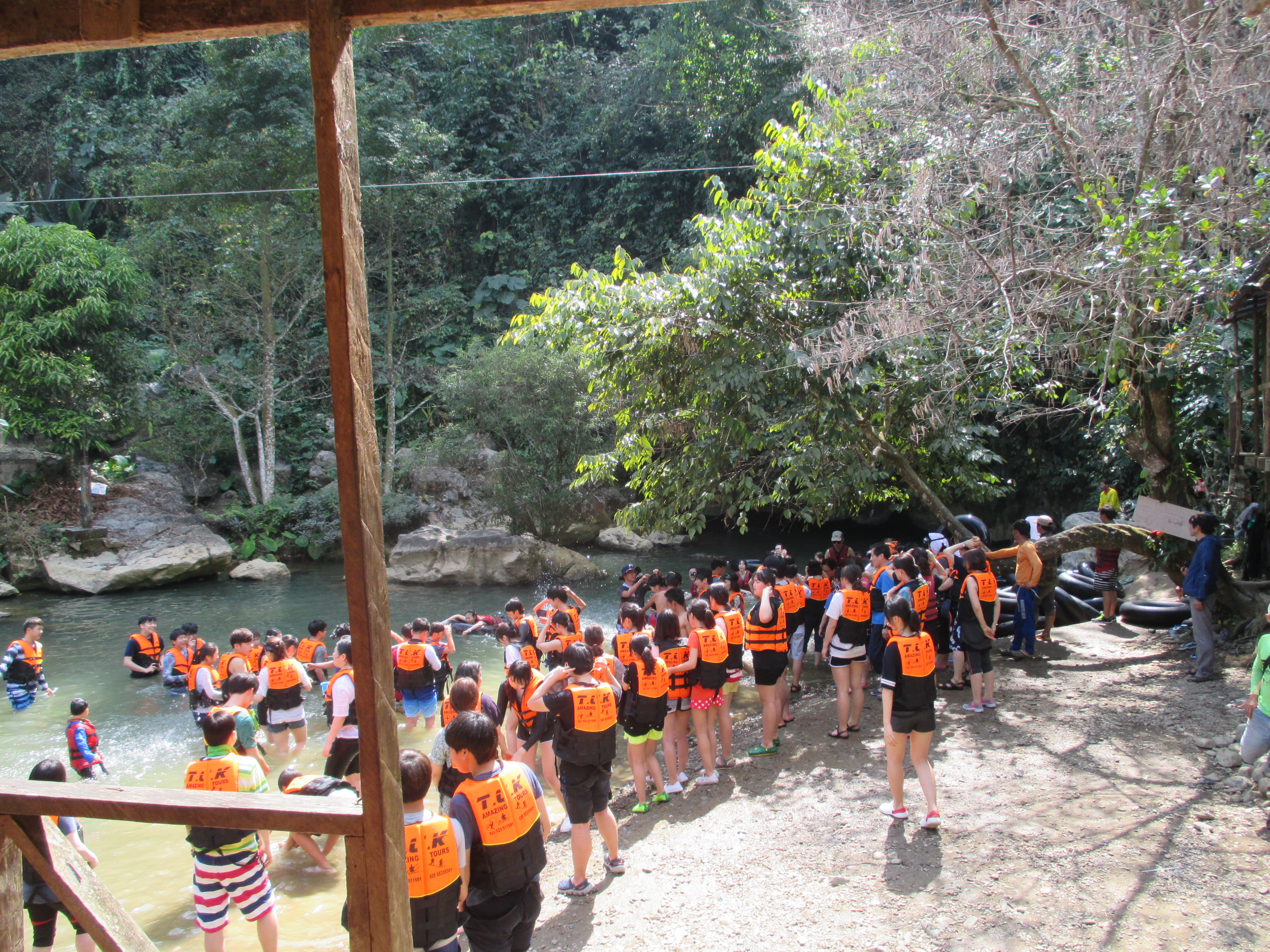
After finishing the meal, we walked to the next cave, Tham Nam. This one is unique because water is running out of the mouth, so to get in it we got into tubes and then pulled ourselves along a rope strung along the cave for that purpose. We headed in for about 15 minutes, then headed back. On the way back we ran into large Korean tour groups which were making quite the racket.

IMG_5691

We then did the “trekking” part of the tour, which was really just walking along an irrigation canal. This did provide nice views of the surrounding karsts and also lots of cute cows. There was also a dog leading the way that gave some nice entertainment. The walk ended through a Hmong village and then over a bridge where our truck was waiting.

We rode for about 10 minutes to a drop off spot where we began our kayak journey. The two of us shared a kayak, with Eric in the front and Della in the back. The water was pretty shallow in places so we had to be careful not to hit rocks. The first stretch didn’t have many others on it. There was one rapid that we navigated successfully.

IMG_5713

Our kayaks. We didn’t take any pics on the water… oops!

Then we hit the stretch where the party tubers were. The big thing for the party crowd is to rent a tube and spend the day going from bar to bar along the river. Again, this was supposedly much wilder before they started cracking down. Still, there was a stretch where there were drunk tubers all over the place. Definitely did not look like our scene. We tried to keep a wide berth so they wouldn’t splash us.

IMG_5715

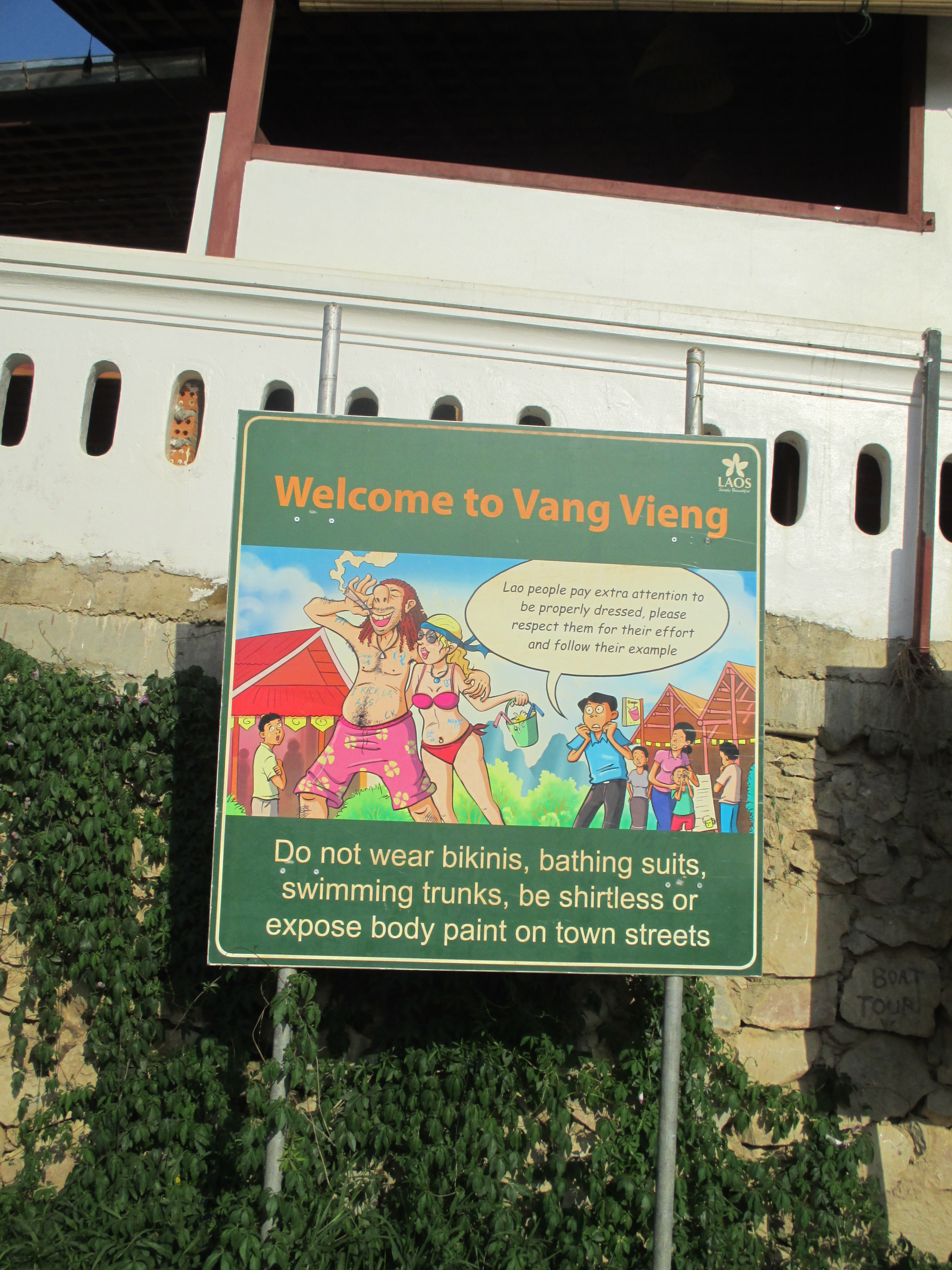
We didn’t actually take any pictures on the water… oops. But, we saw this sign where we got out. It shows a bit of what a party destination this place can be

The rest of the river was more filled with tubes and also many other kayakers. There were a few riffles but no major rapids. We both began to get sore from paddling, making us feel out of shape. We reached the take out at the south end of town, pulled our kayaks out of the water, and said goodbye.

Hang Out By the River – We spent the first part of our second day in Vang Vieng debating what to do. We could do the tubing thing, but we didn’t feel like the drunken parties would appeal to us. There was another recommended cave, but to get there would be via an expensive tuk-tuk or on rented bikes over a hot, dusty road. Inertia won out, and we ultimately settled on just hanging out by the river at a bar we had seen the previous day.

IMG_5721_edt

Crossing the bridge to the other side of the river where we plan to hangout in the huts

It definitely felt like spending a day at the beach. The seating at the bar was just different bungalows that provided relief from the sun. We took turns going for a quick dip – the water was pretty cold – and relaxed and read our books while sharing a Beerlao. The bar also had some speakers playing Western pop music, many of which we recognized and had fun singing along to. We hung around until just after sunset.

Where We Ate

There are a lot of restaurants in town, but we had been warned that none of them really stood out. The first night we ate at one of Lonely Planet’s recommendations, a place called Kitchen that was affiliated with a boutique hotel. The most interesting dish here was some local sausage that Eric tried. (We have noticed that the different towns in Laos all seem to have their own sausage. For example, there is a well-known Luang Prabang sausage).

IMG_5661

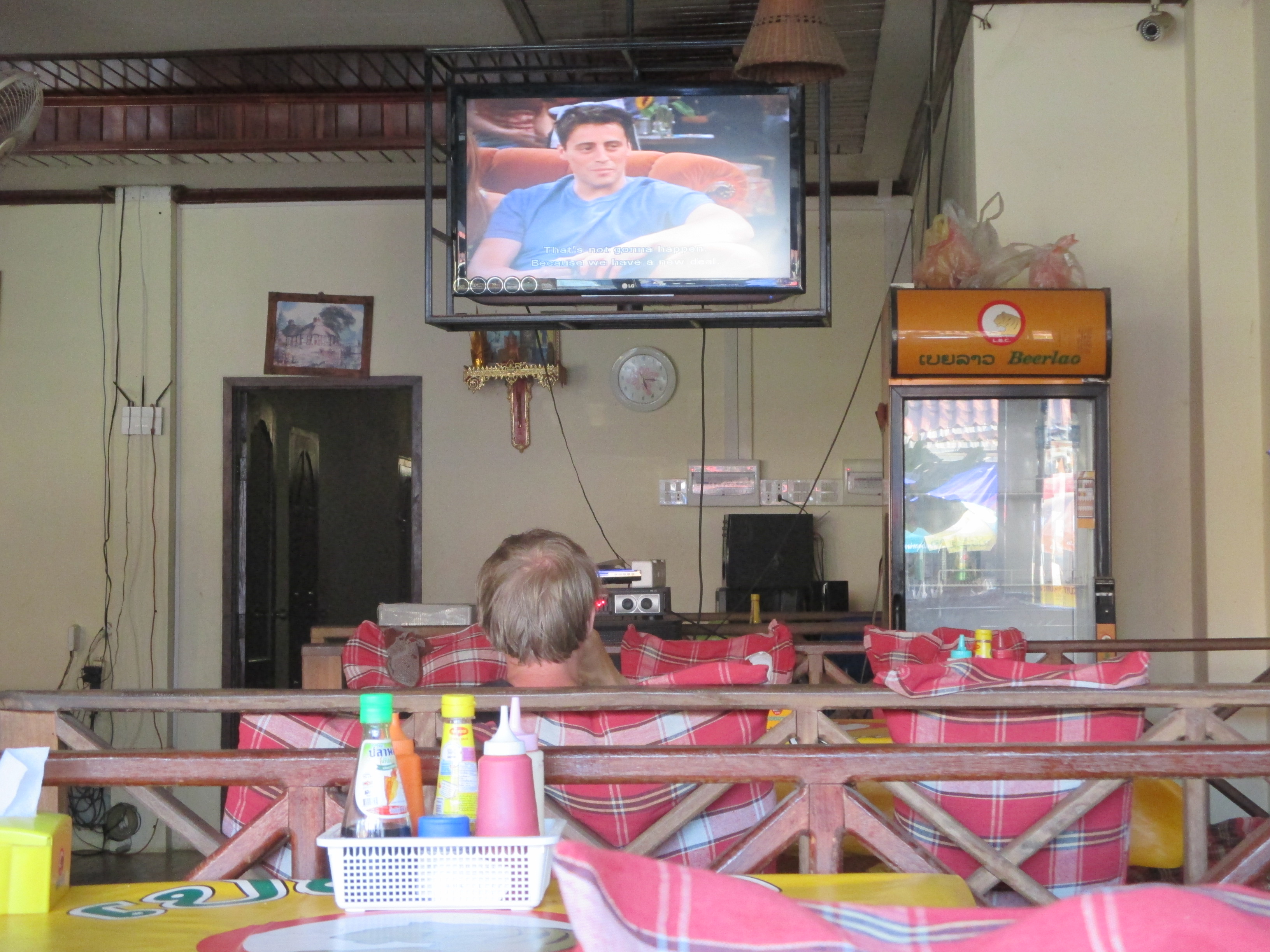
One holdover from the crazy backpacker party era is a very unique type of restaurant: a “Friends bar.” These places have lounge style seating all facing large TVs which are constantly playing reruns of the Friends tv show. There are multiple options in town, plus some that play Family Guy or South Park. We loved the show when it was on, so we decided that even though it might seem cliché we had to do it one night. The bar we chose was showing episodes from Season 7. We ended up staying through two and a half episodes.

IMG_5716

Our final night we wanted a nice view of sunset, so we went to a restaurant with a nice terrace view. Again the food choices were pretty standard, but we did enjoy the fading sunset colors.

Final Thoughts

We still aren’t completely sure how we felt about the Vang Vieng experience. On one hand, we enjoyed the natural beauty and our cave explorations. On the other hand, it still seemed like the town was not quite our scene, with a lot of people just there to get drunk. Service in shops and restaurants was also pretty gruff and disinterested, which is probably a byproduct of their typical clientele. Still, we think we are glad we stopped for a little while, and especially glad we broke up the bus ride… (to be continued)

We’ve Been in Vientiane, Laos

After Cambodia, we headed to its northern neighbor Laos. We debated going overland through the southern part of the country, but after doing some research we decided that our top highlights were all in the northern part. The most convenient place to start our journey through the country was therefore its capital, Vientiane.

Getting There

Getting from Siem Reap in Cambodia to Vientiane was not as easy as we had hoped. We could have done a bus, but it would have been a 28-hour journey which we were not inclined to do. The fastest and most convenient option seemed to be to fly. Unfortunately, flights out of Siem Reap were pretty expensive. From Phnom Penh, it was cheaper, so we took a bus from Siem Reap back to Phnom Penh and spent one night back at Envoy Hostel.

The flight from Phnom Penh wasn’t as cheap as we hoped – the cheapest we could find was $175, and we couldn’t figure out how to do it on miles. But, it was direct so it would save us a lot of time. We flew on Vietnam Airlines, which turned out to be quite nice, not a low-cost carrier like the other flights we have done so far in Asia. We even got a small meal during the 1.5 hour flight!

Where We Stayed

Through Agoda we found the Nanynu Mini Hotel. As the name implies, it was a hotel, not a guesthouse, so there wasn’t really a common area to meet fellow travelers. On the other hand, our small room was comfortable and nicely furnished. The location was just a few minutes walk from the main street with restaurants. The staff didn’t speak a lot of English but were very friendly.

What We Did

Vientiane has a reputation of being a “sleepy” city with not much to do. It is definitely smaller than the capitals of its neighbors, and the roads are much less crowded. There aren’t many attractions, but they are pretty easy to get to by bicycle or on foot.

One day we rented bicycles from a hostel in town to tour around the city. This was actually a little tough because they wanted our passports as a deposit, but we had left them back in our room. They then wanted $50 instead, but we only had $30 on us and finally convinced them that the bikes were probably not worth more than that.

We followed a route suggested by the Lonely Planet guide, which took us past such sights as the old Presidential Palace (used by the French colonial governor when Laos was a French colony), the French embassy and US embassies, an old uncovered stupa and numerous small wats (temples).

We got off the bikes at Patuxai, which is Vientiane’s version of Paris’s Arc de Triomphe. We paid a small fee and climbed inside for nice views of the area. Strangely, you have to pass through a bunch of gift shops as you ascent upwards. There is also a slightly hidden interior staircase in the giftshop at the main level that allows you to go all the way to the top.

We deviated from the recommended path a little bit and rode out to Pha That Luang, a temple and monastery complex that is very treasured by the Lao people as a symbol of independence. The main attraction is the large golden stupa.

On our second day we walked to visit the COPE Visitor Center. COPE is an organization that helps provide prosthetic limbs to those who can’t afford them all across the country. The visitor center describes their work in making the prosthetics, but also talks in detail about one of the main reasons so many are needed: the problem of the tons of unexploded ordinance (UXO) that remains in the country as a result of the many bombs the US dropped on the country during the “secret war” as part of the Vietnam war. We also watched a couple of short documentaries about the efforts to go in the countryside and defuse the found items before someone is hurt by them. The problem is especially tough because scrap metal can bring in a significant amount of money, so people will risk harm and handle items that they shouldn’t.

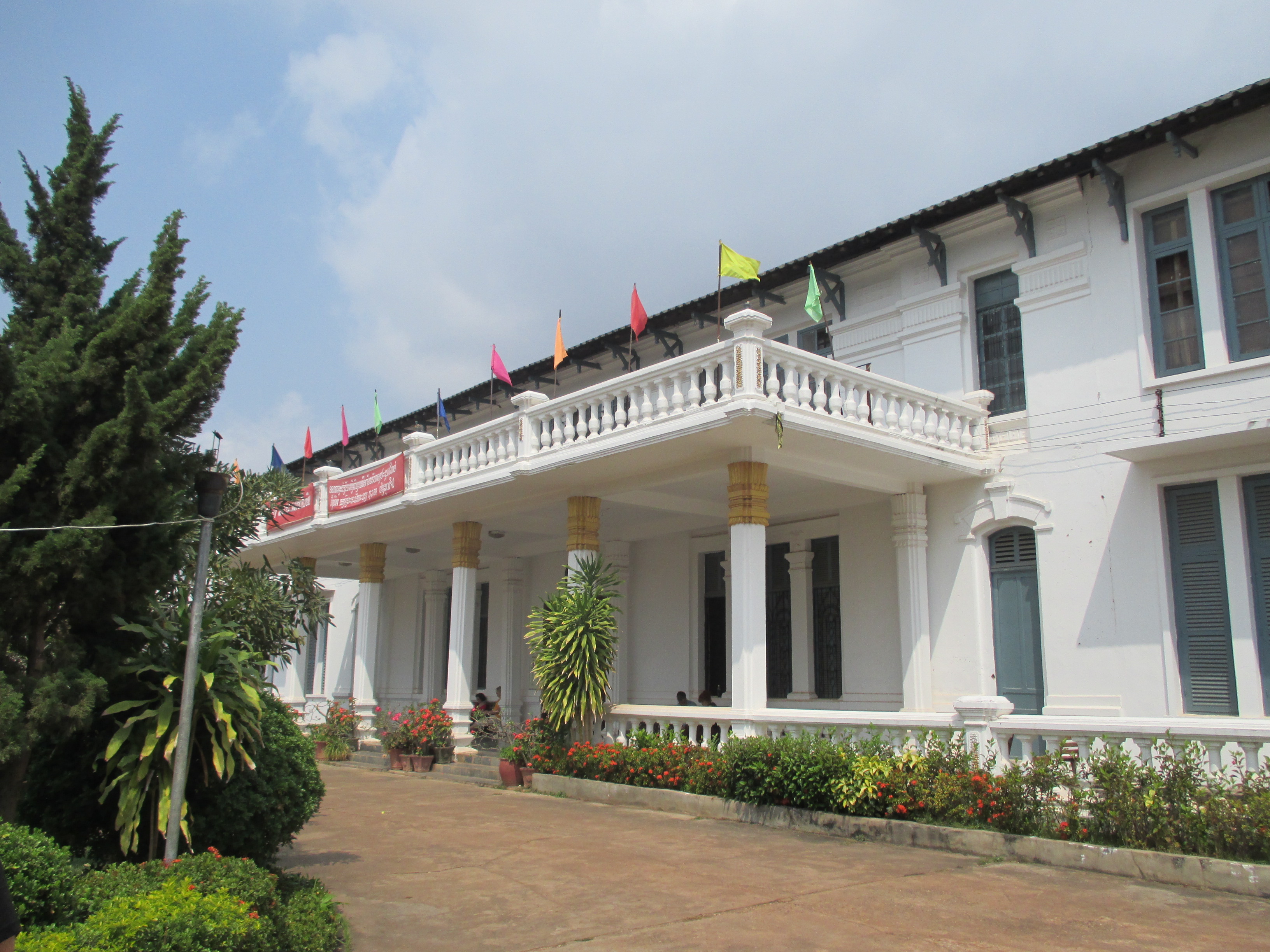
We also visited the National Museum, which we had read was a little underwhelming. It did turn out to be pretty small – we only spent an hour which is quite a feat for us. The exhibits were pretty well signed through the prehistoric and ancient history sections, but once it got to the Lao kingdoms in the 15th century it started to be harder to figure out what was going on. Then, in the section on the colonial period and the rise of the Pathet Lao (communist revolution), the signs were minimal and definitely felt a bit one-sided.

IMG_5637

The exterior of the National Museum – no pictures allowed inside


We heard that, like Phnom Penh, there were aerobics classes in the evening, this time in a large park down by the Mekong River. Unfortunately, when we tried to go the first time it started to rain and the class seemed to be cancelled. The second night it was also cancelled, this time because an afternoon storm had knocked out power and they couldn’t run their speakers. We did still enjoy seeing the other evening activities in the area though, with many people exercising and a large night market.


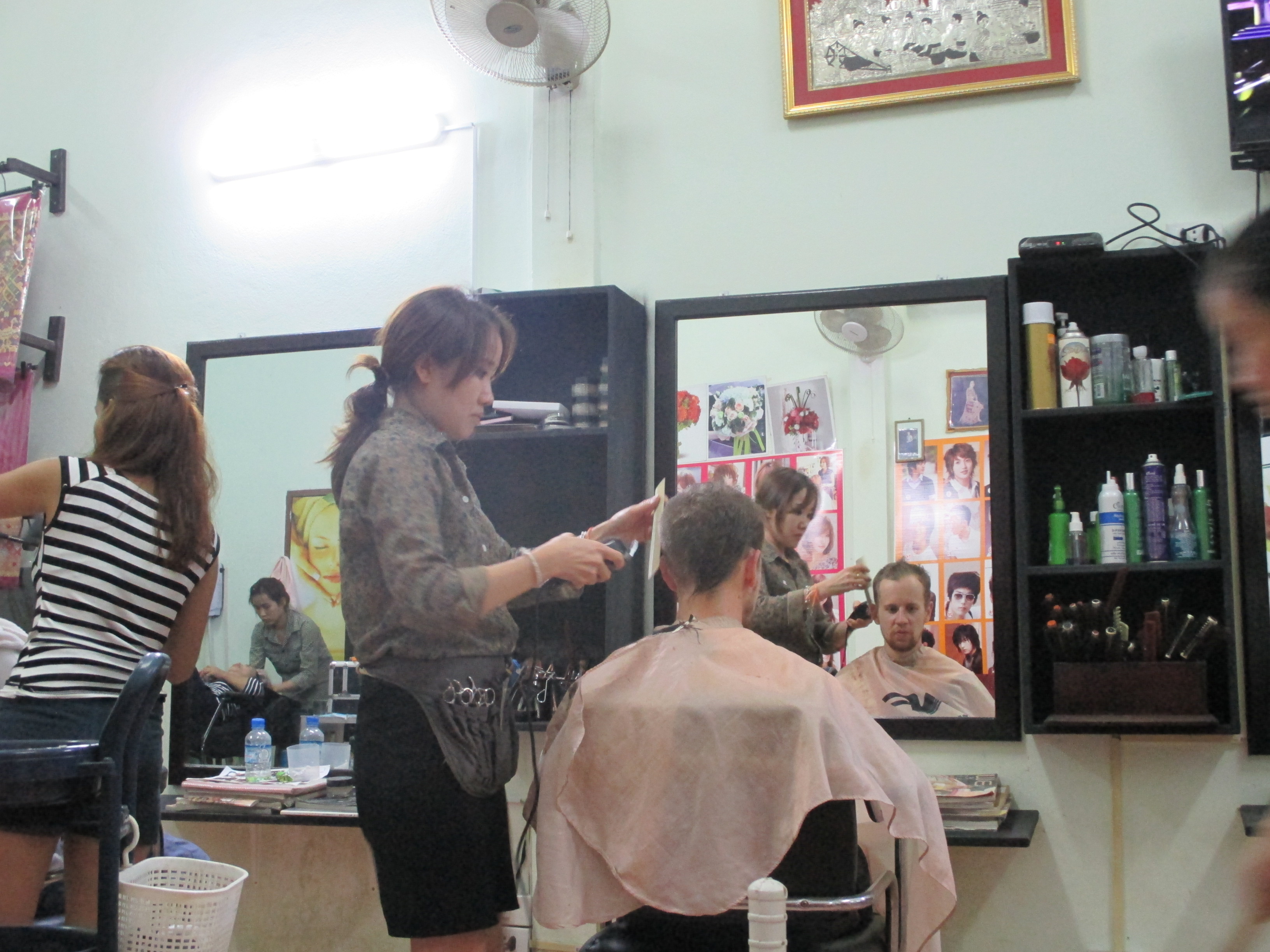
One upside of the aerobics being cancelled was that it gave us time to do something we had been putting off: getting Eric’s hair cut! There was a salon next door to the hotel which had an English sign, so we figured it would be ok. We pointed at a picture of the most basic cut on the wall and they said they could do it. First they gave him a shampoo – not usually something he has done so it was fun. The cut was about the same as at home, except they didn’t use the standard guards on the clippers; instead, the stylist just used a comb to control the length of the cut. The total cost was 50,000 kip – about $6.

IMG_5653

Where We Ate

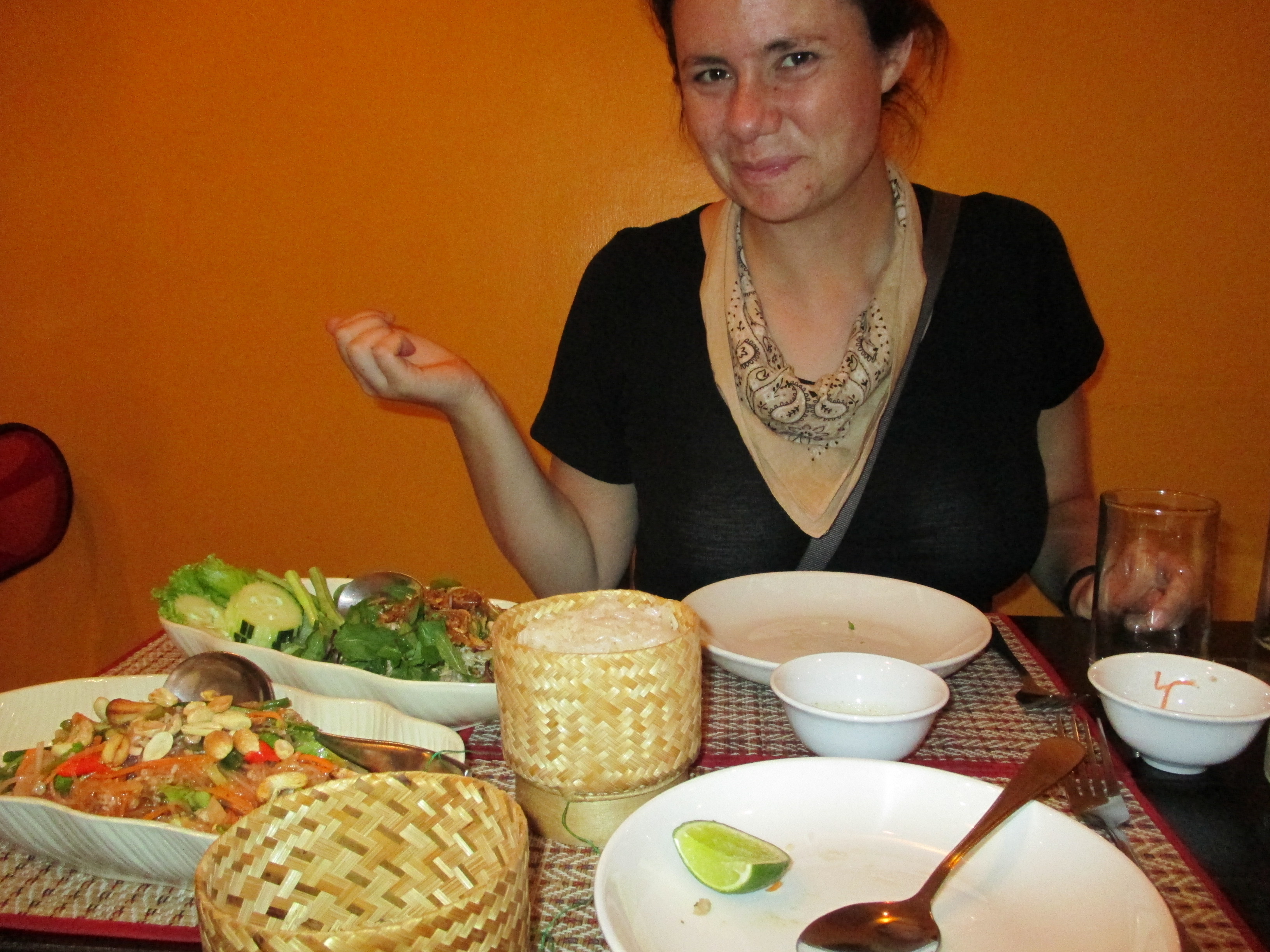
Since this was our first stop in Laos, we were excited to try the Lao cuisine. The food at Lao Kitchen was an excellent introduction. We especially enjoyed the laab, which is minced meat mixed with fresh herbs such as cilantro and mint, usually with sticky rice on the side. Khop Chai Deu also had a good laab, and a grilled chicken with nice flavors.

IMG_5577

The part of Vientiane that we were in is very tourist-oriented, so it wasn’t hard to find other types of food as well. For example, one dinner we just ate Indian food. Also, the French influence is still quite strong, and you see cafes and bakeries all over. For breakfast every morning we would get different types of pastries from the Parisien Bakery, and after our bike ride we got some homemade ice cream from Le Banneton.

Final Thoughts

Compared to Phnom Penh, Vientiane was a lot quieter and more laid back. We actually enjoyed this, because it meant that we could ease into understanding the Lao culture and history, and also that it was easy for us to get around between the various sights. The amount of time we allocated to see the city was just about right: there were nice things to see, but we certainly didn’t feel like we missed out on anything big.

Budget: Cambodia

This is one of our Budget series of posts to give you an idea of how much we spent traveling around the world. Here we will look at Cambodia. Check our posts to see what kind of activities we did and where we stayed!

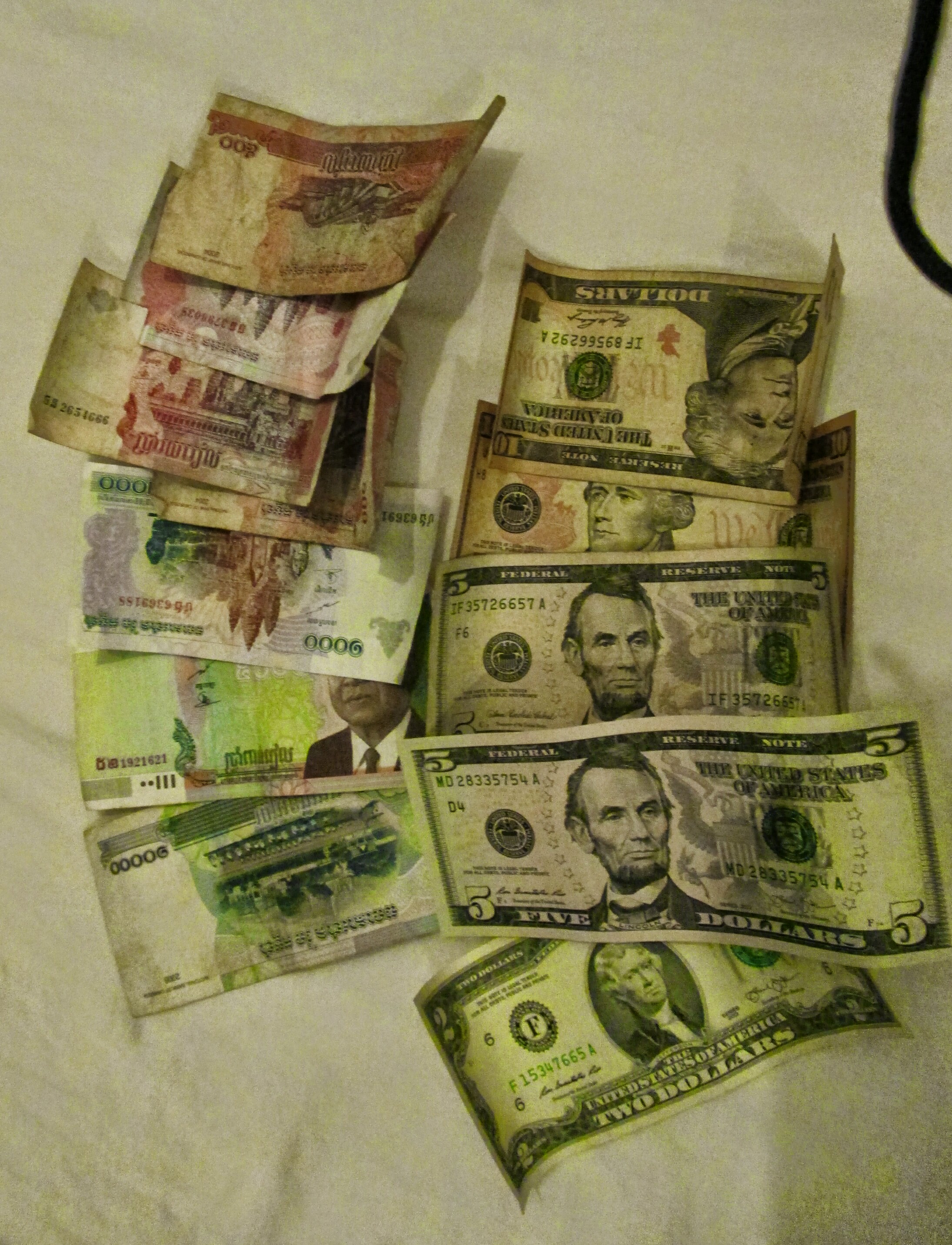
In Cambodia we used the US dollar. Yup, that’s right. Cambodia uses US dollars. They do not use US coins though, so we were also dealing with Cambodian Riel for costs less than one dollar. The going exchange rate at the time of our visit was 4000 Riel to 1 dollar.

IMG_5297_edt

Did you catch it?? Yes, that is a 2 dollar bill. They are in circulation in Cambodia!

IMG_5298

Total (for 12 days): $1092.28

Accommodation: $303.60

We splurged on an expensive place that our friend suggested for two nights, then stayed in hostels and guesthouses for the rest of the time. We always had private rooms.

Activities: $223.50

This included entrance fees to a number of things: museums, the killing fields, Angkor Wat, and more. It also included a few tuk tuk drivers/guides. In addition, we went to the circus in Battambang which was fairly pricey.

Alcohol: $11

Our alcohol category does not include alcohol that we buy with food, so this includes a few happy hours with a friend in Phnom Penh, a wine tasting, and some beers while watching a movie.

Food: $303.93

We ate out one to two times per day and we had to purchase our own breakfast for most of the time (though not all).

Miscellaneous: $29.75

This included postcards, mailing postcards, laundry, a scarf souvenir, and a donation (which Eric thinks was actually a scam).

Transportation: $156.50

This includes a few taxis and tuk tuks as well as bus transport between cities. It also includes rental ebikes and bikes in Angkor.

Visas: $64

Our visas on arrival were $30 each and we had to pay an extra $2 each because we forgot to put our passport photos in our day bags and so had to buy new ones. Oops.

This divides out to $91.02/day which is under our $100/day budget… though not nearly as low as we had hoped. We were so surprised that Cambodia has ended up being one of our most expensive countries thus far. We did a little calculating and realized that we ended up spending much more on food than we ever imagined we would. We didn’t eat street food nearly enough, partly because it is so hot so we always looked for restaurants to get out of the heat. Activities were also high which was in part because of the high cost of visiting Angkor temples. Wow, we have to do better!

Traversing the Temples of Angkor in Cambodia

From the ninth to fifteenth century AD, the Khmer empire located in present-day Cambodia was one of the greatest powers in Southeast Asia, and the vast city of Angkor was the seat of the power. The kings who ruled over the empire constructed large numbers of temples in the city as befitting of its status. The empire and the city gradually declined, but today it is the number one tourist draw in Cambodia. We spent three full days visiting the temples with the city of Siem Reap as our base.

Getting There

To get from Battambang to Siem Reap, we consulted the excellent site Move to Cambodia and chose the cheap local bus. The roads were a little better than we were expecting and we ended up arriving earlier than anticipated. The one hiccup along the way was at a rest stop. The bus paused in one town for a break, and Eric got off the bus to use the restroom while Della remained on with our stuff. As soon as Eric went into the toilet, the bus drove away! Della yelled at the driver to stop, but he just laughed and assured her that the bus would return in about ten minutes, which turned out to be true. So it worked out fine but at the time we were pretty worried!

Where We Stayed

Siem Reap is a large city and is definitely geared to tourists visiting Angkor. We knew we wanted to stay four nights, but only booked two nights at Panda Guesthouse at first because its rate for the last of the nights was double of the other nights. On arrival, we asked about this and found out that this was because of Chinese New Year. They were already booked up anyway, so we had to find alternate accommodations. It wasn’t as hard as we were expecting, and we found an equivalent room at Top Sky Hostel for the last two nights. Both rooms had AC and ensuite bathrooms, which was nice after a long day of temple exploring.

What We Did

We knew we wanted to see the temples of Angkor, but then we were faced with the question of what exactly we wanted to see in our three days. Did we want to just hit the highlights, or see as many as possible? And in what order should we see them: see the best first or save them for last? And which modes of transportation should we use to see them? After lots of soul-searching and Internet research, we settled on what we think was a decent plan.

Day One: Furthest Out Attractions via Tuk-Tuk

We decided to leave the highlights for later, so on the first day we booked a tuk-tuk tour of some attractions that are outside the main park area.

The first stop was actually not a temple but rather a museum. The Cambodian Landmine Museum is a small building that tells the story of a former child soldier who then dedicated his life to defusing the many bits of unexploded ordinance (UXO) left in Cambodia from the wars. The museum did a good job providing background on the wars and explaining more about how mines (the most problematic item of UXO left in Cambodia) work.

We then shifted our focus back to the distant past and rode to the parking lot for the hike up to Kbal Spaen, also known as “The River of 1000 Lingas.” We hiked 2 km up a hill through the jungle to find the small riverbed with many Hindu images carved into it. Further down the stream was a section with hundreds of bumps, which are the aforementioned lingas – a phallic symbol representing the Hindu god Shiva and emphasizing male fertility.


Our last stop was our first Angkor-era temple: Banteay Srei. This temple is known for its intricate carvings and it certainly didn’t disappoint. It isn’t as large as most of the other temples, so our visit didn’t take as long as it did at others.

Day Two: Grand Circuit via E-bikes

There are two traditional routes to see the main temples of Angkor: the Small Circuit which takes in those closest to Siem Reap, and the Grand Cirtcuit which goes to some just a little further (but not as far as Banteay Srei). We devoted our second day to visiting most of the temples on the Grand Circuit. It isn’t so far outside of town, but with the heat we thought visiting on bicycles might be tiring, but on the other hand we wanted to have some freedom for our own pace. Then we saw an ad for e-bikes and thought it would be perfect, especially after using them with great success in Bagan. For some reason, they seem to be much less popular for visiting Angkor, and there is only one outfit renting them: Green e-bike. The process was much more professional than in Bagan (paperwork, safety demonstration, etc.) but that also meant it was pricier.

We started the Grand Circuit at Banteay Kdei, This was our first of the many Buddhist temples built Jayavarman VII in the 12th century. When we visited  this large complex, we recall that we were pretty impressed, but honestly after we saw later temples we have a hard time remembering anything in particular about this one.

We then slightly modified the official circuit and went to Ta Prohm, which is better known as the “Tomb Raider temple” due to its appearance in that movie. It is also known as one of the best places to see trees sprouting out through the ancient walls. Both of these factors meant that this was one of the busiest temples we visited, but the complex is big enough that we were still able to find some places of relative isolation to get good pictures.

After a break for lunch, we started riding the Grand Circuit loop counterclockwise and then stopped at Pre-Rup. This temple was a big contrast from the first two we saw this day: whereas they were covered a large footprint with multiple small buildings, this one was built in the “temple mountain” style and was one large building. In some ways it reminded us of the Mayan ruins we saw in Belize and at Tikal.

We passed by a few more and then visited Preah Neak Poan. This one was interesting because it felt more like an elegant fountain than a temple. Most of the area was blocked off, so there wasn’t much exploring to be done and this one was a quick visit.

The fountain

The fountain

Our last stop was Preah Khan, which is another sprawling complex built by Jayavarman VII like Banteay Kdei and Ta Prohm. So, in some ways it felt pretty similar, but as it was closer to the end of the day the different lighting made for some good pictures. Also, we entered through the eastern entrance, which is not the one used by the large groups, so we were able to feel like we almost had the place to ourselves at times. We tried to explore some side passages but actually ended up outside the temple at one point because so many areas were blocked off with rubble.

On our ride back to Siem Reap as the sun set, we were able to get a bit of a preview for what we would see the next day, since the fastest way back took us through the large Angkor Thom complex and the famous Angkor Wat. We paused just outside the South Gate of Angkor Thom and got some nice sunset pictures.


One benefit of the e-bike service is that the rental period is for 24 hours, so rather than returning them we took them back to our hostel to use the next morning. We could even remove the batteries and change them in our room overnight.

Day Three: Sunrise at Angkor Wat then Bicycle to Bayon

One of the classic Angkor experiences is supposed to be watching the sun rise over Angkor Wat. We went back and forth about whether we wanted to do this. We are definitely not morning people and we wandered how crowded it would be. Ultimately though, we decided to do it, especially since we had our e-bikes to zip out there with.

Our timing was a little off, so by the time we were walking through the gates of the Angkor Wat complex the sunrise colors had already appeared.  We hustled to the “best” spot for viewing  – near the reflecting pool by the NW corner (where of course there were tons of other people). The colors were somewhat decent, but we both were thinking that this would go down as an overhyped attraction.

Then, just as we had given up, the sun itself appeared behind the towers of Angkor Wat. The colors that this produced were worth waking up for! The reflecting pool was definitely a good tool to use to get a nice picture, so we found some spots where we could frame pictures without the other hundred tourists in it.

After the sun rose more, we headed in to visit Angkor Wat itself since the temperatures were cool and the big crowds supposedly have gone back into town to eat breakfast. We certainly weren’t the only ones with this strategy, but it did seem like a relatively calm time to visit. We used the Lonely Planet to guide us through the carvings on the bottom level, and ascended to the top level for excellent views over the complex.


It was then time to return our e-bikes, so we rode back into town. We then took a long afternoon lunch break and siesta to avoid the heat. At 3, we rented bicycles from our hostel and headed back towards Angkor Thom. Transportation trilogy complete! The bikes were pretty low quality – Eric’s sounded like it would fall apart at any moment – but the roads are flat so the ride wasn’t too bad.

We hadn’t left ourselves enough time to see all of the massive Angkor Thom complex (this was Jayavarman VII’s royal city), so instead we just decided to focus on its main temple at the center, Bayon. This temple is most well known for the multitude of towers with semi-smiling faces pointing at the four cardinal directions. Different guides have different theories for who the faces represent: a Bodhisattva, Buddha, or maybe even Jayavarman VII himself. We climbed up to the top level and scrutinized these faces up close, but still haven’t decided which theory we believe.

The sun was beginning to set, so we didn’t have time for anything else, but we did take a quick run up to see the Terrace of the Elephants. Our ride back was a little stressful with a decent amount of traffic, but we made it back in one piece. Ultimately, we are pretty proud of how many different sights we saw, and think that our itinerary worked well for what we wanted to see and do.

IMG_5565_edt

Private Movie Experience

In the Angkor Trade Center (a small mall), there is a little place where you can rent out your own private movie screening room. We got a room one night and watched Gone Girl (since we both had read the book). We got our own large screen with a big couch for $5 a person. It was a fun and unique way to watch a movie!

Where We Ate

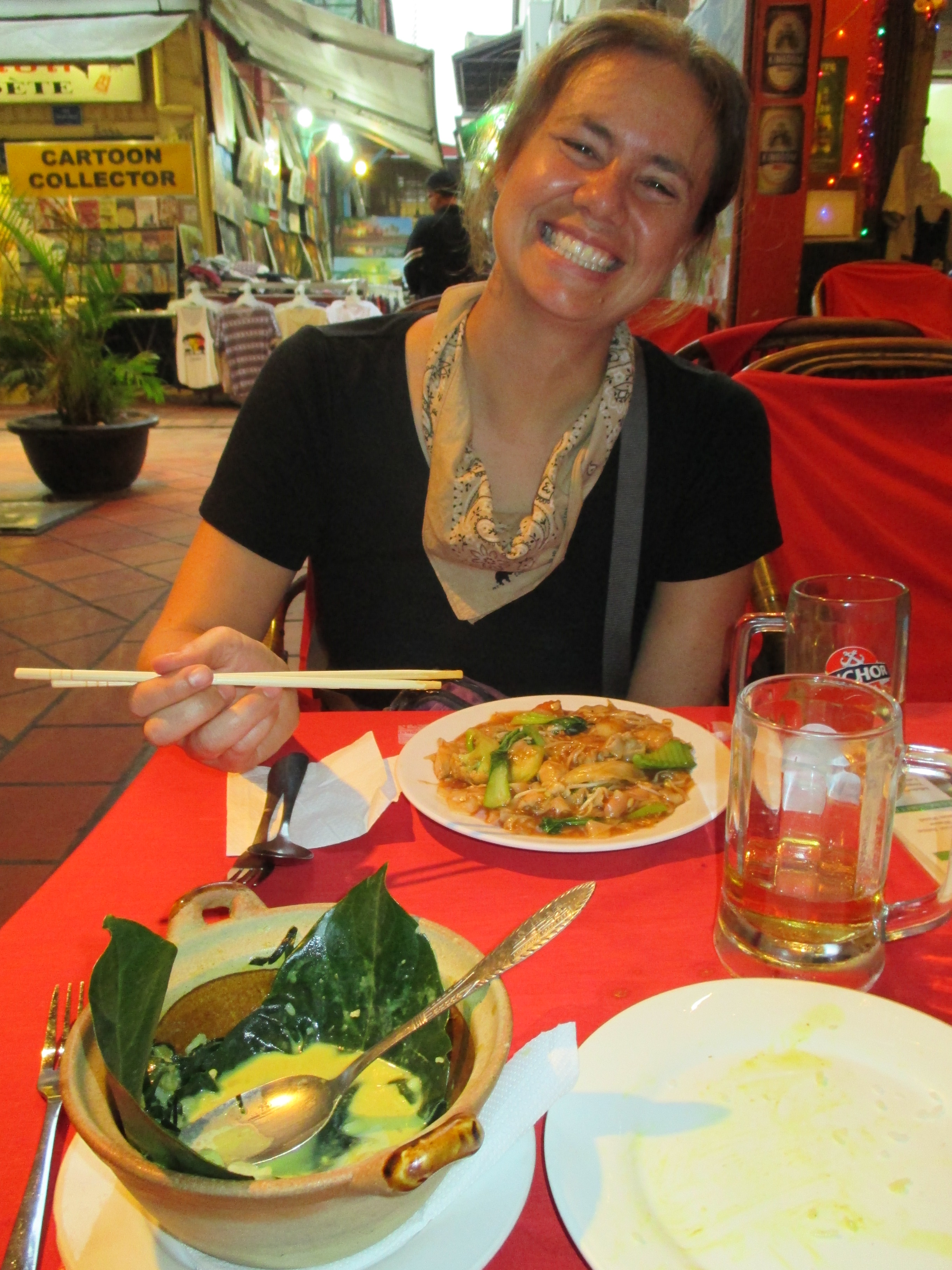
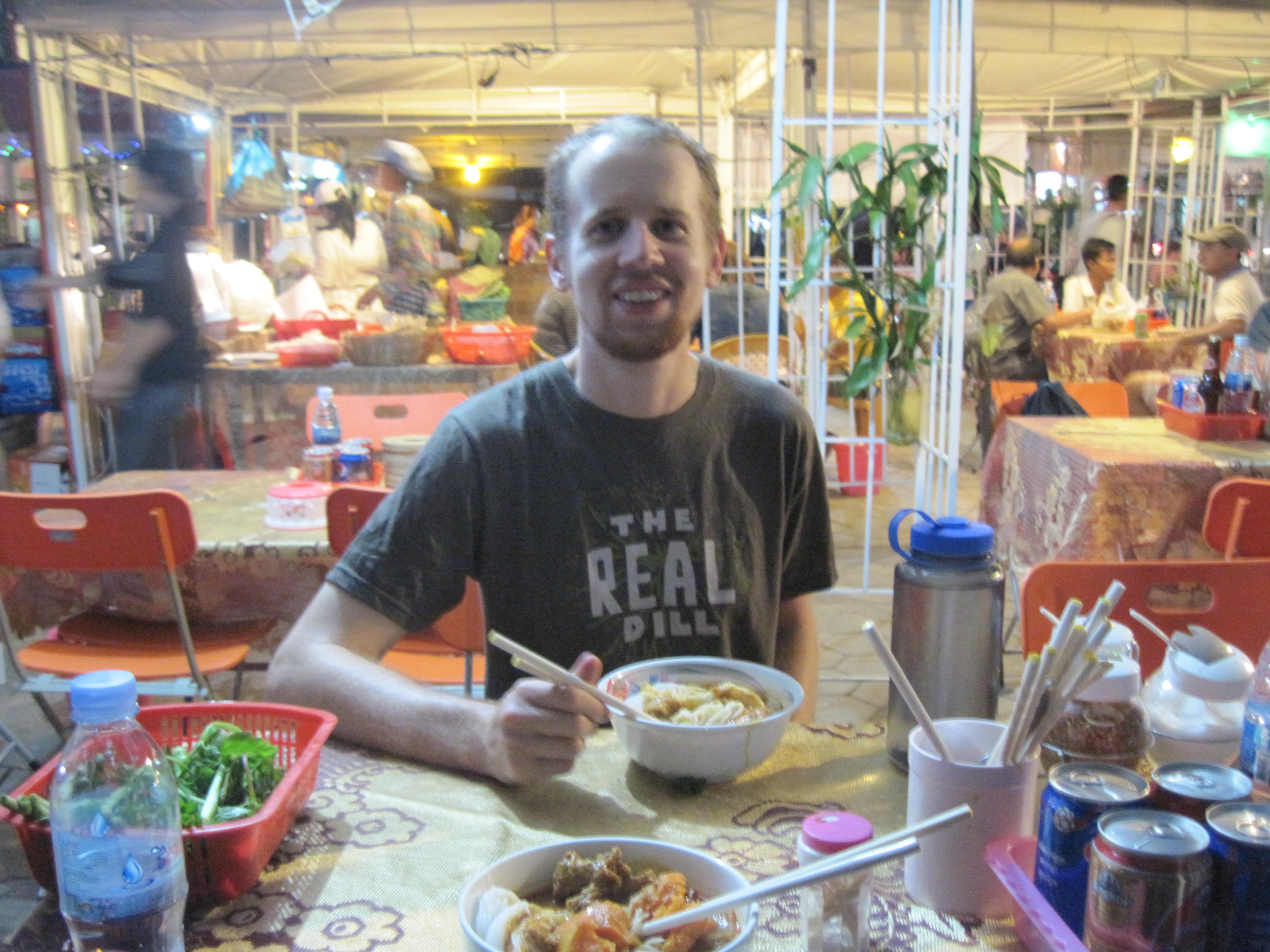
Siem Reap caters to a huge number of tourists, so it is not hard to find a place to eat. One night we ate at a generic restaurant called Angkor Famous where we were able to get a curry (a special Khmer curry called amok) and noodles for $3 each. We also discovered that happy hour beers were only $0.50 here!
IMG_5296

Eric’s curry came out a little bit faster than Della’s noodles


Two other nights we decided to go Western. One of them we got pizza at Belmiro’s, although we got it Khmer-style with lok lak beef and fancy Kampot peppercorns (a tad overwhelming, to be honest). The other night we got burgers at a nearby guesthouse.

IMG_5353

The Top Sky had a kitchen, and we ended up eating two meals here out of convenience / temple fatigue. One of the standout dishes here was a Khmer soup that was pretty simple but had a nice fish broth.

Flashback Friday: Death Valley, California

Flashback Friday is a picture series where we “flashback” to some of our memories – from either from our prior travel or from home. We hope you’ll enjoy some of our remembrances!

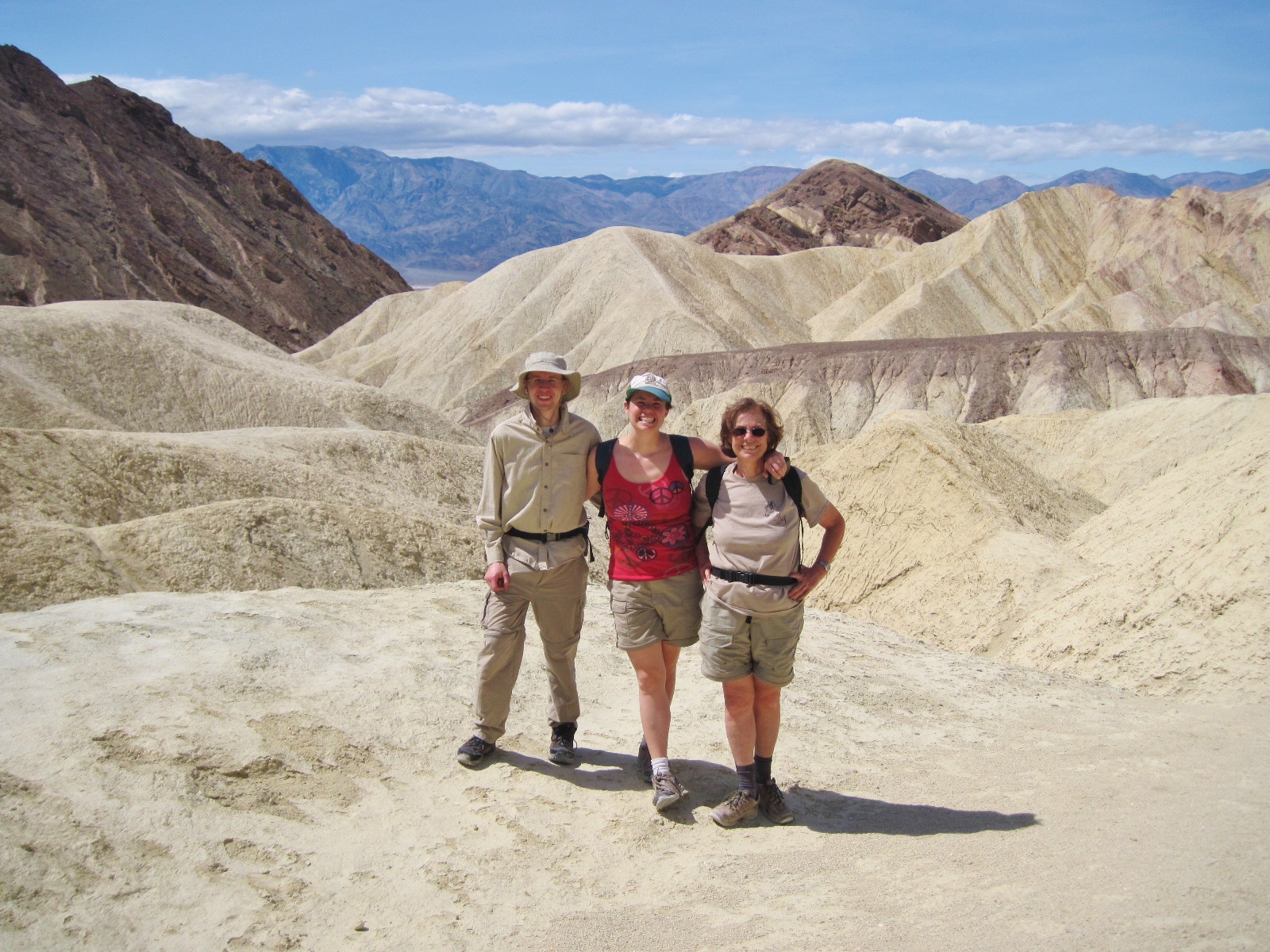
We were pretty excited to meet up with Della’s parents for the third time on our RTW trip this last week. It is their first trip back to SE Asia since their RTW trip 35 years ago. Naturally, this made us think to other trips we’ve taken with Della’s parents. Also, this is the first Friday in March… and March means it is getting close to Spring Break! This picture combines the two: a spring break trip out to CA where our first stop was in Death Valley!

Hiking in Death Valley

Hiking in Death Valley

Monthly Recap: Month 8

We are feeling strangely nostalgic for many of the places we have already visited on this trip. It’s not that the places we are exploring now aren’t wonderful, but it is because we feel the year slipping away from us already. Here we are on month 8, much closer to the end of the trip than we are to the beginning. It’s hard for us to imagine coming back to our real lives! But enough about the future, let’s talk about the present (well… past really) and think about our highlights of month 8!

Here are our stats for this month.

Countries visited:  3 (Indonesia, Cambodia, Laos) *Countries slept in: 4 Add Singapore to the prior list.

*Countries looked at: 1 (We watched sunset over Thailand, viewing it across the Mekong River from Vientiane)

Beds Slept In: 12 (This is a little higher than it could be. There were a few places, Phnom Penh and Siem Reip, where we switched hotels in the middle of our stay, and it counts one night back in Phnom Penh before our flight to Laos. *Chairs Slept In:  1 (See above about Singapore airport)

UNESCO Heritage Sights Visited: 3 (Cultural Landscape of the Bali Province, Angkor, Town of Luang Prabang) Total on RTW: 37

We traveled by 3 planes this month.

We traveled 5 long distance buses/minibuses.

Top Moments:

~ We really enjoyed meeting up with an old college friend in Bali at the beginning of the month. It was great to reminisce about some college times as well as talk about future travel! There were many great moments, but one of the highlights was experiencing a birthday party for the temple in the small town we were staying in near Ubud. It was just great to be able to witness this and the evening culminated with Eric dancing onstage!

~ We had heard about the evening aerobics in Phnom Penh, but kept not making it work to go for the first few days we were there. We finally made it on our final night and it was such a wonderful time! It is hard to explain how both peaceful and exhilarating it was to see so many people getting together to exercise. There were people of all ages doing all sorts of activities. Our favorite of which was dancing, of course! We met some really nice people who welcomed us into their evening tradition. It was topped off by a lovely sunset as well. Hard to beat!

IMG_5156

IMG_5159

Runners Up for Top Moments:

~ We didn’t know exactly what to expect from Battambang, a town in Cambodia. Most people just hit Siem Riep and Phnom Penh and move on. We had just a little bit more time so headed to Battambang on our way to the temples at Angkor. We stayed a few nights and had a wonderful time in this less bustling, less touristy city. One of our favorite memories from there was to see the Phare Circus. The performers were delightful, both funny and talented. It was a lot of fun!

IMG_7182

IMG_7192

~ As most people say, a trip to southeast Asia wouldn’t be complete with a visit to the famous temples at Angkor. We spent 3 days there and saw a lot of amazing temples. We enjoyed several of them, but one of our favorite moments was actually at the tail end of the second day. We had a long hot day on our ebikes, seeing several different temples. We were on our way home while the sun started to set. We rode through one of the famous complexes called Angkor Thom where we glimpsed some of the most famous temples for the first time. We headed out the south gate with the many faces, and had to immediately pause for the glorious sunset over the river/moat. We took some pictures and then continued on the ebikes where we rode past at got our very first glimpse of the most iconic temple of them all, Angkor Wat, before zipping on home. It sounds a bit anticlimactic but it was really one of our favorite times of the visit.

IMG_7745

IMG_7756


Items Missing, Broken, Discarded, or Added:

Discarded/Broken:

  1. Della’s sunglasses broke. They had broken twice before and she had managed to repair them with super glue… and then monkey tape. But they finally bit it and died.

Added:

  1. New sunglasses for Della
  2. New sunscreen
  3. New deodorant
  4. New laundry soap
  5. New shoelaces for Eric
  6. New lotion for Della
  7. New multivitamins

Packing Update:

We are currently quite happy with the contents of our bags. After our repacking at home, we are feeling pretty good about what we have. We both are carrying some more cold weather gear which we haven’t used at all since being in Asia, but we still think we might need it for Nepal and it is comforting to know we have it.

Books Read: (Have you read any of these??)

Della has read Is Everyone Hanging Out Without Me? by Mindy Kaling (4), 1984 by George Orwell (4), UnWholly by Neal Shusterman (3), Wizard’s First Rule by Terry Goodkind (3), No Birds Sing by Jo Bannister (3)

Eric has read The Blind Assassin by Margarat Atwood (3.5), Titus Groan by Mervin Peake (2.5), Gormenghast by Mervin Peake (3), Titus Alone by Mervin Peake (1)

Eric and Della have BOTH read nothing this month.

The rating system is for Della’s mom who is refusing to look at Goodreads. It is 1 to 5, 5 being the highest.

Make sure to catch up on all our monthly recaps: Monthly Recap 1, Monthly Recap 2, Monthly Recap 3,Monthly Recap 4, Monthly Recap 5, Monthly Recap 6, Monthly Recap 7


Backflips, Buildings, and Bats in Battambang, Cambodia

After our stop in Phnom Penh, we headed out to the city of Battambang. This certainly isn’t an undiscovered place – there were plenty of other tourists around, and it’s actually the second-largest city in the country – but compared to Phnom Penh and later Siem Reap, it felt a lot less crowded and much more laid back. We enjoyed a couple of days seeing the sights and enjoying the relaxed vibe of this ex-French Colonial city.

Getting There

We booked a seat on what we thought was a bus through our hostel in Phnom Penh. But, just like in Myanmar, it turned out to be a minivan. This one was a lot nicer though, with padded leather seats and a lot more legroom. It even had a large screen TV that played music for the first half of the journey and then showed Fast and the Furious 6 for the second half (the sound was too low for us to hear most of the dialog, but based on the action we aren’t sure we missed much). The highway was in pretty bad shape at times, and the driver was pretty aggressive in passing, so the ride wasn’t the smoothest, but we got there in one piece.

Where We Stayed

The cheapest accommodation we could find online with decent reviews actually turned out to be more like a hotel than the guesthouses or hotels we have been used to. Our room in the Emerald BB Hotel had a nice king-sized bed, a tv, big bathroom, and even a balcony… although there was no furniture to sit out on and enjoy it with.

What We Did

Tour Colonial-Era Architecture – When Cambodia was a French colony, Battambang was one of the French provincial capitals, and they set out to improve the city’s infrastructure with many buildings and new streets. Many of these influences can still be seen today. We downloaded some free PDFs from the Khmer Architecture Tours website that allowed us to do a self-guided walking tour of some of the best examples. The most iconic structure is the “shophouse,” which is a two-story building with businesses on the ground floor and residential above, with a balcony for the residential forming a covering for the sidewalk in front of the business. There is a large stretch of these buildings in the downtown core. We also thought the central market, an Art-Deco style structure, was impressive.

Hang Out by the River – We had read that there were aerobics classes in Battambang similar to the ones we found in Phnom Penh, so around sunset we walked around the park areas on either side of the river. We never found the classes, but we did enjoy watching the kids playing on the playground and the adults using the exercise equipment scattered around. The most fascinating attraction was a small path made of stones set on edge that people would walk over barefoot. Maybe to build up strength in their feet? Certainly not something we ever saw in a park back home.

The Circus at Phare Ponleu Seplak – The most famous attraction in Battambang is the nightly circus performance at this local arts school for disadvantaged youth. One of the arts the students can train in is circus arts, and they put on a circus show for tourists starring the students and some professionals. We found the show to be very entertaining. It didn’t have any of the circus animals; instead, a group of six male performers did a wide variety of acrobatic stunts, from simple clown tricks to high-flying jumps. The whole performance was backed by music from some of the music students of the school. The show was only an hour long, but we were on the edge of our seats the whole time.

Screening of the film The Killing Fields – After our visit to the Khmer Rouge sites in Phnom Penh, we wanted to learn more about that dark time. We had heard that the film called The Killing Fields was a good resource but we weren’t sure how to watch it. Then we saw that one guesthouses in town showed it nightly in their private movie room. We headed over there one night and watched the film, which we felt did a pretty good job of adding more information to what we already knew.

Tuk-Tuk Tour of Surrounding Sights – Our second day in Battambang, we hired a tuk-tuk driver to take us around to some of the different sights we had read about outside of town. (A tuk—tuk is a carriage that is drawn behind a motorbike).

Our first stop was the Bamboo Train. The French left a series of rail lines through the countryside, but they are no longer used for trains that you would normally think of. Rather, they are traversed by the locals using bamboo rafts on top of two rail axles, powered by a small motor. Traditionally, farmers would use these as a shared taxi to ferry goods around, but it has turned into a large tourist attraction (we only saw tourists riding). The most fun part is seeing what happens when two trains meet on the single track. There is no way around, so instead one train has to be completely dismantled and placed on the side of the track so the other train can pass!

On our way to the next stop, we took a quick break for a wine tasting at Cambodia’s only winery, Prasat Phnom Banan Winery. The guidebook warned that the wine was not very good, and unfortunately we had to agree. We tasted their “red,” a grape juice, and a ginger juice. The wine smelled ok but the aftertaste was a bit strange.

We then headed to Phnom Banan, where we climbed 385 steps straight up the hill to the ancient temple of Prasat Banan. The temple was built around the same time as the temples of Angkor, and definitely shares some similarities, including the layout of the five towers. They aren’t in great shape, but we enjoyed wandering through them anyway.

Our final stop was the area around Phnom Sampeau, where we sampled a few different attractions. Our driver couldn’t take us up the hill, so again we had to walk up. The first stop on the way up was the Killing Cave, a cave with a natural opening in the roof through which the Khmer Rouge threw their victims to kill them. A small memorial with the bones found in the cave still remains. At the top of the hill are multiple Buddhist temples. We relaxed up here and enjoyed the view, being careful to give the monkeys a wide berth. After we walked down the hill, we waited at the base for sunset, when a giant line of bats emerged from a cave in the side of the hill. This went on forever, and we even stopped on the way back into town and could see the undulating line of bats making its way over the countryside.

Where We Ate

Battambang has a nice selection of cafes in the main downtown district. We visited two of the highly-recommended ones: Jaan Bai and Lotus Café. The most interesting thing we got at Jaan Bai was fancy cocktails. Della got the house specialty called “The Crocodile” which seemed to have everything but the kitchen sink in it! At the Lotus Café, Eric got a traditional Cambodian dish called “lok lak,” which is basically just chunks of stir-fried beef. We also had some very good spring rolls here.

There is also a nice Night Market in Battambang by the river. One area of the market has some small food stalls which serve up some cheap meals. We were able to get noodle curry bowls for $1.50 each, and it was pretty tasty!

IMG_7275

Final Thoughts

The guidebooks say that there isn’t a lot to do in Battambang, but we were able to find plenty of diversions to occupy our few days there. We enjoyed both the sights we saw and just the vibe of this small city. Especially compared to some of the other places in Southeast Asia, Battambang was just the right amount of relaxing.

Dark Past and Fun Present in Phnom Penh, Cambodia

Cambodia has always been on our itinerary, but we originally thought we would visit as part of an overland trip between Thailand and Vietnam. Instead, we ended up visiting it directly after our trip to Bali. Our friend Andrew from Denver works with an NGO in Cambodia a few months out of the year, and we found out that he would be there in February, so we switched our schedule up.

Our first stop in Cambodia was the capital and its largest city, Phnom Penh. We spent four nights there exploring many different sides of the city: seat of royalty, echoes of past horrors, and glimpses of a growing modernity.

Where We Stayed

We actually ended up staying in two different hotels during our time in Phnom Penh. The first two nights we stayed at the Khmer Surin Boutique Hotel, because that is where Andrew always stays and he was able to get us a slightly reduced rate. The room was definitely fancier than we were used to! We really enjoyed the large breakfast, where our choices included noodle soup and pad thai.

Even with the discount though, it was still a little too much for our budget. We found the Envoy Hostel just six blocks away and got a private room there with a shared bathroom. Its included breakfast was good but not nearly as fancy, but the space itself felt new, clean and friendly.

IMG_5165

What We Did

Royal Palace – Cambodia is a constitutional monarchy, meaning that they have a prime minister with most of the political power but they also still have a King (like England). The King’s official residence is in Phnom Penh, and parts of it can be visited by the public. The two major attractions to see are the Throne Hall, a lavish hall where the King receives visiting dignitaries, and the Silver Pagoda, which houses many splendid objects and gets its names from the actual silver floor tiles. We weren’t allowed to take pictures inside either of these structures, but were allowed to take pictures of the outside and the surrounding buildings, which were pretty impressive.

National Museum – Located next to the Royal Palace, this museum houses a large collection of ancient Khmer artifacts (the people of Cambodia are not called Cambodians but rather Khmer). It was interesting to observe the changing majority religion in the Khmer Empire as time went on. The earliest sculpture from before the 10th century AD is all Hindu, with images of Vishnu and Shiva, and so on. The apex of the Khmer empire is called the Angkor period (named after the capital, where the famous Angkor Wat is located). The sculpture from the early Angkor period is still Hindu, but then shifts to Buddhist under the influence of some influential kings. After visiting the exhibits, we spent some time relaxing in a pleasant garden in the center courtyard.

Both of the above attractions would fit under the “positive vibes” category, but the other two major attractions we visited definitely do not. In 1975, in the chaos surrounding the Vietnam War, the Khmer  Rouge took power in Cambodia and began a radical restructuring of the country. Cities were emptied and they attempted to make an agrarian Communist society. Part of this restructuring meant getting rid of anyone who didn’t fit into their plans, such as intellectuals, foreigners, or even Khmer Rouge members who didn’t seem “loyal” enough. They only ruled until 1979, but in that time over 2 million people died. We visited two attractions that played a major part in this genocide.

Tuol Sleng Genocide Museum – This is also known as “S-21”, which was the name given to it by the Khmer Rouge when it was used as a secret prison. They used this former high school to house prisoners for long enough to torture them and force a confession for their “crimes.” The facility is left is almost the same state as it was when the Khmer Rouge fled Phnom Penh in 1979. One of the cell blocks still contains the beds in which some of the last remaining prisoners were tortured to death and left before they fled. Others still have the old makeshift cells that the prisoners were held in. Many of the rooms are filled with pictures of the victims; like the Nazis, the Khmer Rouge liked to keep detailed records. This was a pretty harrowing place to visit, to say the least.

Killing Fields of Choeung Ek – After the prisoners “confessed” to their crimes, they would be thrown in the back of a truck and taken out to this site (located in a former Chinese cemetery) just outside of town, killed and dumped in a mass grave. In an attempt to save bullets, most of the killings were done with agricultural instruments. No structures remain, but many of the mass graves have been unearthed. Not all of them have though, and you can still see scraps of fabric and even bits of bone from the victims sticking out of the ground in places. An excellent audio guide helps take you through the site and gives good background information. We also really appreciated that the audio guide meant that hardly anyone was talking throughout the site, leading to an air of solemnity.

After learning about all of these recent horrors, we were feeling pretty depressed. But, the people of Phnom Penh seem pretty resilient, and we got to participate in a fun local activity at the Olympic Stadium one evening.

Where We Ate

Our friend Andrew did a great job of guiding us through the wide range of good food that was to be found in the neighborhood that we stayed in. The variety and quality was quite impressive!

The first night we went to a barbecue place that was filled more with Khmer people than with foreigners. We split a few different grilled meats and side dishes. One of the most exciting parts of the evening was seeing a Rice hat at a neighboring table!

On the other evenings with Andrew, we ate at a French restaurant (a holdover from the colonial influence) and a Mexican restaurant (where Eric was amused to see many Texas references on the menu).

One evening Andrew couldn’t join us, so we ate at the Khmer Surin’s restaurant and had some dishes with a strong Thai influence. We also ate lunch one afternoon at Mok Mony, where we sampled a Khmer red curry (tasted pretty similar to Thai curries) and their version of fried noodles.

One thing that we were really impressed with was how cheap the beer was! At many places, you could get a glass of draft beer during happy hour for 75 cents! Sure, it was pretty plain tasting beer, but at that price it’s hard to complain!

Final Thoughts

Phnom Penh was an excellent introduction to modern Cambodia. We got to see a bit of the royal influence, learn about both the grand ancient history and the somber modern history, and get a little bit of the cosmopolitan feel of the growing city.