Flashback Friday: Holidays in Houston, TX

Flashback Friday is a picture series where we “flashback” to some of our memories – from either from our prior travel or from home. We hope you’ll enjoy some of our remembrances! 

When we were home for the holidays, we had a chance to visit Houston and reconnect with some great old friends! This picture was taken during a secret Santa gift exchange back when we were seniors in college. Also, we want to give a shout out to some dedicated blog readers who are in this photo! (Thanks guys!)

Secret Santa eric jon cait jenny

Traveling RTW – Then and Now

One of the many things that inspired us to go on our RTW trip was that Della’s parents, Peggy and Wayne, did a RTW trip of their own. They traveled for about 9 months in the years 1979-80. The trip was in many ways similar to ours; they visited Europe, Africa, and Asia. One of the things that has been really fun as they have met up with us a few times on our trip is discussing what is the same and what is different from when they traveled 35 years ago!

Their trip took them from Italy (where they visited Peggy’s father’s old home), to Eastern Africa, and finally to Southeast Asia. We decided to ask them some questions about their trip to see how it compares with traveling RTW now! Read their answers and our own and draw your own conclusions!

This is part 1 of this interview series. Stay tuned for part 2!

Before you left the US, how did you plan where you were going to go?

Peggy and Wayne (P&W): We planned to follow in the footsteps of a friend of Wayne’s who had done world travel. He wrote to Wayne with the details of what he was doing. What stuck in Wayne’s mind was that he said he had been gone for 11 months, had traveled overland by bus from London to India, had kept detailed records of his budget and had spent only $530. This overland route had become a somewhat standard backpacker’s route. We hoped to do that. We did a little planning using a single Lonely Planet guidebook for Asia Overland travel. Part of our planning was to attend a series of travel lectures sponsored by National Geographic. We also talked to people we knew in DC who had taken world trips. Both before and during the trip, much of our planning was based on word of mouth information from other travelers.

We also had been invited by our friend who was an Assistant to the  ambassador in India to visit with for a while. We hoped to arrive there by Republic Day in January.
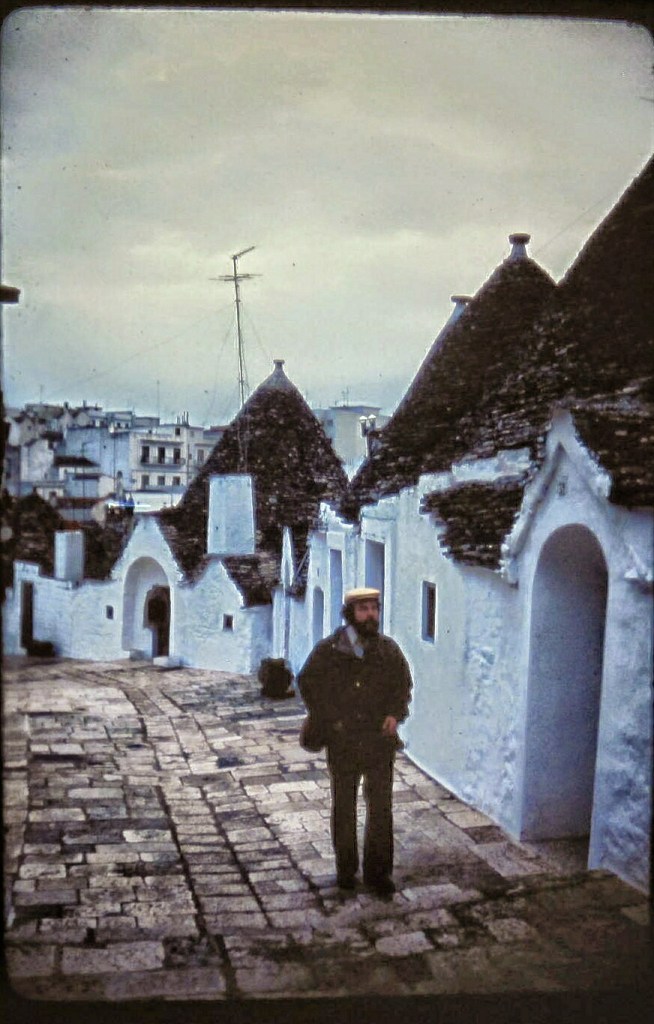
Wayne in Greece

Wayne in Italy

Della and Eric (D&E): We wrote a more expansive blog post about this awhile back, but in short: We talked to Wayne and Peggy about where they went, we read a lot of travel blogs to get inspiration, we checked out a lot of Lonely Planet (and other) guide books from our local library, and we did research on climates in each locale to figure out the best times to visit.

How did people react to your plans to travel?

P&W: People thought we were a little weird. Most of the people we knew in DC were on a professional path and they thought it was strange  that anyone would risk the consequences of getting off that path. They thought the trip was less crazy in terms of a money perspective, but we would miss out on professional advancement.

Wayne had traveled a lot prior and had even gone to Israel for 7 months while in college. His parents, therefore, were accustomed to his wanderlust, but they always worried, especially his mother. His dad was confident he knew what to do. The typical advice his parents gave was “I know you know that you’re doing, but be careful!” Peggy’s parents, who rarely left New York, thought we were crazy, period. They had given up  on understanding our choices, but never sought to influence to change our plans. In both cases, since we were already living far away from home, it wasn’t a huge change for them having us gone. Our parents ultimately were both supportive and helpful, especially because they both took on responsibility for managing affairs back in the US. Peggy’s parents even joined us for the beginning part of our trip in Italy!

Peggy's parents during the trip in Italy

Peggy’s parents during the trip in Italy

D&E: We got a variety of reactions –some jealousy, some wondering how we could possibly afford it, and some just blown away at the thought of leaving home for so long. For the most part, people have seemed quite excited for us. We did write a blog post about why we chose to do this trip which addressed many of the questions and reactions we had received from people.

Not surprisingly, Peggy and Wayne were super supportive and excited for us. They were pleased that we were going to set out on such an adventure, but also started to understand some of the worry that their parents felt when they left. Eric’s parents were also supportive and made plans to meet us along the way. Peggy and Wayne have been very helpful from a logistics perspective in managing our affairs back home and they, as well as Della’s sister, have made it a priority to join us for parts of the trip as well.

What did you do with your possessions from home while abroad?

P&W: We owned a house in DC which we rented out to an existing roommate. We didn’t get rid of anything. We left the house furnished so most of our stuff stayed in place in the house. We did worry a lot about who would handle repairs on our very old house. Just before we left, it rained heavily and a skylight started leaking. We knew we couldn’t leave until we had it repaired. We were trying to clean the roof tar off some clothing using gasoline. Then in a rush we put the clothing in the washer and proceeded to cause a small explosion. Dealing with the consequences of that delayed our departure a couple of days (to New York which was an interim step prior to our international departure). A friend agreed to keep our cat, but only after he had been declawed. Gus didn’t talk to us for days after the operation. We owned two cars. We left one in New York and one in Colorado in the garage of the cabin.

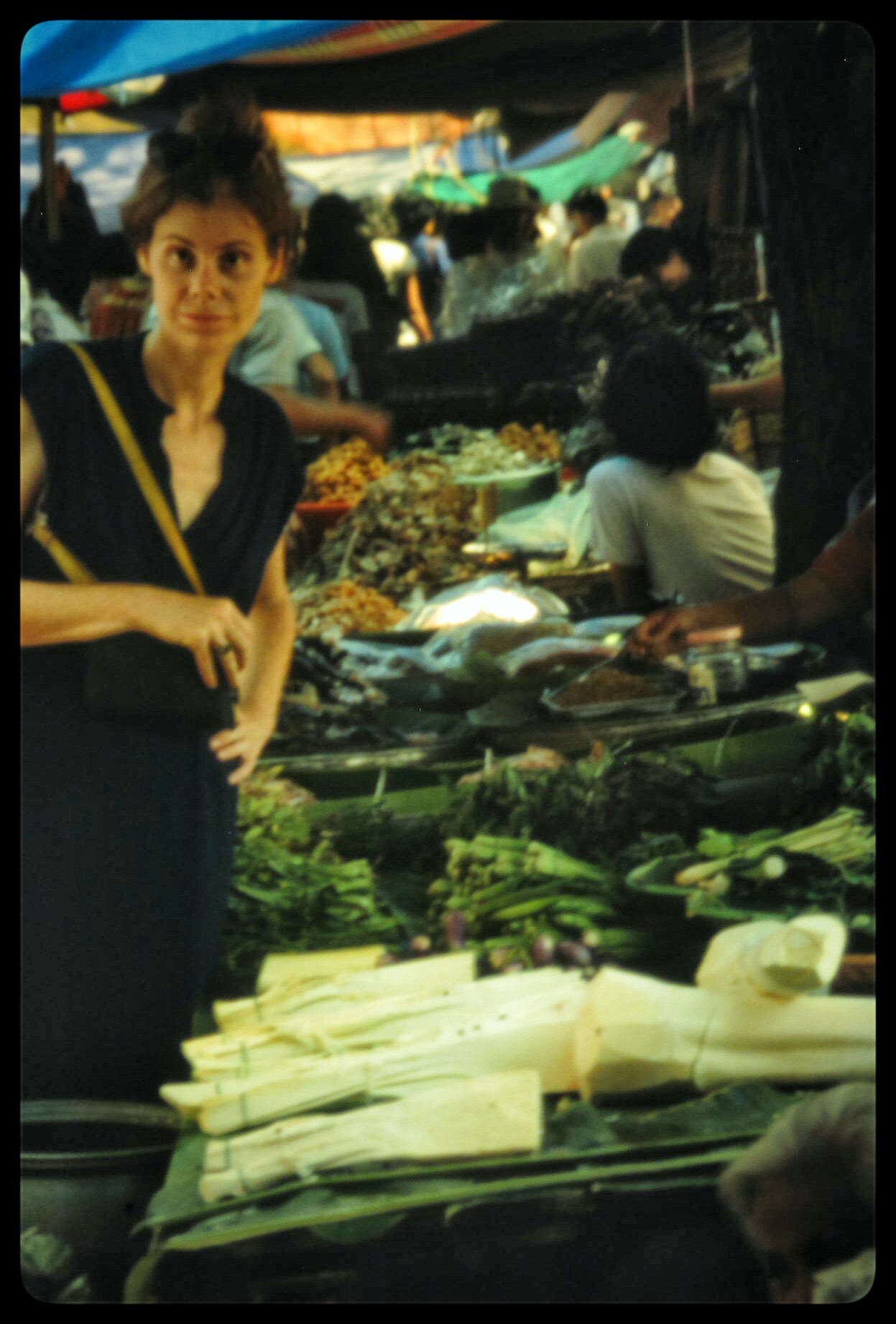
At a market in Thailand

At a market in Thailand

D&E: We also rented out our house, but to a friend who wasn’t already living there. We were able to keep it partially furnished and leave the rest of our possessions in the house in the attic and basement. We asked Eric’s parents to take care of our cat while we were gone. Our two cars currently reside and Peggy and Wayne’s house.

How did you get your appropriate Visas?

P&W: We had to get all of our visas and information from consulates or embassies. We did that while we were in New York and it took almost a week of walking around the city to get it all done.

IMG_5103_edt

D&E: Most of the time, we are able to get our Visas on arrival. There have been a few that we had to apply for in advance. However, luckily, so far we have been able to get this quickly and easily online! We do think we will have to get our Vietnam visa in person before we go there.

What was in your pack? What kind of clothes did you pack?

P&W: We each had a large internal frame backpack. We had one big camera bag, and Peg’s pack had detachable zip pockets that we carried as day bags. We don’t remember exactly what we had in our packs. We know we took one down sleeping bag and made a light weight, quasi sleeping sheet that zipped on. If it was hot we put the sheet side up and if it was cold, we put the sheet down. Peggy had sandals and hiking boots, 2 pairs of pants, and a dress. She bought a great wraparound ankle length skirt in India. She loved skirts because they were cooler in the heat and also facilitated peeing somewhat more discretely out of doors in places where there were no facilities. Wayne brought jeans. He remembers that he bought his first GoreTex coat for the trip. It actually leaked like crazy. He went back to the store in DC a year later and returned it for a replacement! We remember buying replacement black cloth Chinese slippers in Hong Kong and some clothes in Sri Lanka (but those didn’t last).

We had repairs and medicine kits. We also made big zippered nylon bags to wrap around our big packs when we flew, in order to protect the straps. These turned out to be really useful because we were often able to establish a home base in some guest house in a country and then leave extra gear in those bags while we traveled to other places. We did this when we trekked in Nepal.

We had a coil to heat water in a cup. We also used Iodine to purify water. We started with pills but then used a dropper.  We had a hell of a time communicating with pharmacists when we needed to replace the iodine. We had to treat the water pretty much everywhere we traveled, even for brushing our teeth.

We always remember spending days in New York packing and repacking our bags. We weighed everything! The problem was that no one item weighed very much, but put together they weighed an awful lot. We finally made our decisions, went to the airport, decided we were too heavy, shed stuff at the gate sending it back home with Peg’s parents. Then after travelling in Italy with Peg’s parents, we sent even more stuff home! Mostly we parted with some sweaters and fancier clothes that we figured we wouldn’t need after leaving Europe.

D&E: We focused on packing things that were lightweight, quick dry, and wouldn’t hold smell. We talk extensively about our packing lists here and here.

How did you buy plane tickets?

P&W: We considered buying an around the world plane ticket, but they were expensive and had confusing rules regarding stops and direction of travel. That posed a dilemma because back then one-way tickets generally sold at a large premium. We finally decided to buy our initial ticket from New York to Frankfurt from a travel consolidator for $175. You had to send him money via mail and then he met you at the airport with the actual ticket on the day of the flight.

Remember our original plan was to travel overland, mostly by bus, from Europe to India. Once we were in Italy we had to revise our entire travel plan. It was then that the Iranians took the American hostages. That foreclosed travel there and the Russians had recently invaded Afghanistan. So that wasn’t an option either. As a result, we ended up having to take many more flights than we originally anticipated. During our re-plan of the trip, the key was to find big cities with travel agents or flight consolidators who would bundle tickets at discounted prices. Athens and Bangkok were those cities. We spent a lot of time in Athens going between different agents trying to find routings that made sense. We decided at that point to buy blocks of tickets that took us to Egypt, Kenya, and then, India. We did the same thing in Bangkok, trying to figure out a route that would take us home. We had to choose between one that would take us through Malaysia, Indonesia and Australia or a route that would take us via Hong Kong, Japan, Taiwan, Honolulu, and then home. We chose the latter.

When we booked these big chunks of tickets, we would have to carry the paper tickets all with us! It was as important as your passport and money. Sometimes people would even steal tickets. You didn’t need a picture ID to fly on tickets then. We also learned the hard way, that having a ticket didn’t necessarily mean we had a confirmed seat on a flight. From that point on, we checked flight codes very, very carefully.

We figured out our travel as we went from arrival in Bombay through to Bangkok. Mostly we traveled by train, bus, or boat. But some stretches required air travel. In India, we learned that there was a narrow window in which you could buy tickets.  “Control” over ticketing would shift location depending on how much in advance you tried to get tickets. We tried to book a flight from Kathmandu to Calcutta a couple of months out. The ticket agent in Delhi, sent us to the main computer center on the other side of town for the airline. When we got to Kathmandu (still several weeks before the scheduled flight out) we stopped at the airline office to confirm the ticket. Not only did we not have a confirmed seat, it turned out there was no such flight. The man was actually mad at us for having a ticket! We had to explain that it was their system who had given it to us in the first place. He told us, “I didn’t do this! The computer people did this!” We were at an impasse until we were able to talk to the manager. He understood and told his underling to book us on a different flight. We waited a long time. It turned out that he was filling out a lot of paperwork to cancel the original flight. We always laugh when we remember the manager informing the underling “It is not necessary to cancel a ticket for a flight that does not exist!”

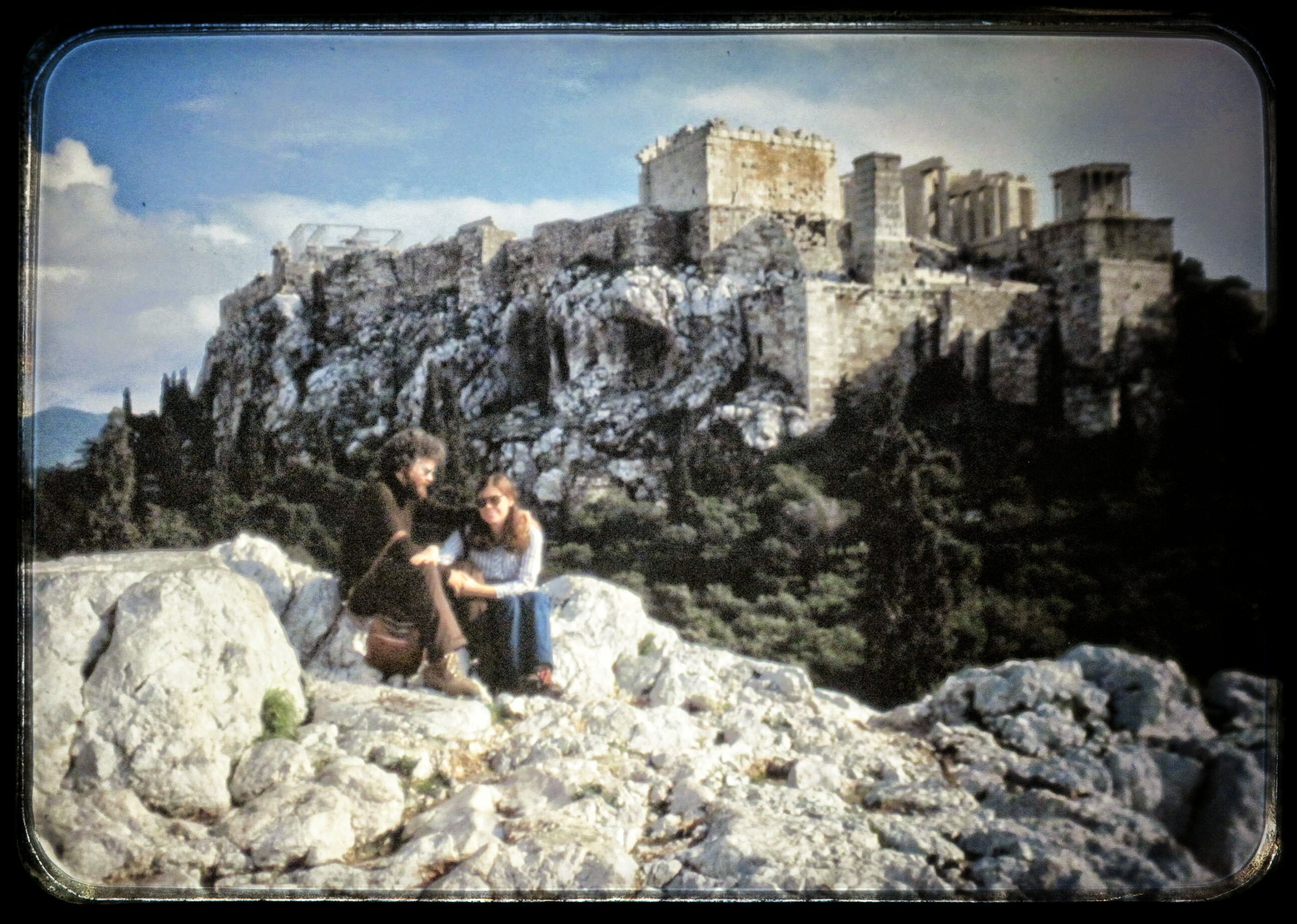
Spending time in Athens

Spending time in Athens

D&E: Buying plane tickets is easy! We buy them online of course. The only challenge is figuring out how to use miles to fly more cheaply. We worked hard to gain credit card “miles” so that we wouldn’t have to pay full price on any of our long plane rides. Thus far, we have succeeded! We flew from the US to Africa, South Africa to Europe, Turkey to home, and Denver to Bangkok all using miles. We search for the best deal using a lot of different airline search sites, but one of our favorites is Kayak.com.

While you were traveling, how did you figure out what to do within cities? How did you choose accommodations?

P&W: We carried the Asia Overland guidebook and that helped with some of the planning. We would visit the Tourist Information (TI) center and get a lot of information from them at the beginning. Peg read everything really carefully. Wayne relied more on talking to people, he asked everyone he met, whether it was the guy hawking his wares or other travelers, what to do and how to get there. We would also always try to find out what things should cost, so we knew how to approach bargaining. We also would stop by travel agents selling tours. That gave us an idea of what was worth seeing. If we could figure out how to do it on our own, we would. Other times, we might buy the mini-bus tour.

D&E: We access a lot of tools to figure out what to do in a city. We use our Lonely Planet guide books which we can carry a lot of thanks to Kindle Unlimited and our tablet. We use websites like tripadvisor to help us decide what to do. One of our biggest resources is other travelers- but instead of talking in person (we do sometimes of course!), we use travel blogs. There are so many travelers out there who share their experiences in blogs, and we use those a lot to figure out how to get places and decide what to do. For accommodation, we use Lonely Planet and travel blogs (and other travelers in person), but we also do extensive research online. We use sites like hostelworld, booking.com, and airbnb. In Asia, we have started to use agoda.com as well.

What kind of places did you stay?

P&W: Where we stayed varied by country. We didn’t stay in a lot of hostels and didn’t prefer them. Most hostels locked you out during the daytime hours. We usually stayed in guesthouses where we had our own room. We did stay in hostels in Japan and Bangkok. In India, we stayed in places where the Indian middle class might have stayed, or places that catered to the Peace Corps crowd. These guesthouses often had common area or associated restaurant.

In India and other places where we traveled by train, we would often book sleeper trains, thereby reducing our need to find lodging. We also enjoyed staying in government guest houses some of which were in the train stations themselves. These were holdovers from the days of the British Raj. In Japan, we also stayed with Servas hosts. This was an international peace through friendship organization. In general, Servas worked best for a trip highly planned and with long lead times. Staying with real people in real homes was a treat – really interesting and informative, but a bit exhausting.
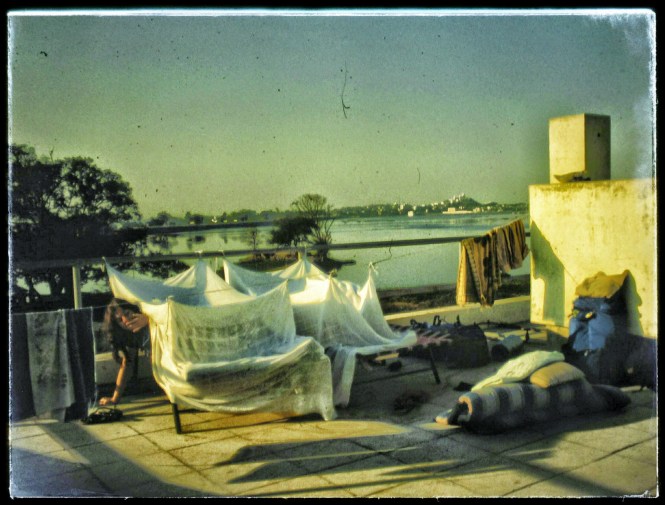
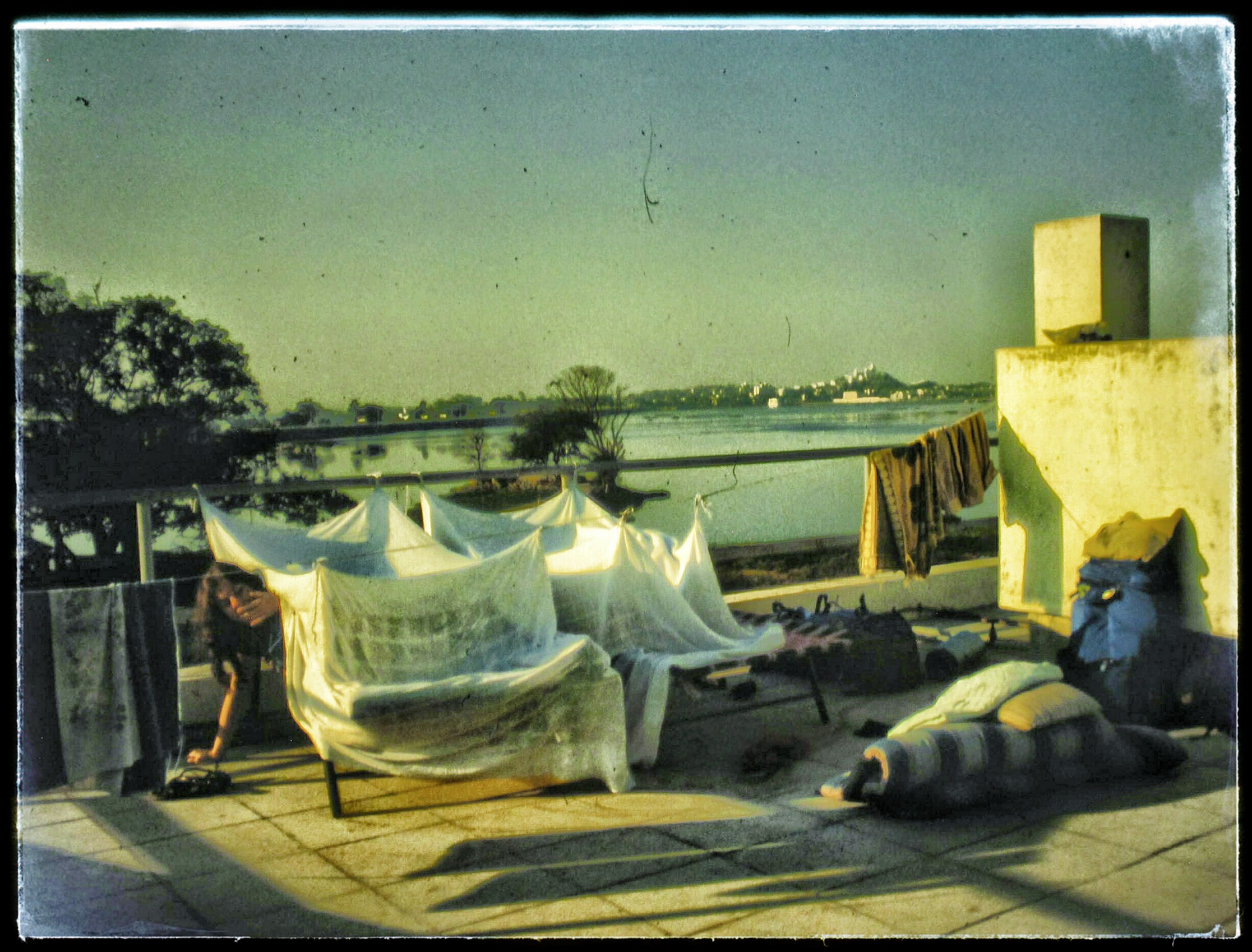
Staying on a roof!

Staying on a roof!

D&E: For the most part we have stayed in hostels and guest houses. Every now and then we stay in a hotel. We have also stayed in several apartments using sites like Airbnb. Our favorite places have a communal vibe so we can meet other travelers to make connections and a kitchen so we can cook some of our own food.

How did you get around?

P&W: We took flights for large distances. In Egypt, India and Sri Lanka we took a lot of trains. They were great. We also took a lot of buses, although we liked them less well. Schedules and routes were much harder to figure out and they were always very crowded (with animals as well as people). Some of our best rides were on the roofs of the buses. Some transport was in the back of pickup trucks (that had wood seats along the edges) or in mini vans. The hard part about these was that even if they told you they were leaving at a given time, you usually had to wait for however long (sometimes hours) that it took for them to fill all their seats (and then some). Within cities, transport was often by bicycle rickshaw. There were still many rickshaws pulled by men, but we felt too big and heavy to want to ride these.

D&E: We’ve gotten around almost every way you can think of. Planes for big distances (and some small when we were in a rush). We’ve used a lot of buses and trains. Within cities, we are always happy if there is a subway or rail equivalent. We have even traveled by boat, horse cart, and electric bicycle! Occasionally we have used taxis as well.

Read Part 2 of our interview with Peg and Wayne here!

Our First Taste of Myanmar in Mandalay

Our first stop in the country of Myanmar was the city of Mandalay. When originally planning this part of our trip, we had assumed that we would start in Yangon, but when we found out it was possible to get to Mandalay we figured it would be better to start up top and do a one-way trip down to Yangon. The guidebooks and fellow travelers didn’t rave about Mandalay itself, so we wondered a little bit if it was going to be that much fun to visit.

Getting There

The key to our decision to start in Mandalay was figuring out that there was a cheap flight from Bangkok to Mandalay every day on AirAsia (technically the same airline as the one that just crashed, but there are different subsidiaries in each country and this one was on the Thai version). The flight left from Bangkok’s secondary airport, Don Mueang, which we had to take a taxi to get to. The flight itself was delayed for an hour because of a military airshow, so we were there in plenty of time and were able to enjoy a bowl of noodles at the gate.

The Mandalay airport itself was a bit small but getting in and getting our bags went smoothly. It is located 45 minutes outside of the city, but AirAsia provides a free shuttle to the city center. We caught the shuttle and then at the dropoff point were able to get a taxi to our guesthouse.

Where We Stayed

We can’t rave enough about the Yoe Yoe Lay Guesthouse. If you are going to Mandalay, you should stay there, no question. The level of service is amazing: everything is done with a smile, the provided breakfast is large and you have to fight to keep from getting extras and the facilities are nice, clean and commodious. The owner, who everyone calls “Mama,” is amazingly kind and generous, and will go out of her way to make you feel at home. Also, this place seems to attract a nice crowd of like-minded travelers, and we made a lot of fun connections just hanging out in the common area each night. Yoe Yoe Lay set a very high bar for the level of accommodations we are going to expect in Myanmar.

We ended up staying at Yoe Yoe Lay for four nights, and in three separate private rooms. We only booked two nights in advance since we weren’t sure we would like Mandalay, but almost immediately we decided we wanted one more. But by the time we asked them, our room was already spoken for, so we had to switch to a different room. The new one had a private bathroom instead of using the shared facilities, so it wasn’t too much of a sacrifice. We also stayed one more night in a different room after spending two nights in the nearby town of Pyin Oo Lwin (separate blog post coming soon).

What We Did

Ancient Cities Tour

The taxi driver who took us to the Guesthouse on the first day also told us that he would offer his services for the day to drive us around to sights in the three “ancient cities” near Mandalay: Amarapura, Sagaing and Inwa. All three were the capital of a kingdom at some point in history and have remnants left over from their glory days in addition to active Buddhist sites. The cost for the day was $35, which our host told us was reasonable, so we decided to accept.

The day started out bright and early with our driver picking us up at 8:00 AM. Our first stop was actually within the city of Mandalay: the Mahamuni Paya, the main Buddhist temple in the city. He dropped us off at one of the lesser-used entrances. We put our shoes in lockers (everyone must be barefoot within the sacred area) and walked into the complex. The main attraction is a 13-foot tall seated Buddha, made of gold and believed to be 2000 years old. Male worshippers may approach this image and apply gold leaf, but women have to sit outside or watch on one of the TV monitors. There were quite a few people visiting this image on the day we were there. In the buildings surrounding the courtyard, we also went through a gallery of paintings describing how the Buddha was moved to Mandalay and a room with some bronze figures from Angkor Wat.

The next stop on our tour was at a shop that did traditional wood carving. It was pretty interesting to watch the male workers chisel away at the pieces of teak wood. We were tempted by a smaller piece but didn’t want to have to figure out how to get it home. Inside there were some ladies working on pieces of embroidery. We did buy a smaller piece of this which had an owl on it.

We then headed onto Amarpura and into the Maha Ganayon Kyuang Monastery there. Our driver instructed us on where to stand to watch them get their lunch at 10:25. We had a little bit of time before to wander around the grounds. We made it back to the spot by the road in time for them to line up. Unfortunately, there were a ton of other tourists there, so it was kind of a strange experience, with everyone snapping pictures of all of the monks as they stood in line. It was interesting to watch the process of how they got their food: volunteers were standing just outside the dining hall, and the monks would file past and get a large serving of rice, some cake and a drink.

We got back in the car and drove on south. We paused before crossing the big Ayerarwady River on the new bridge to take in the sight of the river and our next destination: Sagaing Hill. We could see the large hill with many sparkling pagodas covering it. This was the site of a capital of a Shan kingdom in the 14th century but now is mainly known as a big site for monasteries and temples.

We were dropped off at the base of the hill and shown the path to take to get to the top, through One Lion Gate. The path up took a while – Lonely Planet says it was 350 steps. Once we reached the top, we took off our shoes and explored the Pon Nya Shin Pya, with its shiny gold stupa and a big Buddha image. The platform surrounding gave nice views of the surrounding area. We stopped and sat for a while just to relax.

We headed back down the stairs and found our driver. We drove back over the river on the old bridge (much smaller) and went to the dock to head to the dock for Inwa. We found out that the driver doesn’t actually take you there – you have to take a boat across. Inwa has been the site of a royal capital four different times from 1364 to 1841. There are a few ruins and old temples spread about. The way they expect you to see the sites is by horse cart. We weren’t sure we wanted to pay for this, so we started walking past them, declining numerous offers. We had just turned the corner when we gave in to one persistent driver and took the cart. This caused some sort of argument between him and other drivers, which left us feeling a bit awkward.

The ride in the cart down the narrow dirt/sand paths was fun but quite bumpy. After a little while we were dropped off at our first stop, Maha Aungmye Bonzan, also called the “Brick Monastery” since it was built from brick covered in stucco (in 1822). It felt quite older than the other temples that we had thus far seen. There weren’t a lot of other people around. As we were first circling, a teenage boy came up and started talking with us in English. We think he just wanted to practice, because he never asked for anything. We had to pause where a Burmese family basically insisted that we take a picture with their infant. Della held it while the rest of the family tried to make the baby look at them. We then took off our shoes and entered inside the upper level, still accompanied by our conversation friend. He followed us until we left to head back out to the horse cart.

We then stopped at Nanmyin, the “leaning tower of Inwa”. This was a watchtower for the palace of King Bagyidaw. The staircase to go up into the tower was closed for safety reasons so we just briefly walked around one side of it.

CAM00578

Back on the cart, our driver cut through a banana field and took us to the Bagaya Monastery. This temple is built out of dark teak wood, and definitely had a different feel to it. This was probably our favorite of the different things we saw in Inwa. It was also the most crowded with tourists. We took our time strolling around the buildings, making sure not to damage our bare foot with any nails.

Our final stop was a small complex called the Yadana Sinme Pagoda. The highlight of this area was the ruins of an old chamber (with columns arranged like a Christian church) with three Buddha statues at one end.

Our horse cart driver then returned us back to the dock. We hopped right on a boat and returned to the other side where our driver was waiting. He drove us back to Amarapura, this time to the U-Bein Bridge. This famous bridge is made out of teak wood and is over 1 km long, making it the longest teak bridge in the world. It also seems to be quite a popular destination in the evening, with many people strolling back and forth over it. We walked all the way over to the other end of it, then returned to about halfway and waited for the sunset. Eric went down off the bridge briefly to snap some pictures of the bridge from below on an island.

As it got dark we returned to our accommodations, arriving at about 6:30 PM. Quite a long day of sightseeing!

Sandamuni Paya and Kuthodaw Paya

The next day we decided to stick to sightseeing within the city limits. We rented bikes from the guesthouse and braved the Mandalay traffic (just stick your nose out there and people generally give you a wide berth), heading in the general direction of Mandalay Hill. We rode past the large fortress walls and moat but did not go inside.

This was one of the quieter streets we rode on. Otherwise we couldn't have taken this picture!

This was one of the quieter streets we rode on. Otherwise we couldn’t have taken this picture!

Our first stop was the serene Sandamuni Paya, which contains rows upon rows of white stupas (1774 to be exact), each of which holds a marble slab inscribed with a page of writings from one of the teachings of Buddha. There were few people here, and we enjoyed relaxing and listening to the tinkling of the bells attached to the tops of the stupas. While we were wandering, a monk approached us and struck up a conversation in order to practice his English.

He directed us towards the nearby Kuthodaw Paya, which has 729 inscribed marble slabs of its own. Its temple complex was more brightly colored that Sandamuni, and there were many more people visiting, so we didn’t prefer it quite as much.

Mandalay Hill

We rode to the base of Mandalay Hill, parking our bikes in a dedicated area next to the entrance with two big stone lions. We knew this would be a long hike up, so we were sad to see that we had to take our shoes off at the base! Reluctantly we followed the rules and started hiking up the hard concrete barefoot.

After long flights of stairs, we went through a few different small pagodas and one with a large statue. We made it to a landing with a pagoda with a large golden Buddha pointing back at the city. We thought this must be the top so we stopped and gulped some water.

But then we walked around the back and saw the stairs continued upwards. We kept going, and realized that it seemed like it would never end. We passed more small pagodas, a really steep staircase that led to what felt like an abandoned warehouse, and a flashy temple with a Buddha footprint. Then, we finally reached the top! We walked around the outside railing, enjoying the views in all directions of the area below. We also sat own and rested our aching bare feet.

But we knew we couldn’t pause for too long since it was almost 4:30, and we didn’t want to be riding bikes home too long after the sun set at 5:30. We started back down the hill at 4:50. Our feet were really killing us but we pushed on as fast as we could. It took us about 20 minutes to get down. We hopped back on our bikes and rode home as fast as we could, making it back just as it started to get dark.

Where We Ate

We had heard that Myanmar food left something to be desired, so we weren’t quite sure what to expect. As it turns out, we were pleasantly surprised by the meals we received.

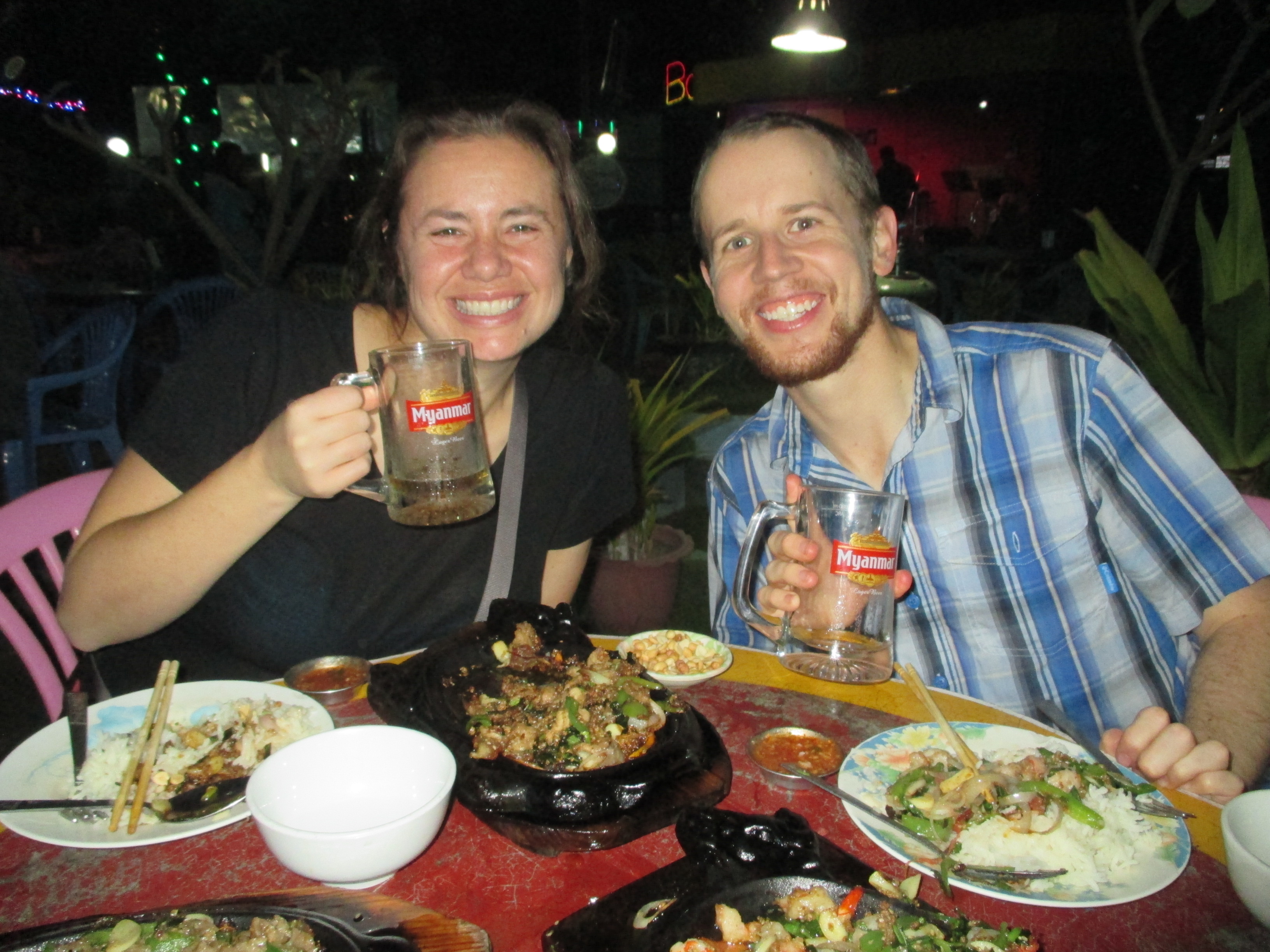
Our first night in Mandalay, we headed with some fellow travelers to Win-Win 35, a restaurant/beer station/live music venue within walking distance of Yoe Yoe Lay. Each of us got a variation of an “iron plate,” which turned out to be an iron skillet with a meat of choice sizzling on top (kind of like fajitas). It was very tasty and filling – we probably could have shared one between the two of us.

Iron plates at the Win-Win

Iron plates at the Win-Win

On our Ancient Cities day trip, our driver directed us for lunch to a restaurant near the Inwa ferry landing. It felt pretty touristy but was a nice introduction to some of the traditional dishes. Della tried some of the fried noodles, which she enjoyed. Eric ordered a chicken curry, in which the meat itself was definitely mildly spiced, but the best part was that curries traditionally come with multiple side dishes, including a sour vegetable soup, noodles, and a few different sauces plus vegetables for dipping.

Eric's curry came with a lot of side dishes

Eric’s curry came with a lot of side dishes

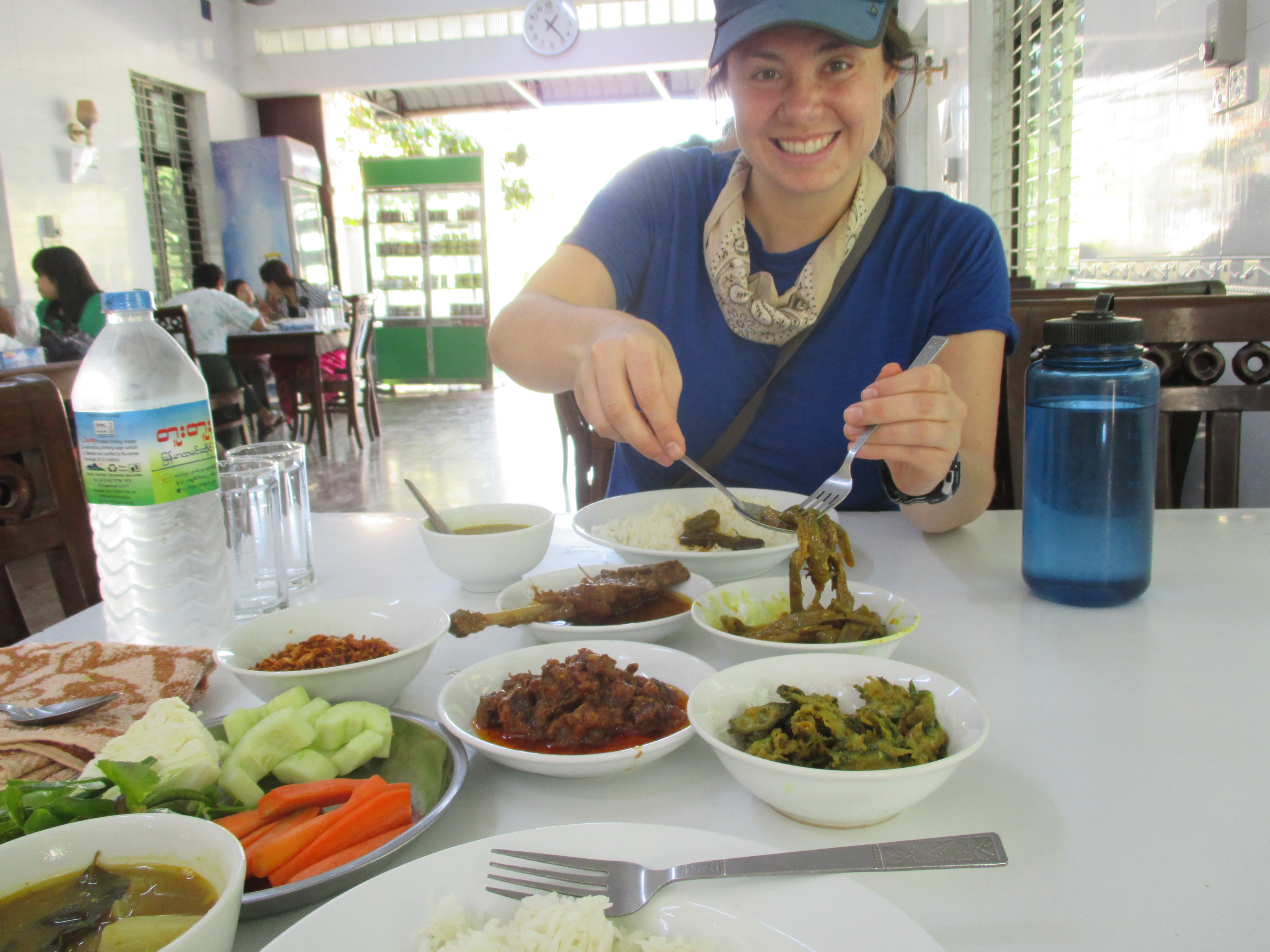
The day we rode our bikes to Mandalay Hill, we stopped for lunch at Too Too Restaurant downtown, recommended by both our guesthouse and Lonely Planet. Here we each picked a curry from a selection of trays near the front. We enjoyed eating our selected meat with the similar spread of all-you-can-eat side dishes and rice.

Lunch at Too-Too

Lunch at Too-Too

The day we returned from Pyin Oo Lwin, we ate lunch at a simple noodle house next door to Yoe Yoe Lay. We thought our noodles were great, but that may have been because “Mama” came over and made sure the cooks knew not to make them too oily (a common complaint from tourists)!

Our noodles, as supervised by Mama

Our noodles, as supervised by Mama

Final Thoughts

As it turns out, we are really glad that we started our trip in Mandalay. We enjoyed the sites that we saw, and we got to experience a great guesthouse. If this is a destination that some people think is skippable, we can’t wait to see what the rest of Myanmar has in store for us!

Packing Update: Della

We were happy to spend some time at home during the holidays in part because it gave us a chance to reevaluate what was in our packs and change some things up.

IMG_0437

This post will focus on Della’s pack. See our previous posts about packing to learn what she brought before.

Della’s bag was significantly heavier than Eric’s which always irked her. She realized that she was carrying more clothing than he was. She ultimately decided to drop several of her long sleeved items with the assumption that it would be warmer in Asia on the second part of the trip. She also dropped one of her underwear (turns out it is easy to wash in the sink as you go), but added a pair of socks (expecting sweaty feet with her new waterproof shoes), dropped one of her tank tops thinking that it was unnecessary even though it will be hot (many places in Asia require covered shoulders anyway). She also had to go on a quest for new shoes, which was not fun… But she ultimately decided on a pair of waterproof New Balance.

Della carries an Osprey Ariel 65 L pack with three sections.

Without further ado, this is what is now in Della’s pack!

In the bottom section:

  1. Our first aid kit which includes: a variety of pills for gas, diarrhea, allergy, stuffy noses, and pain. We also have special antibiotics for really bad food poisoning or diarrhea prescribed from a travel clinic before we left. We have Band-Aids, moleskin, and other bandages. We have a thermometer, and various creams and ointments: antifungal, antibacterial, etc. We also carry several pills for relief of the common cold. This all fits in a bag which we found at the thrift store!
  2. Della carries extra batteries and a charger for her camera. In addition, she has an extra memory card and a screen cleaner.
  3. Campsuds and a drain plug for doing laundry in sinks on the road.
  4. Medication for malaria

    Della's portion of Malaria pills - Doxycycline

    Della’s portion of Malaria pills – Doxycycline

  5. Extra spices for any cooking we do on the road. These were mostly purchased while abroad in Africa during the self-drive safari.
    IMG_5017
  6. Water sandals
  7. Some extra books for pleasure reading (much fewer than were carried on the first half of the trip!)

    Everything that goes in the bottom of the pack!

    Everything that goes in the bottom of the pack!

In the middle section:

  1. 6 pairs of socks (1 smartwool hiking, 2 lightweight, 3 ankle from the dollar store), 5 pairs of underwear (2 special Ex-Officio travel underwear, 1 cotton, 2 polyester blend), 4 bras (only 3 pictured) (1 normal, 1 sports bra that can double as a swim suit top, 2 stretchy comfortable bras that are relatively quick dry). All stored in a medium Eagle Creek packing cube.
  2. Sarong, towel, turbi-twist – stored in a zipper bag from Target
  3. Swimsuits – one bikini bottom, one athletic top, one swimsuit shorts – stored in a zip lock
  4. Sleeping sheet, extra laundry bags (from dollar store), extra straps/belts – stored in a zip lock
  5. Pajamas – one tank, one shorts, one pair of socks (all lightweight) – stored in a small Eagle Creek packing cube
  6. Cold Weather Gear – one Marmot rain jacket, one Mountain Hardwear jacket, leggings and long sleeve midlayer from target, a lightweight fleece from Sam’s Club. Hat, gloves, heavy socks (in a stuff sack) – stored in a large Eagle Creek packing cube
  7. General Clothing – 2 long pants, 1 zip off (Sierra Trading Post), both quick dry. Two shorts, one longer, one shorter (thrift store). 3 merino wool t-shirts (all from online). 3 tank tops, 2 with built in bras, one cotton, one Ex-Officio, one polyester. One Ex-Officio travel dress. All stored in a large Eagle Creek packing cube.
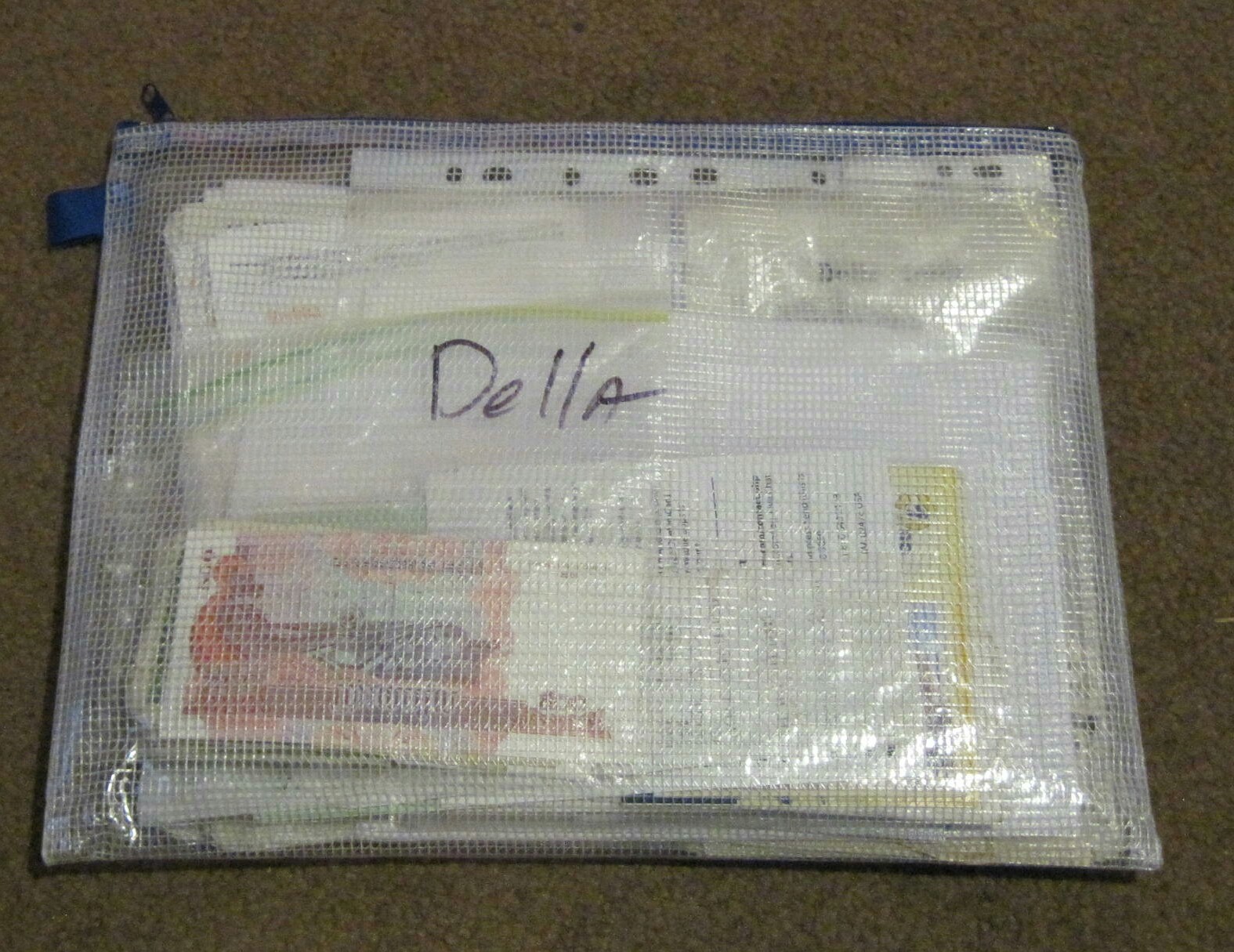
  8. Zip bag with important documents.
    IMG_5385_edt
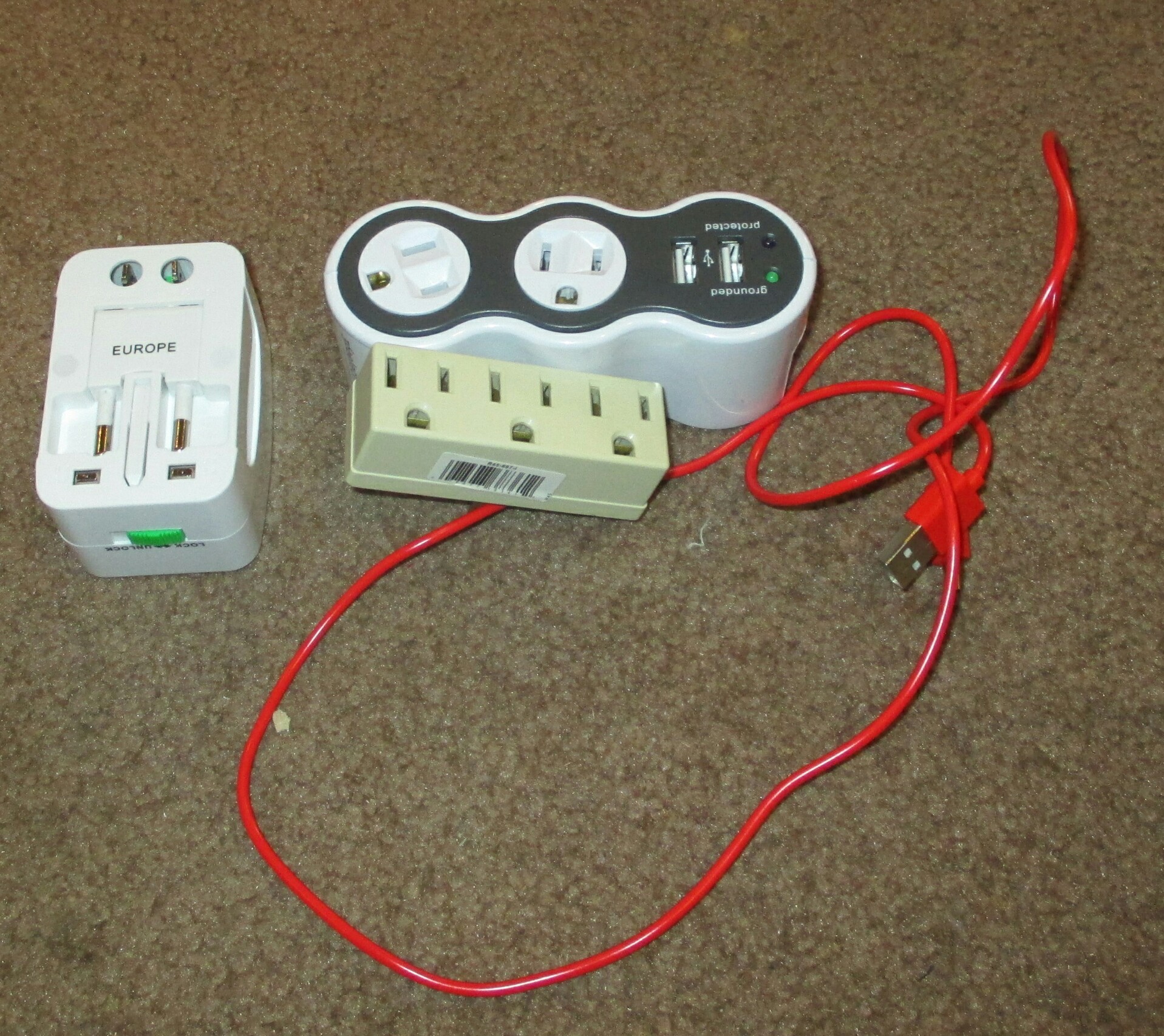
  9. Plugs: 1 all-purpose plug adaptor, 2 mini power strips (one with 2 USB connections), extra USB charging cable. All stored in a random old zipper bag that was packaging for a set of sheets.
    IMG_4011_edt
  10. Toiletry kit for everyday use: Comb, foldable brush, 2 toothbrushes, toothpaste, floss (not pictured), soap bar, shampoo bar, extra conditioner, chapsticks, tweezers, nail clippers, small swiss army knife, nail polish, extra hair tie, deodorant (not pictured) – All stored in a toiletry kit from Sierra Trading Post
    IMG_4010_edt
  11. On the outside of the bag – new purple shower shoes/slippers
    IMG_5394_edt

    Everything for the middle part of the pack!

    Everything for the middle part of the pack!

In the top section:

  1. Bag covers: 1 for rain, 1 for checking on the airplane
  2. Extra wet wipes
  3. Extra tea
  4. Extra poncho
  5. Sun hat (until it gets into the day bag)
  6. Extra rubber bands and zip lock bags- always useful on the road!
    IMG_5393_edt
  7. 1 of the 2 tupperware containers (until it moves to the day bag)
    IMG_5390_edt

    Everything that goes in the top

    Everything that goes in the top

In the day bag:

  1. General Use: Poncho, sun hat, extra toilet paper, sunglasses, extra feminine products, headphones, extra water bottle bag, extra rags, tissues, eye cover, pain medicine, wet wipes, 1 of three bandanas.
  2. Electronic bag: Nexus 7 Tablet, Tablet keyboard, USB connector, extra mini hard drives, power plug, carrying bag for tablet, stylus, and travel sim card for phone – Stored in a wet bag from Target
  3. Notebook and pencil – Stored in a bag found at thrift store
    IMG_5774
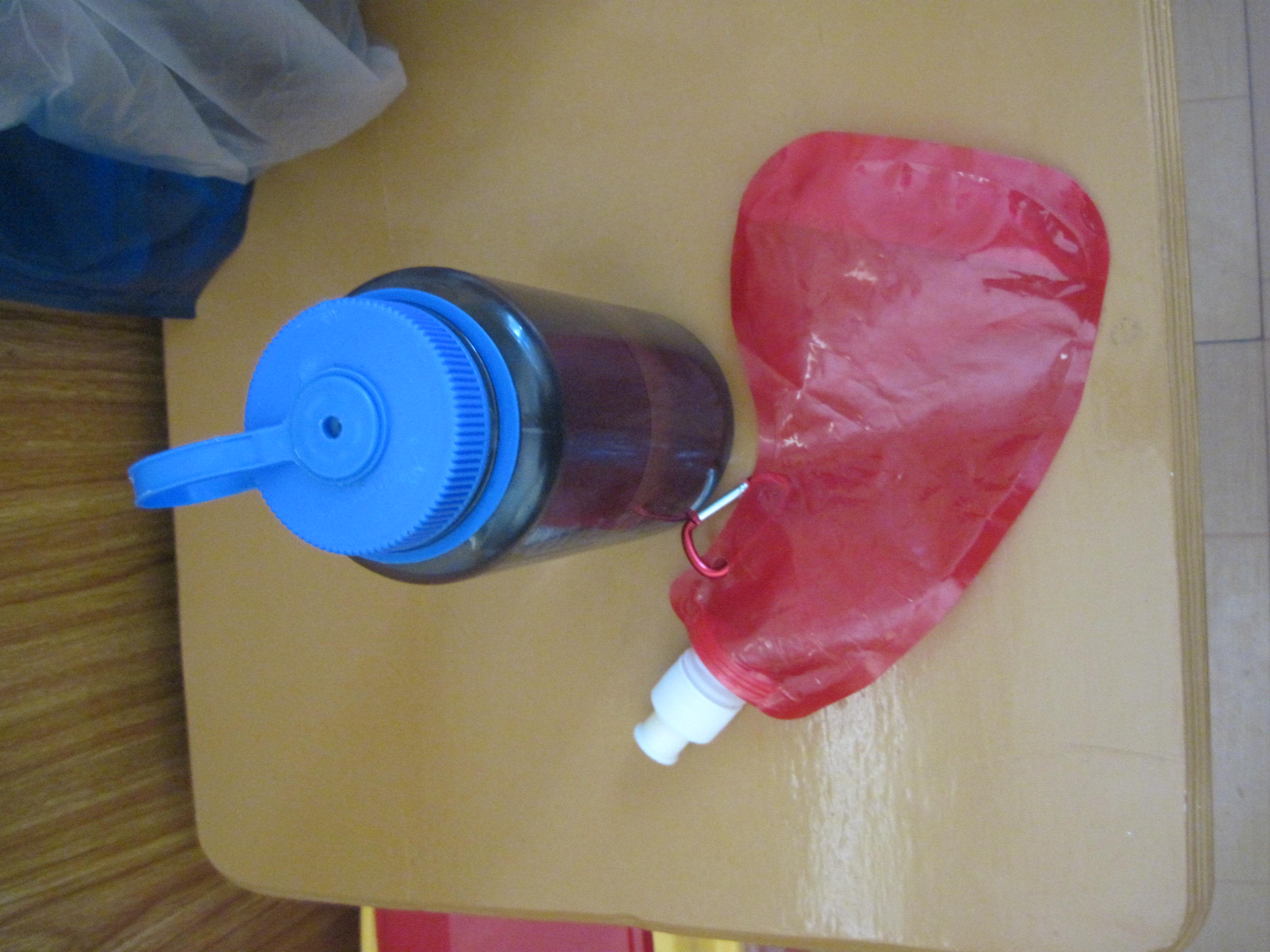
  4. Water bottles – 1 Nalgene, 1 foldable (dollar store)
    IMG_5775
  5. Extra zip lock bags

Purse:

  1. Wallet
  2. Camera/mini tripod
  3. Phone
  4. Chapstick
  5. Extra tissues, wet wipes, pain meds, feminine products
  6. Compass
  7. pen

There you have it! Everything that goes in Della’s pack! In all, the large pack weighs 29 lbs… So, not light, but lighter than it was before and much more manageable! She has the day bag in addition which adds a couple of pounds, though this varies depending on the books she is carrying as well as how many full water bottles she has!

Bangkok, Thailand Part 1

Our first stop for the second half of the trip was the capital of Thailand, Bangkok. We arrived on the evening of the 7th, and were leaving for Myanmar on the 10th, so we didn’t have much time in Bangkok. Therefore, we decided to not try and see everything we wanted to in Bangkok and instead take it easy and recover from jetlag. We know that we will be back through this Southeast Asia transport hub at least one more time.

Where We Stayed

Choosing a place to stay in such a large city is pretty overwhelming, especially when there are so many budget options. We saw good reviews for the U-Baan Guesthouse on hostelworld, and it sounded like it might be a little quieter than other places since it was in a non-tourist neighborhood. There was no double room available, but there was one with two twin beds, which is fine.

We ended up enjoying our time at the U-Baan, but didn’t really feel a connection to it. This was probably our fault though, because we never chose to hang out in the common area and interact with the other guests. The best part of the U-Baan is the owner, Joy: she was a great help with many of our needs while in Bangkok, most importantly coordinating with the airline to get our bags delivered the day after our flight.

What We Did

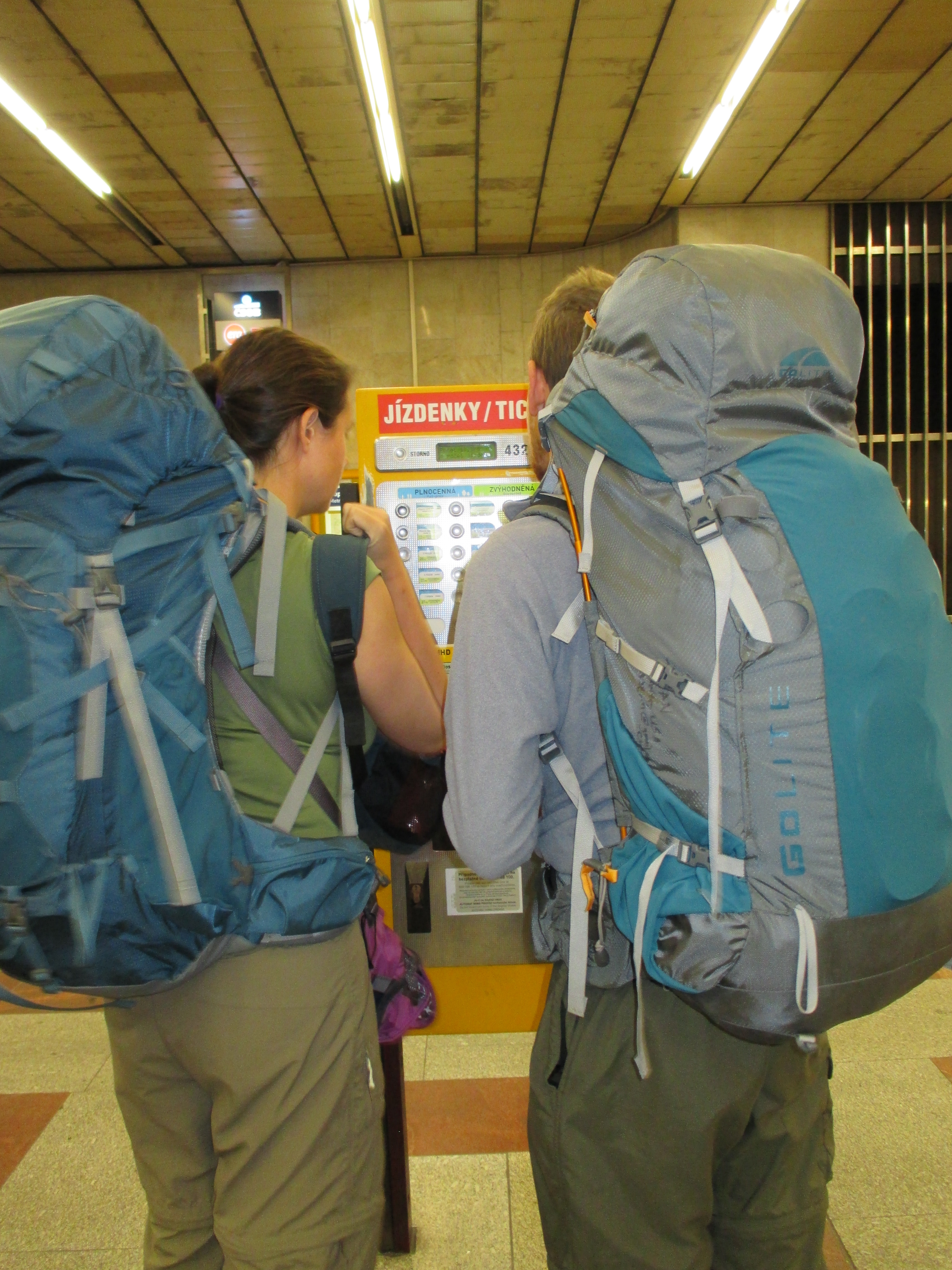
Since we had the limited amount of time in Bangkok, we chose to focus on activities that were easily reached via the Skytrain (the elevated rail system), since there was a stop near our accommodations. This meant foregoing visiting the Royal Palace and the biggest temples, but we definitely plan to see them the next time through.

Our first afternoon in town, we were still pretty tired so we just took a walk around the neighborhood surrounding the U-Baan. We walked through a small local market then headed up a big road with a vague plan to make it to the river. On the way, we saw a temple of to the side and ended up investigating. It turned out to be the Wat Phitchaya Yatikaram, a minor royal Buddhist temple. There was hardly anyone else there, so we just strolled through the grounds. We weren’t really sure of the rules for visiting yet, so we didn’t linger. This was enough for the moment so we just headed back to the guesthouse.


In the evening we rode the Skytrain downtown to check out the MBK Center, one of Bangkok’s giant malls. We thought the mall we saw on Istikal Caddesi in Istanbul was large, but this one blew it out of the water! It was seven stories tall, and each story covered a huge amount of ground. This is known more for discount options, so instead of big chain stores it is dominated by small booths selling discount clothes, electronics and other merchandise. We took a while walking a loop on each floor to get a glimpse of all that was for sale. We also visited to try out the food court, which had come recommended – see Where We Ate below.

The next day we hopped back on the Skytrain towards downtown, this time hopping off near Lumphini Park, Bangkok’s version of New York’s Central Park. We wandered through this shaded urban oasis and found a nice spot to relax and read our books for a while.

We then walked past more fancy malls and headed to the Jim Thompson House, the impressive complex of old Thai teak structures that an American expatriate put together to house his art collection. After his disappearance, it was turned into a museum. To see the interior of the main living quarters, we had to take a guided tour. The interior is quite impressive, with beautiful dark teak wood and Thompson’s art collection displayed throughout. After the guided tour we were able to wander through the other houses that made up the complex. Thompson made his fortune in the silk industry, so there were also some interesting displays on how the silk thread from the worm is turned into the fabric that is so highly prized in the garment industry.

The MBK Center was in the area, so we returned there for dinner, then headed home on the Skytrain. While in the Skytrain station, we got to see a pretty cool Thai tradition: at 6 PM, the national anthem is played over the loudspeakers. Everyone froze in place and stood at attention as the anthem played. As soon as the song was over, everyone un-froze and continued on with whatever they were doing.

Where We Ate

We were very excited about the food, since we both love Thai food and we had heard that it would be very cheap! We were not disappointed. 🙂

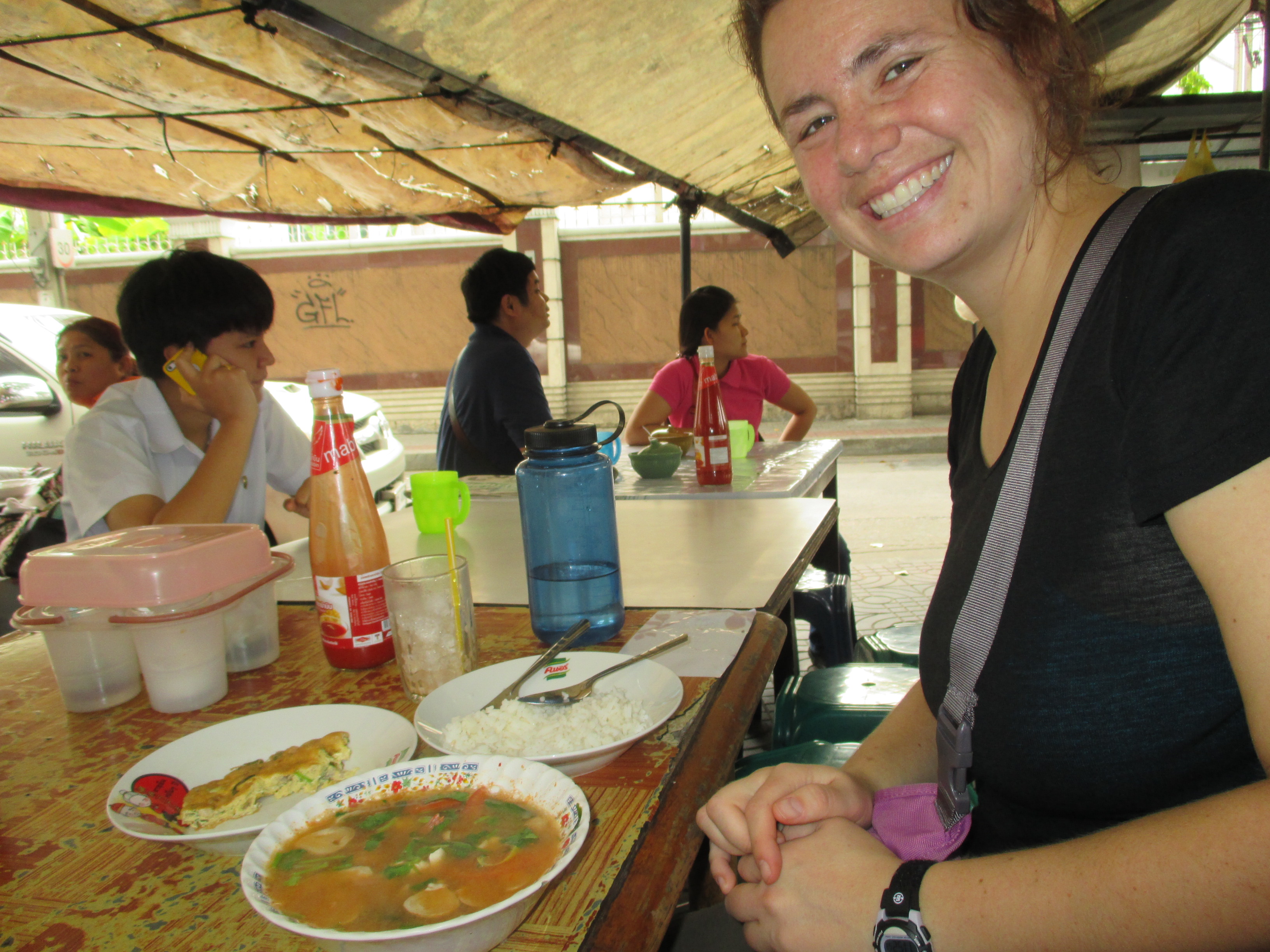
On our walk the first day, we saw a small food stand on the side of the road that seemed pretty popular with locals. We wanted to jump right into the food scene, so we grabbed a plastic seat and waited for the magic to happen. Unfortunately, the cook didn’t speak English, and our effort to gesture at what someone else had didn’t work. Luckily, a traffic cop saw this and came over and helped translate. We ended up getting a tom kha soup with meat and seafood in it. It was quite tasty, and only $2.55 (plus $0.45 for a Thai iced tea).

IMG_4040

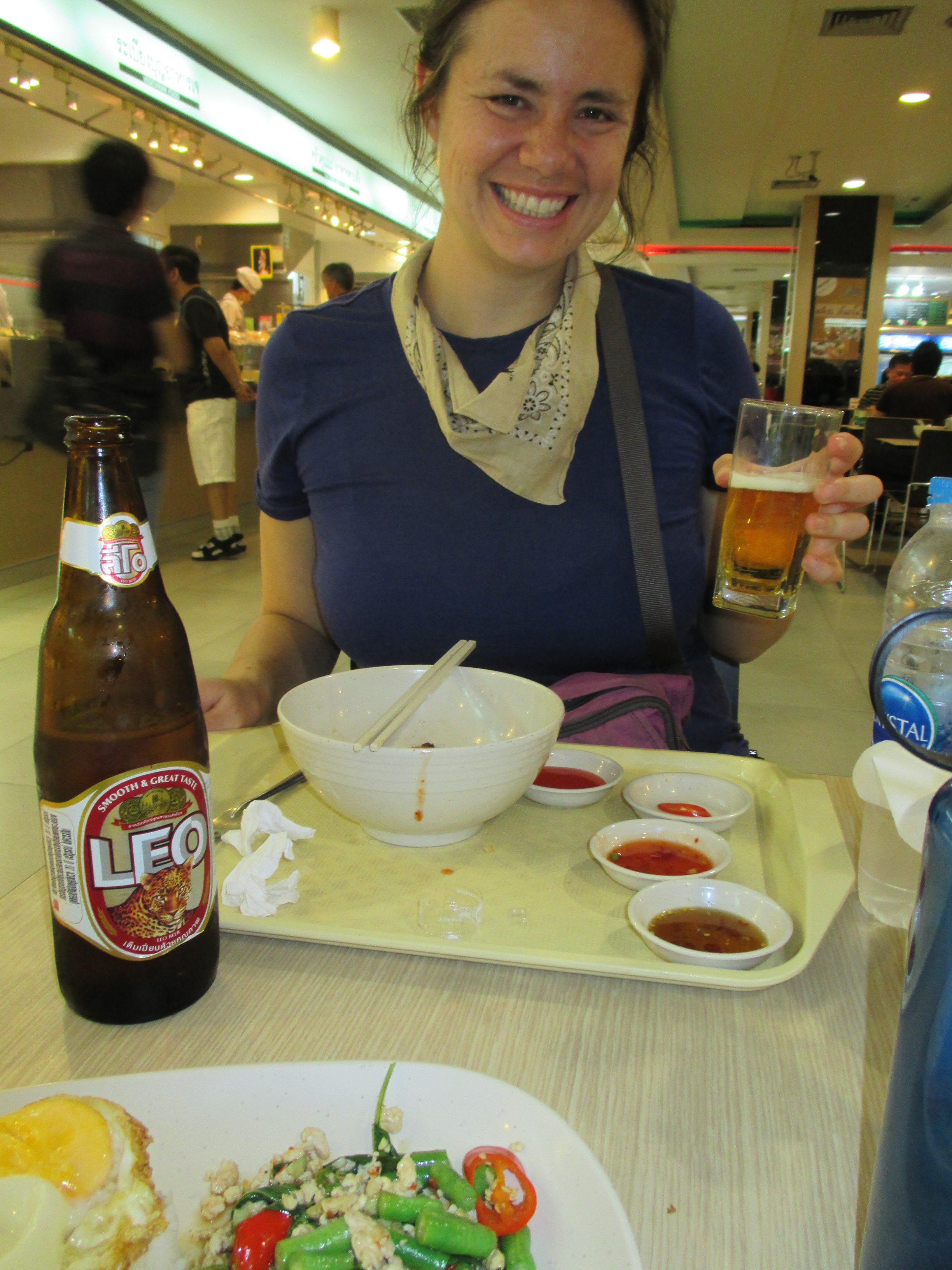
At the MBK Center, we were on the lookout for a food court where you could choose from a wide variety of international options for cheap. On the fifth floor, we saw the International Food Avenue and figured it must be it. We were given a plastic card loaded with a large value, and then you could go between different stalls and order what you wanted. They would then swipe your card for the appropriate amount. Della found a pad see eew (her favorite Thai dish) and Eric got a red curry with duck. The total with two beers worked out to be close to $20, so still cheap by American standards but not as cheap as we were expecting. Right after eating, we went up to the next floor and found a different food court that was almost half the cost, so we then realized we had ended up at the wrong place!

So, the next day, after visiting the Jim Thompson House, we returned to the MBK Center and ate dinner at the food court on the sixth floor. Here you also got a card to swipe at different stalls, but it was definitely less fancy but cheaper. Here Della got a fried noodle dish and Eric got a fried rice dish. The total with a beer was only $8.40, which was more in line with our cheap expectations!

Whoops, almost finished before we even take the picture!

Whoops, almost finished before we even take the picture!


Flashback Friday: Philadelphia, PA

Flashback Friday is a picture series where we “flashback” to some of our memories – from either from our prior travel or from home. We hope you’ll enjoy some of our remembrances! 

We enjoyed a quick layover in our old stomping grounds in the eastern USA in the Philly airport. It made us remember lots of good trips to Philadelphia when we lived in Delaware!

Philly sometimes gets a bad rep, but we really enjoyed our visits to downtown. It is a great place to be inspired by our nation’s history at Independence Hall or to see some great sporting events or dance performances.

September08 017

Home for the Holidays in Denver!

We managed to split the Christmas holiday, flying to Denver on Christmas day. We had a wonderful time celebrating with family and friends in Denver.

We enjoyed a Christmas dinner with family,

Experienced a white Christmas,

Took a snowy trip up the mountain to visit our cabin,


caught up with friends old and new (really sad that somehow we didn’t manage to get any pictures from friends from school… boo!),

celebrated the new year in our traditional style,

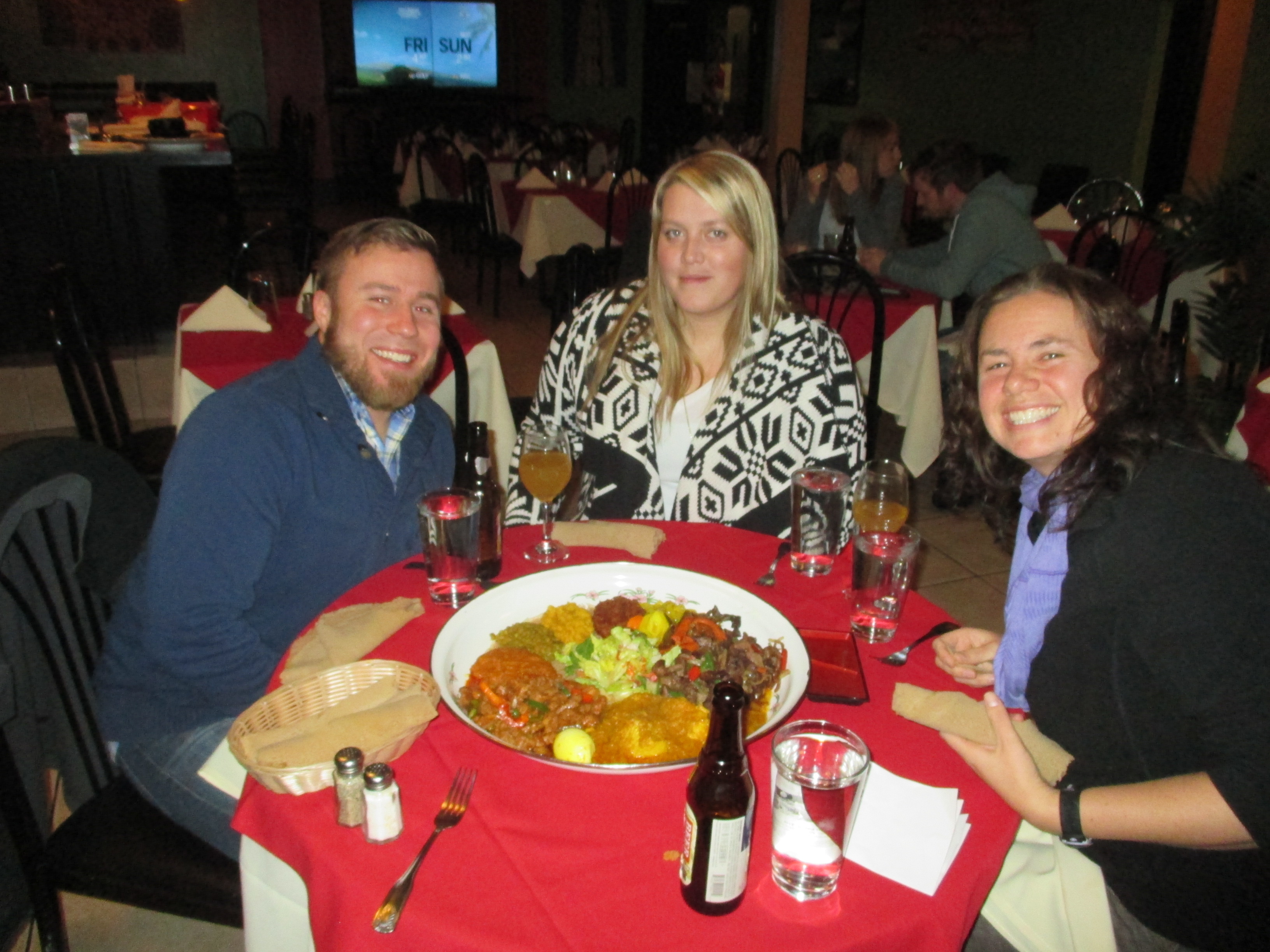
ate Ethiopian food,

IMG_3984

celebrated a special birthday,

looked at pictures from a RTW that helped inspire our own (see more in an upcoming post),

and reevaluated and repacked our bags (see upcoming posts!)

It was so nice to see everyone and enjoy some of our favorite things from home!

Small Comforts: Our Own Bags and Soap

As we mentioned in our post about getting from Denver to Bangkok, we had a tight connection in Beijing. Fortunately, we made the connection… Unfortunately our bags did not.

We always keep a small bag of toiletries with us in carry on for plane use, but this mostly consists of toothbrushes and lotion. We were very thankful to have that for our first night in Bangkok!

Thai Airways promised us that they would deliver our bags the following day, and lucky for us, they did. Our bags arrived about 5pm the day after we did. It seemed like a smooth process, but we had help from our hostel owner who had dealt with this before…

IMG_5425

When we received our bags!!


It is so nice to have access to soap again! Especially in a sticky, humid environment!

image

How We Got to Bangkok for $264

After taking our break in the US around the holidays, we needed to book a new ticket to get back out on the road. We decided to fly to Bangkok as our next stop. This ticket turned out to be the most complicated one that we’ve booked so far, and the flight experience the most grueling.

Booking the Ticket

We have miles in a variety of places, so we started off by just seeing what the easiest way to get to Bangkok from Denver would be. It became pretty clear early on that flying on Star Alliance would be easier because Thai Airways is a member.

United Airlines is a member of Star Alliance, so our first idea was to book the flight using United miles. However, Eric then realized that he was only 1,000 miles short of what he needed to book his ticket. He could have gotten the miles from someone else, but the fee associated irked him.

We then had a flash of insight and looked into using American Express Membership Rewards points. These are points that we earned from each having one of the American Express Gold cards. The key idea to understand with these points is that they can be transferred to a number of different airlines where they become miles in that airline’s frequent flier program.

However, we had an issue… Eric couldn’t transfer his points. He had downgraded his Gold card to a Blue card before we left for the trip last summer. This allowed him to keep the points, but he didn’t realize that it also meant that they were no longer transferrable. Apparently American Express has a Membership Rewards Express program that uses the same points but just with less benefits – and the Blue cards fall into this category. He was perplexed at what to do.

Della on the other hand had downgraded to the American Express Everyday card, and she was still able to transfer points. So, Eric decided to also apply for the Everyday card and see what happened. Amazingly, after he got the card he was immediately again able to transfer points!

So, with transferrable points in hand, we had to figure out what to do with them. United Airlines is not a Membership Rewards transfer option, so we had to get more creative. We remembered that Air Canada is a Star Alliance member and a transfer partner, so we looked into their Aeroplan program.

The search tool on the Aeroplan site is easy to use, and we were able to find a series of flights on United and Thai Airlines that could be booked with Aeroplan miles (since they are in Star Alliance with Air Canada). So, we transferred the required amount of points to Aeroplan and booked the ticket!

BKKFlight

The main downsides of the ticket were that it left Denver so early, and the tight connection in Beijing. But we figured that would be fine….

Flying to Bangkok

We got up at 3 AM in Denver on January 6, and Della’s parents graciously drove us to the Stapleton Park and Ride to catch the bus to the airport. The first flight to Chicago was uneventful and on time.

Given that we were worried about our Beijing connection, we crossed our fingers that the flight from Chicago to Beijing would run smoothly. It was listed as an on time departure and we boarded on time, but as we kept sitting at the gate we worried that something was wrong. Finally the pilot got on and explained that the loading of cargo had been delayed, but was about to wrap up. But then we still sat at the gate… Then the pilot came back on and said that we were waiting for a new ground crew to push us back. It was so cold in Chicago that they had special rules in place to limit the time people spent outside, and the first crew had exceeded that limit.

We ended up leaving almost an hour and a half later than the scheduled time. It seemed like we might make up a little time, but we spent the whole 13 hour flight worrying about what would happen when we land.

We arrived in Beijing at 4:30, meaning we had just half an hour to catch our flight. People on the plane were not very understanding about helping those of us with tight connections, so we had to fight our way through them to get off the plane. Even though our bodies were pretty stiff from sitting for so long, we ran through the terminal to get to the gate.

We were slowed down a bit by having to do an immigration check for international transfers (not sure why they needed to give our passport a China stamp…) and an additional security check, although luckily in both places fellow travelers let us through when they heard our situation. We made it to the gate with only a few minutes to spare, but plenty of people were still in line to board so we were finally able to relax! We heard that five other people missed the flight, so we were pretty proud of ourselves for making it.

IMG_4024

We made it!


Our 4.5 hour flight to Bangkok was thankfully stress-free. After the bare bones service on United, the service on Thai Airways was very impressive (free hard liquor on the drink cart and personal in-seat entertainment consoles).

We were happy to have made it to Bangkok as originally scheduled, but not surprised to hear that our bags did not make the tight connection. The Thai Airways luggage staff made arrangements for our bags to make the first flight from Beijing the next day and then be delivered to us. We headed to our guesthouse, where we crashed after over 24 hours of travel!