Flashback Friday: Leaving on our World Trip

Flashback Friday is a picture series where we “flashback” to some of our memories – from either from our prior travel or from home. We hope you’ll enjoy some of our remembrances!

Well – So, it’s not Friday… But, still, we thought this was a flashback worth having. One year ago today, we left Denver on one of the biggest adventures of our lives. We packed up super early and headed to the airport both excited about and terrified of what awaited us. Looking back, we feel so much pride in what we managed to do in this last year. For the most part, it was a collection of fantastic memories: one amazing experience after another. We’re already hoping and planning we can another trip like this again someday!

Look at our fresh (also tired because it was way too early in the morning) faces: ready for adventure! Here we come, World!

10420788_966585597581_7913711058980940808_n

Goodbye at the airport

Goodbye at the airport

Ready for some Globe Gazing... also ready to adjust our packs

Ready for some Globe Gazing… also ready to adjust our packs


Budget: Vietnam

This is one of our Budget series of posts to give you an idea of how much we spent traveling around the world. Here we will look at Vietnam. Check our posts to see what kind of activities we did and where we stayed!

In Vietnam we used the Vietnamese Dong. We converted to US dollars using the current conversion rates at the time of our visit. It was approximately 20,000 Dong to $1.00.

IMG_9513_edt

Total Spent (20 days): $1324.30

Accommodation: $327.40

We stayed in mostly small hotels and guesthouses. We stayed in one dorm room in Phong Nha.

Activities: $306.80

This included all museum entrance fees. Amazingly, it also included four day tours: Cu Chi Tunnels, My Son, kayaking in Cat Ba, and the most expensive: a cave tour in Phong Nha.

Alcohol: $6.80

We only count alcohol costs when it is not purchased with other food. However, beer is amazingly cheap in Vietnam. This price includes 6 separate instances of buying alcohol (for two).

Food: $259.61

Food is delicious and affordable in Vietnam! Many of our accommodations also included free breakfast!

Miscellaneous: $47.98

This was mostly laundry and sending postcards. We also purchased new sunscreen which was a little expensive. We bought a few souvenirs which we were able to send home with Della’s parents.

Transportation: $257.72

We did quite a bit of moving around in Vietnam. This included buses, an overnight train, air flights, cabs, airport pick ups, and some bike rentals!

Visas: $118

Visas are a bit complicated for Vietnam. First you have to gain an approval letter which you must do before you arrive in the country. There are a couple of options for how to get the approval. We used a website called Hotels in Vietnam. It was a pretty, easy but somewhat expensive and time consuming process. We applied for the letter on the 14th of the month and didn’t get it electronically  until the 17th. Once you have the letter, you print it out and take it with you. When you arrive in Vietnam, you must have the letter and passport photos and you must pay another fee. Even though we did everything right, it still took close to half an hour to get the visas processed in the Saigon airport.

This divides out to $66.22/day which is under $100/day budget! Now that’s what we were hoping for in Asia! We even felt like we splurged on activities and accommodations, and we were able to remain this low, so it just goes to show that Vietnam can be an inexpensive place to travel.


Cruising the Karsts Around Cat Ba, Vietnam

We’re going to switch the blog back to talking about some of our other travels on our round-the-world trip, but are hearts are still with Nepal. If you’d like to contribute to help the people of Nepal recover from the devastating earthquake, please visit our page collecting some worthy causes.

One of the biggest tourist draws in all of Vietnam is the scenic UNESCO World Heritage-listed Halong Bay on the coast east of Hanoi. We considered a visit there, but when researching came across many stories of how scam-prone it was to take a trip on the bay. We then found out about the neighboring Lan Ha Bay, which also has the characteristic karsts but is further away, so less infiltrated by large tour groups. Another benefit of Lan Ha Bay is that it easily visited as a day trip from the sizable town of Cat Ba, on large Cat Ba Island. This sounded like a better fit for us, so after our time in Hanoi we took a two day trip out there.

Getting There

Based on the advice from Lonely Planet and our Hanoi hotel, we booked a multi-step trip from Hanoi to Cat Ba town using the one company that offers this service – Hoang Long transport. It was a long and somewhat grueling process, but we did make it to Cat Ba as promised with no last minute fees, so we felt it was worth it. The steps were:

  • Taxi from our hotel in Hanoi to the bus station
  • Bus from Hanoi to the Hoang Long office in Haiphong. This bus left earlier than the ticket stated, but went somewhat slow as it would pick up and drop off people anywhere along the road. It was a bit of a strange ride too, because for the first half of the journey they looped a show of old-time Vietnamese music performances about four times over, then for the second half they switched to videos that showed scantily-clad women dancing to pop music.
  • After a wait at the Hoang Long office, a different bus from the office to a ferry terminal on the coast
  • A 30 minute or so ferry ride across a channel to another ferry terminal on Cat Ba Island
  • A bus ride from the ferry terminal to the Hoang Long office in Cat Ba town
  • Walk from the office to our hotel

Where We Stayed

Cat Ba is a big tourist draw, especially in the summer, so there are plenty of big hotels right on the water. We chose the Gieng Ngoc, which was on the somewhat quieter end of the main road. Both the two of us and Wayne and Peggy (Della’s parents) went for a small upgrade to get a room with a balcony overlooking the water. Our room itself felt a little dated, but the view was quite nice, so we were glad we made that decision.

What We Did

As you might expect, one of the big draws of visiting Cat Ba is taking a tour out into Lan Ha Bay, so our first order of business after getting checked in and grabbing some lunch was to go around town and find a tour for the next day. A few different offices on the main drag offered some decent-sounding tours with both snorkeling and kayaking, but we kept looking because we were hoping to find something that was more oriented to just kayaking. We found just such a tour at Asia Outdoors. Their main focus is rock climbing, but they also offer full-day kayaking tours. We booked one of these for the next day, then asked them for guidance on what to do with the rest of our afternoon.

They recommended that we walk out to the beaches just outside of town. The first beach was just an easy 20-minute walk away.


Wayne is never one to turn down a swim, so he got into his suit and dove right in. The rest of us decided it was a little too chilly, so we just relaxed and watched the groups of Vietnamese teenagers frolic in the surf (maybe they had just graduated like the groups we saw in Hanoi?). Some of them were even playing in organized team activities that we had fun trying to figure out (future Rendezvous games ideas?).

To get to the second beach we took the nice pedestrian path along a cliff face. This gave us an excellent view of the karsts of the bay that we would be kayaking through the next day.

At the second beach Wayne hopped right back in the water.

From the second beach there was a road that led back into town, making for a nice loop. We walked back in and then headed out for dinner (more on that later). After dinner, we enjoyed just walking down the main drag. The teenagers were out in groups and seemingly having a lot of fun. One of the most popular activities was to rent a tandem bicycle and ride up and down the street.

The next day, we woke up bright and early and headed over to the Asia Outdoors office. They rounded up the group of kayakers and rock climbers, then shuffled us into vans for a short trip over to a small harbor. Here we got on the traditional junk boat that was our transportation for the day.

It was a nice large boat with tables and benches downstairs and a platform upstairs. For the first part of the ride, we stayed downstairs and enjoyed the view as we cruised out into Lan Ha Bay. The boat dropped off the people that were going rock climbing, and then we moved up to the top. The boat had to stop at a depot to pick up our kayaks, and then drove us to our first spot.

We got into our kayaks, which were two-person set-ups made up heavy fiberglass. You sat down inside, but no net or anything like that. Della took the back seat. After the group was all in their boats, our guide led us on a tour of the different spots. We kayaked through a hole in a karst, then around some others.

We headed to a place where at high tide you can go in to an isolated lagoon. This is very low tide though, so we had to park a ways a way and walk in over the muddy ground and sharp rocks. It was pretty inside but not too much to see.

Our next stop was a beach, where there was a small cave with a shrine inside. We also tried to help a giant jellyfish that was near the shore get back out in the open water.

We rode into one cave, where we were able to get pretty deep since the tide was so low. We went around another karst, through another opening, and then headed back to the boat. In the distance we could see a karst with a hole underneath that the guide said was on one of the Vietnamese dong notes, but we later couldn’t find it.

Back on the boat, we rode back to pick up the climbers. On the ride over we got to talking with some of the people on the tour, and they were very easy to talk to. During this ride our lunch was ready, so we headed down to the cabin area. It was a variety of Vietnamese dishes served family-style, and all very good. We were stuffed! There was also a pause when we let some overnight guests off, and Wayne and Della took the opportunity to jump in for a quick swim.

The boat drove us back to the kayak depot, where we got out for our second round of kayaking. This was with a larger group since some of the climbers came. This time Eric got in the back.

This trip wasn’t quite as scenic but was still nice. We were led past floating villages, where fisherman live on the water and have large setups to grow fish and to catch squid. We went into a large interior cove of one karst. Della got out and swam here, but didn’t linger long because we had seen a few of the large jellyfish. We road back around through some more karsts and past a sunken concrete boat. Wayne wanted to go out to the open ocean, but no one else did so he didn’t.

We kayaked back to the depot and returned our kayaks. Once everyone was onboard, the boat headed back to harbor. We enjoyed the views of the bay in dwindling sunlight. Peggy stuck up a conversation with a group of New Yorkers who had gotten on at the depot – as it turned out, one of them was the founder of Asia Outdoors, so it was interesting to hear his stories.

The minivans took us back to Cat Ba town, and we rushed to make sure and get good shots of the sunset from the boardwalk and then the rooftop terrace of our hotel. A long day, but a fun one. We couldn’t have asked for better weather, and the amount of kayaking seemed to be just right!

The next morning, the two of us just hung out in the room and caught up on the blog, but Wayne and Peggy still had a bit of a sightseeing itch. They hopped on the back of motorbike taxis and took a ride up the hill behind town to the Cannon Fort situated on top. From here they had great panoramic views of the island and the bay beyond. There were also a few exhibits from the fort’s use during the French and American wars.

Where We Ate

As we said, Cat Ba is definitely a tourist town, so there are plenty of places to eat along the main drag, all with about the same menu. It was still early April when we visited though, so some had not yet opened for the season. We tried three different places that were open, and none particularly stood out. They all had seafood dishes which Wayne was interested to sample. Della isn’t as much of a fan of seafood, but was able to find dishes like curries to satisfy her.

On the first night, it was Eric’s birthday, so we also went out in search of “fresh beer,” the very cheap local beer that has been recently brewed (that we first tried in Hoi An). It was a bit of a scavenger hunt, but we finally found one place and enjoyed a couple of glasses.

Getting Away

From Cat Ba, we wanted to get back to Hanoi, and again the recommended way was to book a combination ticket through Hoang Long. We took the 1:30 bus back to the ferry port on Cat Ba island, then the ferry back across to the mainland.

From here our journey changed from what we were expecting. While we were on the ferry, a guy who we didn’t recognize said that the four of us should follow him once we got off. We were a little skeptical, but a big group followed him so we went to investigate. As it turned out, they were a tour group coming back from a multi-day trip and headed back to Hanoi, and the guy we were following was their guide. There were a few empty spots on their minibus transport back, so some arrangement had been made for us to get on that. This saved us from having to transfer to a different bus in Haiphong.

While on this bus, we did witness some of the rudeness that we had been warned to expect in northern Vietnam. Another couple had also gotten on the minibus, seemingly with the same permission from the guide. After a break at a rest stop though, the guide came to the back where they were sitting and stared at them hard for a minute, then asked to see their ticket. They showed it to him, and he accused them of getting on the wrong bus at the rest stop! They protested, and the rest of us backed up their claim that they had been on since the ferry. The guide wasn’t satisfied, and flagged down a passing Hoang Long bus on the highway. Both our bus and that bus pulled over, and the guide tried to get the Hoang Long bus to take this couple. But that bus didn’t like their ticket either, so they had to get back on the minibus. The guide threw his hat down in disgust and sulked the rest of the journey home.

Final Thoughts

We really enjoyed our time on Cat Ba. It helped that we found a tour that met our desire to kayak so well, and that there was such great weather to allow us to really appreciate the scenery of the karsts. At least for us, choosing to stay on Cat Ba and do a day trip to Lan Ha Bay over cruising into Halong Bay turned out to be the right decision.

Hanoi, Vietnam

We’re going to switch the blog back to talking about some of our other travels on our round-the-world trip, but are hearts are still with Nepal. If you’d like to contribute to help the people of Nepal recover from the devastating earthquake, please visit our page collecting some worthy causes.

After our trip to the caves of Phong Nha in Vietnam, we headed to the capital and center of the northern part of the country, Hanoi. Here we met up with Wayne and Peggy (Della’s parents) once again, and spent three days exploring the sights. Hanoi has an extensive history: founded in 1010, served as the imperial capital until it shifted to Hue in 1802, the capital of North Vietnam, and now the capital of the unified Vietnam.

We had heard mixed reports about the city, with many people saying that the people were unfriendlier than those in Saigon, and that the narrow streets were unsafe to navigate with crazy motorbikes flying around. Also, we wondered how Americans would be received in northern Vietnam, where for so long we had been the enemy. So, we were a little anxious to visit and see how the city would strike us.

Getting There

We ended up using airline points to book a cheap flight from the Phong Nha area directly to Hanoi. The flight was a first for us in that it was on a propeller plane. This made us a little nervous, but it all went smoothly. The flight was so quick that we only got served water!

IMG_0185

The Hanoi airport is pretty far out of town, so once we landed we still had a bit of a journey to get into town. There isn’t an easy way to do this, so we booked a private transfer through our hotel.

After we left the baggage claim area, we were a little perturbed that no one was waiting for us with our name on a sign as we had been promised. We stood around for a minute and finally a guy showed up fumbling the sign. He was also messing with his phone and eventually motioned to us to sit while he made some calls. We were pretty confused. Our inquiries were not really answered as he didn’t speak English very well.

Eventually he led us outside and out to the parking area… where we got on a medium-sized bus! We were now very confused since we thought we would be riding in a car. Our “handler” left and went back towards the terminal, leaving us with the bus driver who also didn’t speak much English. The bus then exited the parking area… and went to the international terminal. More confusion. We waited in the pickup area for 10 minutes or so, but no one ever got on. Security eventually motioned to him to leave. He made some phone calls, then exited and drove out to the city.

Confused on our private bus from the Hanoi airport

Confused on our private bus from the Hanoi airport

The drive in took almost an hour. We were nervous, but the bus did indeed drop us off right in front of our hotel.

Where We Stayed

We stayed in the Golden Time Hostel 2 (there are three locations in Hanoi), which was more like a hotel despite its name. Probably the best part about the Golden Time was the friendly staff that work at the front desk. Tony and Ahn, a married couple, always greeted us by name and with a smile. There was always coffee, tea and bananas set out all the time as well, which was refreshing after a long day of sightseeing. The included breakfast had a good selection as well. The rooms were nice and spacious, so we slept well. The location was close to the main tourist attractions but not right in the center of the hubbub.The only downside in our opinion was that the bathroom was a bit strange, because the shower drain was in a tub, and the shower curtain didn’t really surround the tub, so it was easy to get water all over the floor where it wouldn’t drain.

Posing with Ahn, the friendly proprietor at Golden Time Hostel 2

Posing with Ahn, the friendly proprietor at Golden Time Hostel 2

What We Did

Sightseeing in Hanoi was refreshing just because we finally had relief from the heat! It was a little overcast with occasional light rain, but after weeks of sweltering temperatures we didn’t mind too much.

Hoan Kiem Lake and Ngoc Son Temple – This lake in the center of town is pleasant to walk around and a hub of many of the city’s activities. Our hotel was just a block away so we walked by almost every day. There is a legend associated with the lake which states that the Emperor Le Thai To returned a magical sword to a giant turtle that lives in the lake, giving it its name (the English translation is “Lake of the Returned Sword”). A red bridge goes out to the temple on an island in the lake, which contains a stuffed carcass of one of the turtles that still live in the lake. In the mornings you can find local residents doing all sorts of aerobic activities.

Old Quarter – We spent a day just wandering through the maze of narrow streets in the Old Quarter. This is the historic commercial area of the city, and is still buzzing with all sorts of commerce. Interestingly, many of the streets are named after the type of item that was traditionally sold on the street, and in many cases is still sold there today. We especially enjoyed Bamboo Ladder Street and Votive Paper Street. There was also a historic merchant’s home that we visited to get a sense of how the buildings used to look.

Ho Chi Minh Mausoleum and Museum – We had read in advance that the mausoleum housing the preserved body of the national hero Ho Chi Minh (the leader of Vietnamese Communist revolution and first President after independence – their version of George Washington) had limited visiting hours, so we made sure to head over on a morning that it was open. It was more than a quick walk away, and we thought we would save money and hassle by just taking a local bus that Google Maps said would drop us off right in front. But, as we followed the progress of the bus, it took one turn that took it away from the mausoleum, then kept going in that direction. After we passed a giant intersection, we figured we had to get off before we got even further away. We then walked a little bit to get back through the giant intersection and back towards the complex. We hailed a cab, nervous that we would get scammed, but it turned out to be a quick and cheap ride. We never quite figured out why we were on the wrong bus.  We saw the same bus (with the same bus number) later that day near the mausoleum…

There were something like eight roads converging at this circle

There were something like eight roads converging at this circle

The guidebook had warned that the mausoleum was popular, so we weren’t surprised to see a large line going into it. We headed around the side of the complex to find the entry point to the amusement park-style line corrals, and kept going… and going… The line had spilled out of a security checkpoint and across the street. We figured that it would take hours to get through the line, and the mausoleum closed in two hours anyway, so we decided that we would not be able to visit after all.

Instead, we went to the Ho Chi Minh Museum which is in the same complex. It told the story of Ho Chi Minh from childhood through the revolution, but also had some random modern art interpretations of the ideas underlying the Communist revolution, so the overall experience was a little confusing, but quite interesting.

Also in the same complex is the One Pillar Pagoda, which as its name implies, is a temple on top of one pillar, built in 1049 by Emperor Ly Thai Tong. After a brief visit there, we walked to the mausoleum, which was closed for the day. We did get to see a changing of the guards, which was interesting to contrast with the one in Athens. We walked past the current Presidential Palace and tried to make our way to Ho Chi Minh’s Stilt House, but ended up lost in a neighborhood and had to give up.

Imperial Citadel – The complex served as the center of the Vietnamese Empire’s military when the capital was in Hue. Much of it has been lost to the ages (and destroyed by the French), and there are still many archaeological excavations uncovering the site. Some bunkers were also built here during the modern war as command centers for the Northern Vietnam army, and were preserved as they were then. We weren’t expecting to spend much time here, but there turned out to be quite a few things to see so we spent almost a whole afternoon. We also enjoyed the extensive bonsai collection as well as high school graduates posing for pictures in traditional outfits.

Temple of Literature – There were also plenty of graduates posing for pictures in the scenic pavilions and courtyards that make up this temple. Fitting, because it was established in 1070 to honor scholars, and dedicated to Confucius, the famous Chinese philosopher. It also served as a university, and you can still see stelae that list those who received doctoral degrees.

Hoa Lo Prison Museum – The small sliver that remains of an old prison built by the French has now been turned into a museum describing its former use. The majority of the exhibits were dedicated to its use by the French to hold and execute Vietnamese political prisoners. There were two small rooms describing its role as a jail for American prisoners of war during the Vietnam war (when they gave it the nickname the “Hanoi Hilton”). The most famous resident was probably John McCain.

Vietnamese Women’s Museum – This modern museum describes the role of women in the culture and history of Vietnam. Special attention was paid to women during the Vietnam War, where they were involved both on the home front as well as on the front lines. The cultural aspects felt a lot like many of the other ethnographic museums we had visited, in that it described the various traditions and clothing (involving women) of the many ethnic groups that make up Vietnam.

Water Puppet Show – We took in one of the performances of this unique art form that started in the rice paddies of North Vietnam. This puppet show uses water as the stage for many small vignettes using different puppets, accompanied by a small traditional orchestra. We were fascinated the whole time by the spectacle.

54 Traditions Gallery – Wayne and Peggy know one of the founders of this neat collection of artifacts from the different cultures found in Vietnam (the name comes from the fact that there are 54 different cultures!). Their friend Mark gave us a nice tour of their collection, where we feel like we barely scratched the surface of all of the interesting stories associated with the items. Wayne and Peggy purchased a nice artifact that was once part of an altar in a temple.

Street Hair Cut – Wayne needed a trim, so he went just down the street from the hotel to a barber set up on the street. He got a nice cut for a very good price, and a good story to tell!

Zumba Class – See the separate post.

Where We Ate

Hanoi is known as one of the best places to get some Vietnamese street food, and we didn’t delay testing this out. We had our first lunch at a little place right outside the hotel. Most places just set up little plastic tables and chairs – think what you would use at a kid’s tea party. We crouched down into these chairs and ordered their main dish, bun cha, which is sweetly-marinated grilled pork served with a broth over vermicelli noodles. We also had Hanoi-style spring rolls, meaning they are fried (we decided we preferred the fresh ones to fried).

IMG_7067

Hanoi also has plenty of small sit-down restaurants in the area of the Old Quarter, and we visited a few. The first night we went to Minh Thuy’s in the main backpacker area. Eric and Peggy got the specialty called xoi xeo, which was a yellow sticky rice.

IMG_7090

On the night of the water puppet show, we needed a place to eat quickly, so Tony at the hotel recommended New Day, which turned out to be a great call. We were worried that there was no seating, but they found a place to squeeze us in. For food, we were able to select a bunch of premade dishes from cafeteria-style trays and get them brought to our table promptly. It was all very tasty, so much so that we went back on our last night in town (but that time ordered from a menu).

IMG_7158

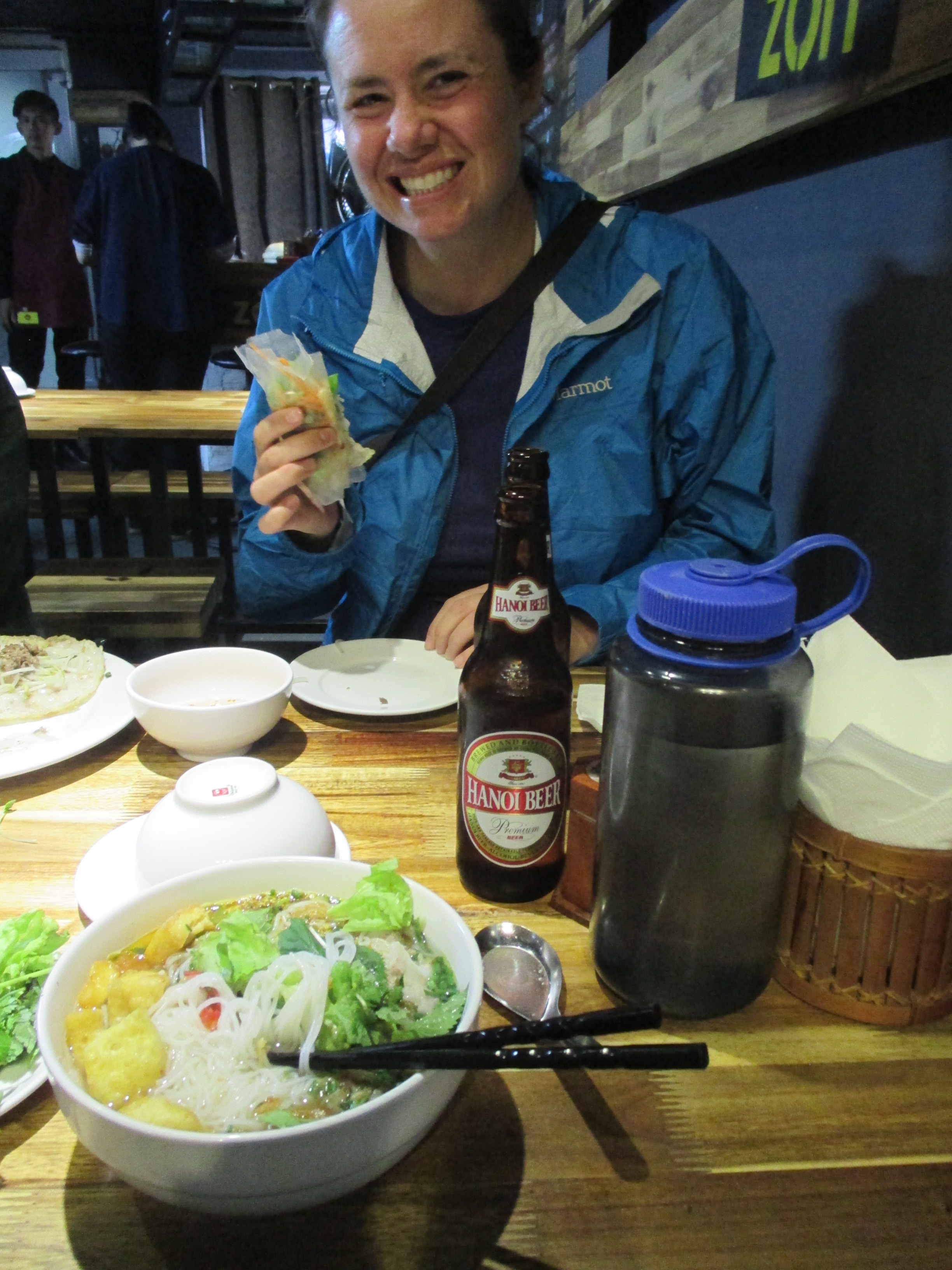
The night after the Zumba class, we wanted something simple and close, so we headed to a small place just around the corner from the hotel called Bahn Xeo Zon. As the name suggests, their specialty is bahn xeo, the Vietnamese savory pancake. Their version was probably the best one we had in Vietnam. Eric got a crab-flavored noodle soup called bun rieu cua.

Bun rieu cua in the foreground, Della enjoying a banh xeo in the background

Bun rieu cua in the foreground, Della enjoying a banh xeo in the background

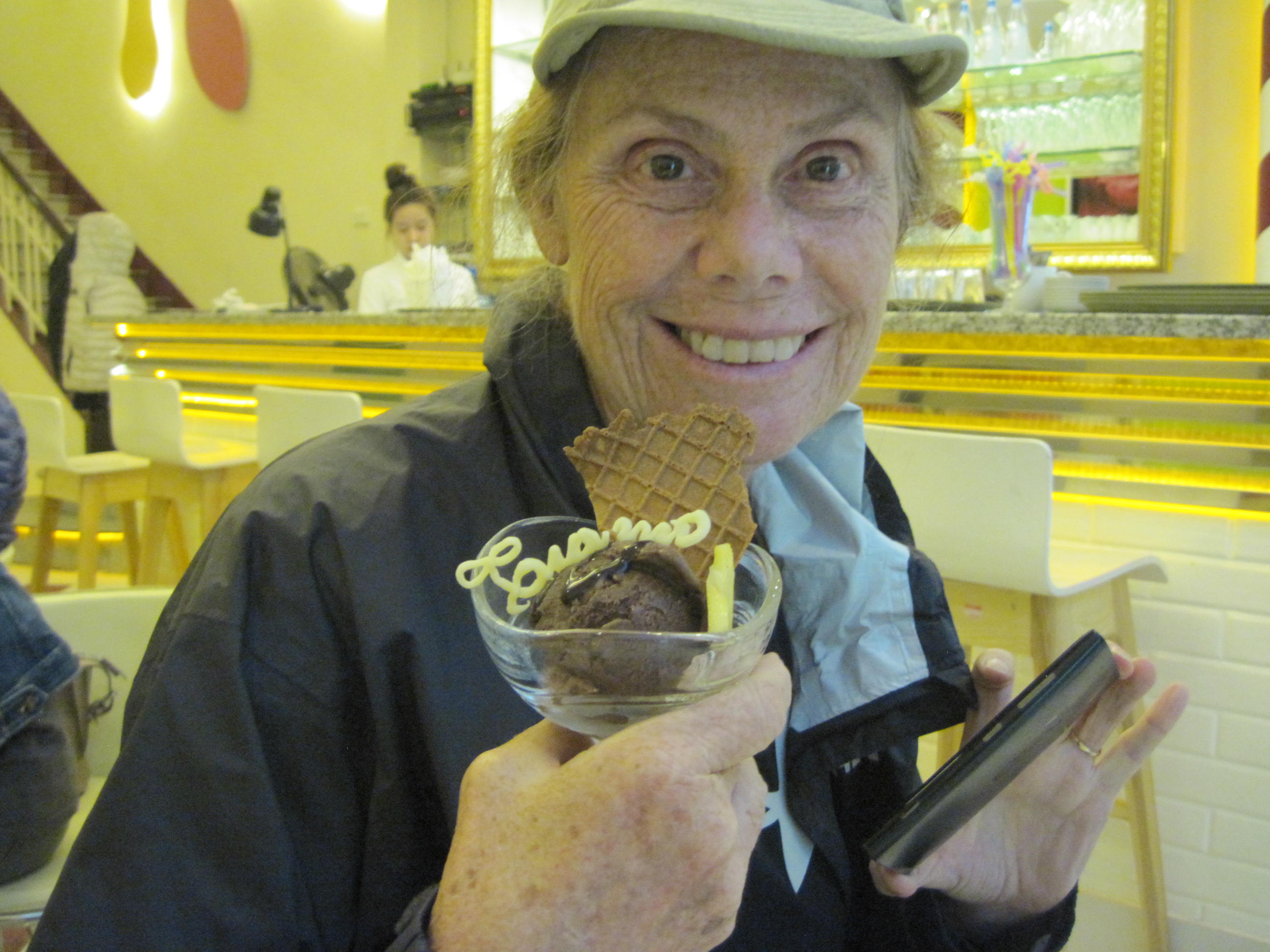
We also splurged one evening and got some gelato from a fancy place on the same block as the hotel. It was a little overpriced but the service and presentation were excellent.

IMG_0374

Final Thoughts

Hanoi greatly exceeded our expectations! We found the city’s ancient and recent history enlightening to explore, and the food was all very good and cheap. We didn’t find that people treated us poorly; the service was at the same high level that received throughout Vietnam. The weather was a little gloomy, but never kept us from doing what we wanted. Even with our jam-packed three days, there are plenty of things we feel like we missed out on. Hopefully we can figure out how to fit Hanoi back into future travels.

We’re Home After the Earthquake: How Do We Feel?

If you’d like to contribute to help the people of Nepal recover from the devastating earthquake, please visit our page collecting some worthy causes.

We’ve just passed the one month anniversary of the original Nepal Earthquake. We’ve been home for about 3 weeks now. One of the questions that people keep asking us is how we feel. It has taken us a bit of time to come up with an answer to that question. We feel a lot of things and some of them are a bit hard to explain. But, we’ll try to describe them the best we can.

The order that we write them does not really signify the extent to which we feel them because as time has gone on, the emotions change. They grow and shrink, but they’re still there. The order is mostly a reflection of the order in which things occurred…

For our own ease of writing, we’ve each written in the first person. Della writes in italics while Eric writes in normal type.

We feel…

Disappointment

I’m a bit disappointed in my own abilities to cope with a disaster. I remember being more confused than anything when the earthquake first happened. I don’t think I had logical thought quickly enough to save my life. If I hadn’t been in a place where I was somewhat safe, then I’m not sure I would have survived. For example, a few minutes before the earthquake happened, I had decided I needed to go to the bathroom. I remember seeing a sign that was near where the donkey was in this picture.

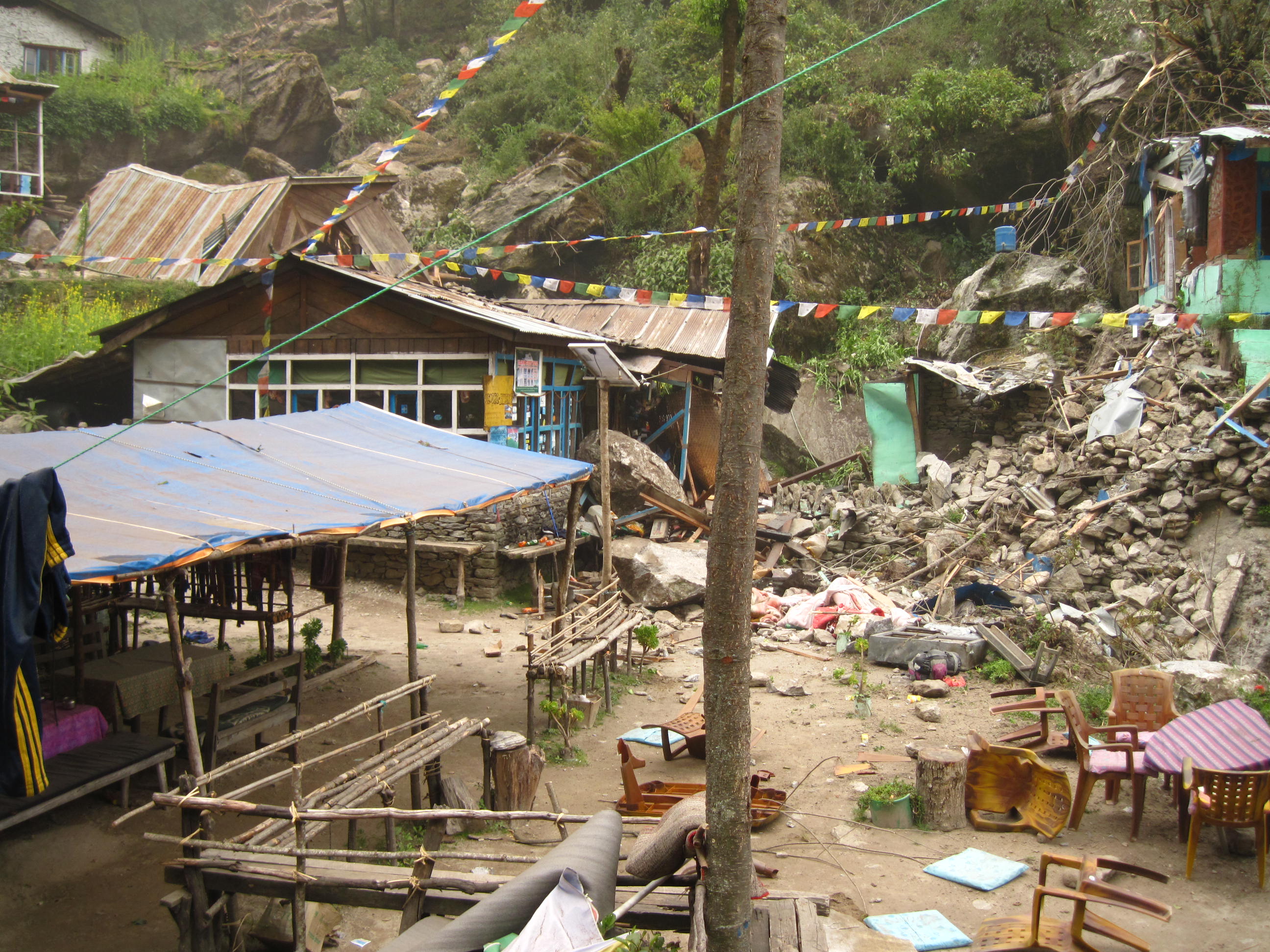
The view from our table at the teahouse

For some reason, I told Eric that I needed to go but I was going to wait until our tea arrived. If I had followed my usual pattern and gone right away, I don’t think I would have thought fast enough to get out of the area when the ground started shaking. I would have been under the rocks in this picture.

Another look at the destroyed teahouses after some of the dust has settled

As camp life continued, I don’t feel like I was drain on the group, but I wasn’t a leader either. Of course, not everyone can be leaders, but I’m still disappointed in myself. I’m not sure if I would have been as effective in surviving without the help of the rest of the trekkers who were there. The best way I can think of to explain it: If it had been a film… I wouldn’t have been the hero. Far from it, I would have been the equivalent of an extra, maybe “Trekker #28,” and might have been cut from the movie during editing. 

I think I’m generally OK with how I acted during the earthquake. I am disappointed in my lack of contributions in the survival situation afterwards. Watching TV shows like “Survivor,” I always imagined that I would be one of the ones that would step up and help organize the activities around camp. But as it turned out, I was too reluctant to suggest much of anything and relied on others to lead the way. I’m very glad that they had the knowledge and foresight to do things like string up a tarp, because I don’t know if I would have had that idea. I’m not sure that any of my contributions around camp were essential.

Lucky

Somehow, despite the bad luck of being in Nepal during the time of the quake, we had the best luck we could have had. We were seated outdoors, as close to the middle of the canyon as we could be. Even among the terraces, ours was the best because very few rocks flew that way which prevented injury. We came out of the earthquake and the landslides literally unscathed. We were in the low part of the valley which meant that survival was relatively easy – we weren’t cold or worried about altitude sickness. We experienced the earthquake while in a village which meant we could stay there and use resources from the village to meet our basic needs (food, water, shelter). There was an amazing group of people who, by accident, were stranded with us and through their support and camaraderie we survived. 

I keep thinking about how many different little things led up to the luck of us being where we were when the earthquake hit. As Della said, we were very lucky that we ended up where we were. What if we hadn’t made the last-minute decision to stop at Bamboo for tea? What if we hadn’t spent an extra day in Kathmandu before setting out on the trek? What if we had gone straight to Nepal from Vietnam instead of going to Hong Kong first? We were very lucky to end up in the situation that we did.

Guilt

I know that survivor’s guilt is a thing. It’s hard to explain exactly because there is nothing that I did or didn’t do that allowed me to survive while so many others didn’t. But, I feel a huge weight of guilt all the same and maybe that is exactly why I do feel it. I think we as people look for explanations or reasons for things. It’s in our nature to understand why something happened. But, that’s just it. There is no reason why. I was lucky, but I feel such guilt. There were a lot of wonderful people, people who probably deserve to be alive a lot more than me who aren’t. I know a lot of people didn’t even have a chance… Those who were in Langtang village had no time to do anything. Moments after the initial quake, essentially a glacier coming at huge speeds just bowled over them. But, why was I lucky enough to be where I was? What twist of fate allowed that to be? What have I done to be more deserving? I know the answers of course. Nothing. The tension under the earth became too much and the great plates that have been forming the Himalayas for generations moved. The earthquake happened and some places were hit worse than others. It is a random occurrence and I was one of the lucky ones. But, that doesn’t really stop how I feel. 

I also have a hard time coming to terms with our survival when so many others didn’t make it. I also feel guilty about the resources that were expended to rescue us when so many other people in Nepal were in situations which were just as bad as ours or maybe even worse. We had plenty of food and a decent shelter, and we could have definitely stayed out there longer if need be. Or, we could have tried to walk out, like some others did (although I think it would have been a gamble given that there was at least one landslide on the trail every day). Should I feel bad that my status as a tourist meant that maybe our rescue was given higher priority than sending supplies to a local village? A few people have asked a version of that question since we’ve returned and we don’t really know how to answer it.

In addition, I wonder if there is something more that I could be doing to help. I got to come home which is safe and comfortable and far away from the tremors of the earth. But, should I have stayed in Nepal to try to help? (More likely I would have just been in the way.) Should I be doing more here to raise money? (Not sure what else I should be doing…) Should I be giving more of my own money? (Already given probably more than I can afford easily…) Overall, I think we made the right choices, but it doesn’t stop the uncertainty and guilt. 

I also feel guilty that we maybe we haven’t done as much as we could to help. We made the conscious decision to come home for what we believe were the right reasons, but other people who stayed seem to be doing great things. The same can be said about our decision to go back to our old jobs as opposed to dedicating our lives to help. We will try to keep raising awareness, but is that doing enough?

Frustration

I have been looking forward to my visit to Nepal for soooo long. My parents have these fantastic memories and pictures from their Langtang trek 35 years ago. I so wanted to have my own memories. The top of that valley just looked like the most glorious place. I am so frustrated that we didn’t get to finish our trek and continue what we had planned for Nepal. I’m also frustrated that our fantastic RTW journey had to end on such a sour note. Now all of the wonderful memories are overshadowed by how the trip ended. On top of that, we ended our trip early, cutting out a month of this journey of a lifetime. Again, I think we made the right choice to come home, but it is still so frustrating to have it all end like this.

I didn’t have the same personal connection to Langtang as Della did, but I still was quite frustrated to not be able to complete our trek. I had expected it to be an activity like our self-drive safari, a huge adventure that would test us in ways that we didn’t expect but would be something we would look back on as one of the highlights of the whole year. We kind of got that, but not in the way that we wanted or expected. And losing a month of our year-long trip hurts. Once the trip of a lifetime is over, what do you do with the rest of your life?

Sadness

A beautiful trek is damaged – perhaps beyond repair. More than 8000 people are dead. A country that was struggling with poverty before is now wrecked with terror and destruction. So many people, beautiful people, have lost their homes and all their possessions. They will struggle to just survive in the years ahead. Hundreds of children from the Langtang Valley are now orphans, their parents buried under rock-slides. They will have to grow up without so many of their family members and removed from their homes. I tear up randomly throughout the days just thinking about it. Terror and heartbreak are now familiar to the people of Nepal. 

And then, while fearing and mourning for all the people in Nepal who lost their livelihoods due to an act of nature, I hear news stories of people in other areas of the world who are facing some of the same pain… And even more terribly, it is due to war; People creating the terror and pain and inflicting it upon others. And that, in a lot of ways, is even worse. There is so much darkness, cruelty, and pain in the world, and it is hard to see beyond it at times.

It hit me at some point while we were in Bamboo that we had just watched the life’s work of many people be destroyed right in front of us. And after we were back in Kathmandu, the stories that the cab drivers and business owners would tell would just break my heart. Every day now I hear about aftershocks that just have to be terrorizing the people living there.

Helplessness

I mentioned above about the pain and loss of the Nepali people (and so many others around the world); it’s hard to know how to help. I live in a beautiful place that is solid, orderly, and mostly safe. I want to help, but sometimes it seems hopeless. 

Anxiety

While sheltering at Bamboo, our senses were always on alert, feeling for aftershocks, listening for landslide, and looking to spot helicopters coming towards us. Even after we got back to the US, I’ve found it hard to turn that sense of awareness off. I have to remind myself that a thunderclap is not an earthquake. And every time I hear a helicopter I reflexively look up to the sky to see where it’s heading.

Hope

Even with all of the negative emotions discussed here, I do have some positive feelings associated with the event. The spirit of the group that stayed at Bamboo inspires me and reminds me of all of the good people in the world. Seeing all of the messages on social media that helped to get us rescued shows me just how great of a network of people there is out there that care for us. Finally, looking at all of the great work that is being done for relief in Nepal gives me a hope that the country will be able to persevere and rebuild.

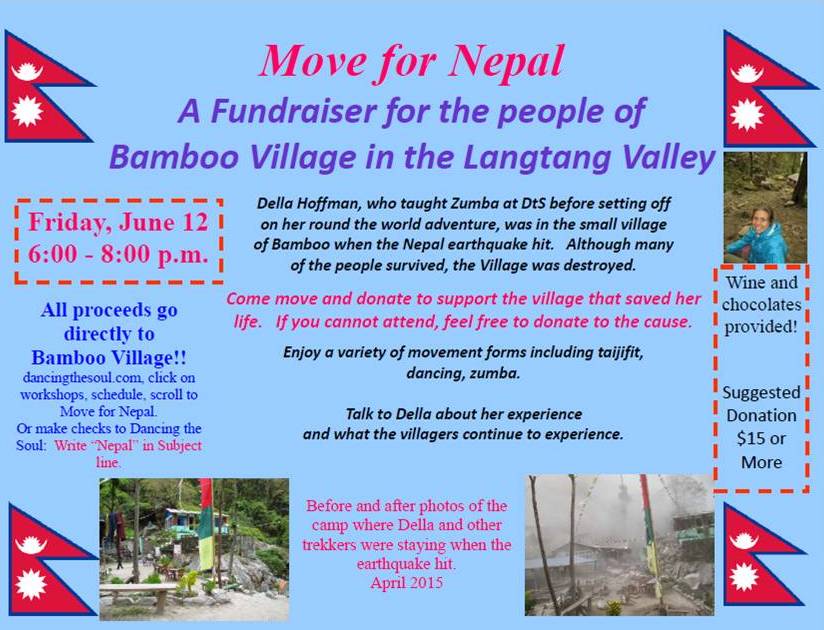
Denver Area: Dancing Fundraiser to Support Bamboo! Friday, June 12 6 pm

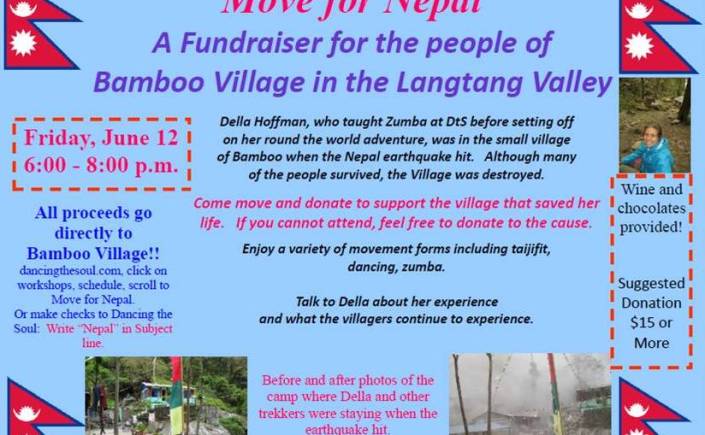
Eric and I have been looking for ways that we can support Nepal. One of the ideas I came up with was to use Zumba as an avenue to raise some money to help support the villagers of Bamboo. Click here to read our Earthquake story and learn how this village saved our life.

Margie Krest of Dancing the Soul has graciously agreed to host and support this event. I taught Zumba at Dancing the Soul for several years before I headed out on our RTW journey. It is a wonderful studio in Denver that offers many modalities of movement and stillness. I’m so pleased that this wonderful community has agreed to help support Nepal!

On Friday, June 12 from 6-8 pm, we will have an event called Move for Nepal. It will feature several types of movement including Qigong, Belly Dancing, and Zumba. Two other instructors will be joining me to lead this class. We will Move for approximately 1 to 1.5 hours and then enjoy some wine and chocolate and ask any questions people may have about Nepal.

We’re asking for $15 donation with all proceeds going directly to the people of Nepal.

You may sign up in advance by going to http://dancingthesoul.com/ and clicking on “Workshop Schedule” on the top right hand side or clicking this link. You can also chose to donate directly online at that time.

Dancing the Soul is located in the Mayfair Neighborhood of Denver at 950-C Jersey Street | Denver, CO 80220. Click here for more info on location.

Please come to help support Nepal. (It will also be my Zumba debut after my RTW trip and I would love the support of familiar faces!)

Picture1

Connections: Team Bamboo

Traveling is a wonderful way to meet people! Unfortunately, often those connections are strong but only fleeting. Connections is our tag to recognize and remember some of the wonderful people we meet.

If you’d like to contribute to help the people of Nepal recover from the devastating earthquake, please visit our page collecting some worthy causes.

We’ve described our experiences during the Earthquake in Nepal and now we’d like to write something a little bit more hopeful. We’ve written about a lot of Connections that we’ve made with amazing people on our travels. As great as those relationships were, it’s probably safe to say that they aren’t nearly as intense an the connections that we made with the people who sheltered with us in Bamboo after the earthquake in Nepal.

A lot of people ask us about what the group dynamic was in this large collection of people in a survival situation. It could easily have been pretty bad, with people taking an “every person for themselves” approach, but from the start it was exactly the opposite. Everyone was making sure that everyone else was ok, and sharing food and water.

As the days went on, this team spirit continued. Projects that were done were for the good of the group, and never just for an individual or small group. In many ways it was hard to find something to do to make yourself useful, because so many other people were volunteering to do the same thing!

Beyond the practical matters though, it was a great experience just interacting with this group of people. Even though the group was from all around the world, they all spoke English (which we are always amazed by). It was easy to pass the time by just striking up a conversation with whomever happened to be sitting on the rock next to you. Everyone kept a positive attitude, and when some would start to get weighed down by disappointing events, others were right there to pick them back up.

We have also been inspired by the different efforts that members of the group have started to help Nepal in the aftermath of the earthquake. You can find links to support their causes on our earthquake relief resources page.

Even though we were thrown together by a random twist of fate, the diverse group at Bamboo quickly became a team, surviving and working together. We forged a bond that we hope will last a lifetime!

Team Bamboo plus the staff of the Chabad House

Team Bamboo plus the staff of the Chabad House

How We Got Home from Kathmandu for $104

If you’d like to contribute to help the people of Nepal recover from the devastating earthquake, please visit our page collecting some worthy causes.

After spending a few days in Kathmandu, we caught a series of flights over 35 hours that got us all the way back home to Denver. Even under the special circumstances, we were able to do like we did for most of the flights on the rest of our trip and book it using airline miles.

Booking the Flight

As we alluded to in a previous post, we had already booked a ticket leaving Nepal using miles. We were scheduled to fly from Kathmandu to Seoul, South Korea on May 12, which we purchased using United frequent flyer miles. United considers Nepal and South Korea to be in two separate regions, so it cost us 37,500 miles per person, plus $21.90 per person in fees. We got these United miles by transferring points from our Chase Ultimate Rewards account which we got by signing up for the Chase Sapphire Preferred Card. We also had some United miles gained from signing up for the United MileagePlus Explorer Card.

Once we decided to head home, we had the idea to see if we could switch our South Korea ticket to one heading back all the way to Denver. Amazingly, there was United award availability for the day we wanted to leave, Sunday May 3. We called United customer service and fed them the flight details, and they agreed to change our ticket. We did have to pay the difference in miles and fees, as the new flight to Denver cost 42,500 miles and $52.20 per person. The United rep kindly agreed to waive the change fee once we explained the circumstances, which we were definitely grateful for.

The Journey

Our trip back to Denver required three flights: Kathmandu to Bangkok on Thai Airways, Bangkok to Tokyo on Thai Airways, and Tokyo to Denver on United itself. Both layovers were fairly long, and two of the flights were as well, so it would require over 35 hours of travel time.

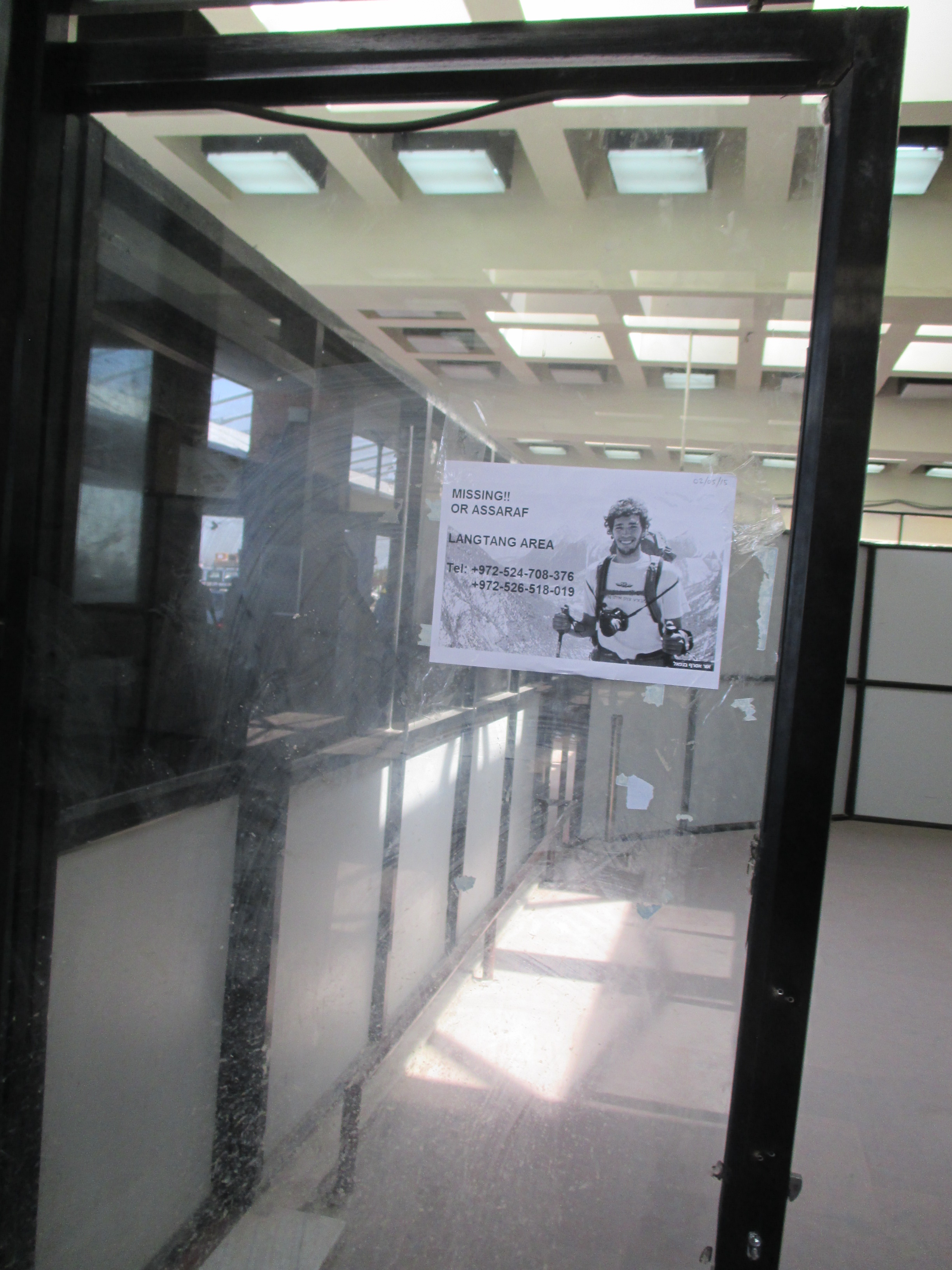
We got to the airport in Kathmandu four hours ahead of scheduled departure, since we had heard that it had been very crowded and chaotic since the earthquake. As we headed into the terminal, we saw missing people posters, including one for Or Assaf, who rode our bus to Syabrubesi.

IMG_7995

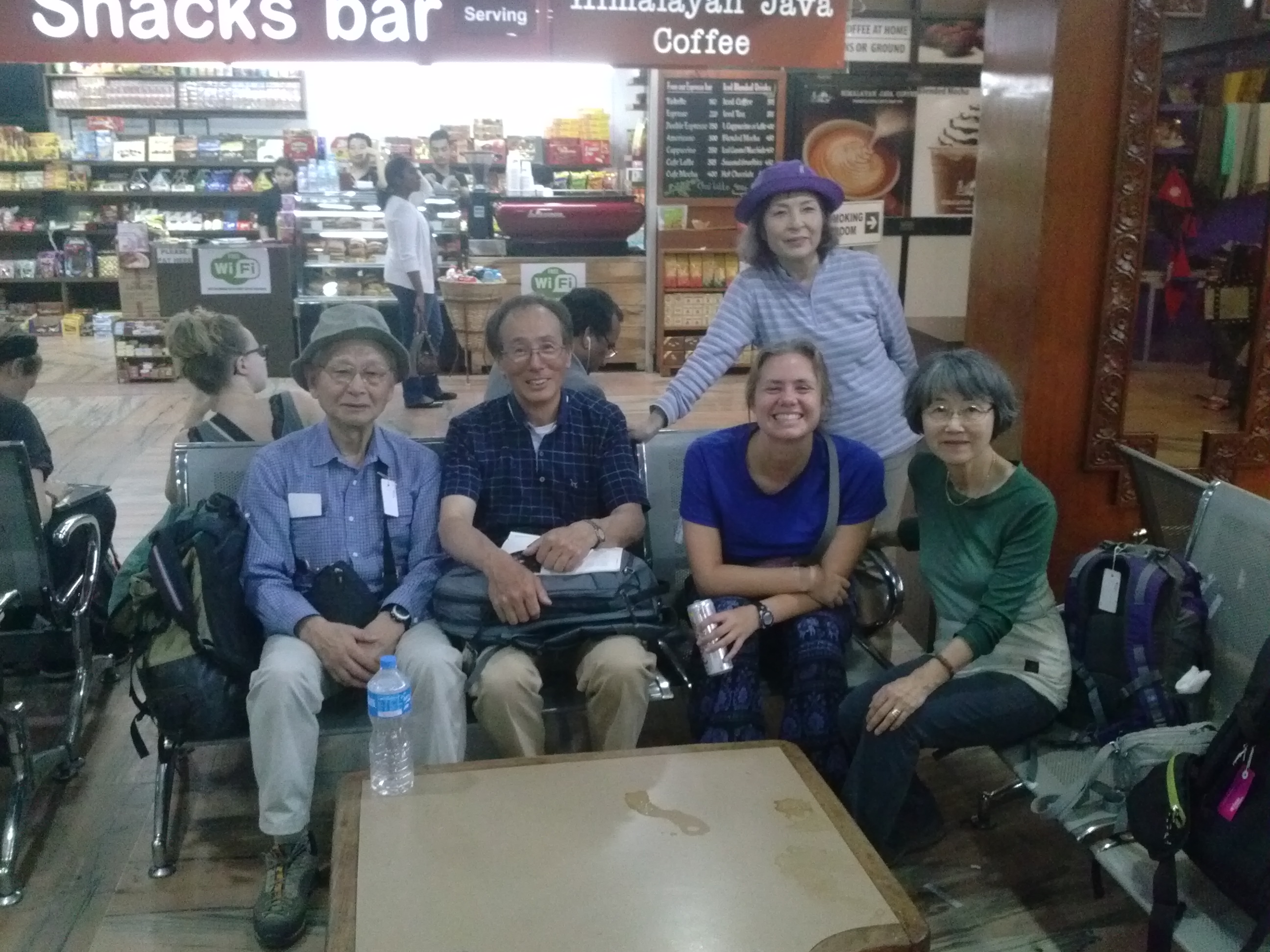
There was already a long line at the Thai Airways checkin desk, so we were happy we got there early. But that was the main delay; immigration and security lines were actually quite short. We spent a couple of hours in a small lounge where we got a bite to eat and bought some souvenirs with our last rupees. We also ran into the Japanese tour group which had sheltered with us at Bamboo. It turned out they were on our flights to Bangkok and Tokyo!

CAM00679

As we headed out to our plane on the tarmac, we got our last look at Kathmandu. We could tell the airport was still quite busy with relief supplies being ferried around. We had mixed emotions: happy to be going home to see family and friends, but sad to be leaving Nepal on such a low note.

Once in Bangkok, we had four hours before our next flight. We were excited to be able to sample our favorite cuisine from the Asian portion of the trip again, so we sought out a restaurant that served Thai food. We found a small Thai Muslim place and enjoyed some of our favorites.

IMG_8006

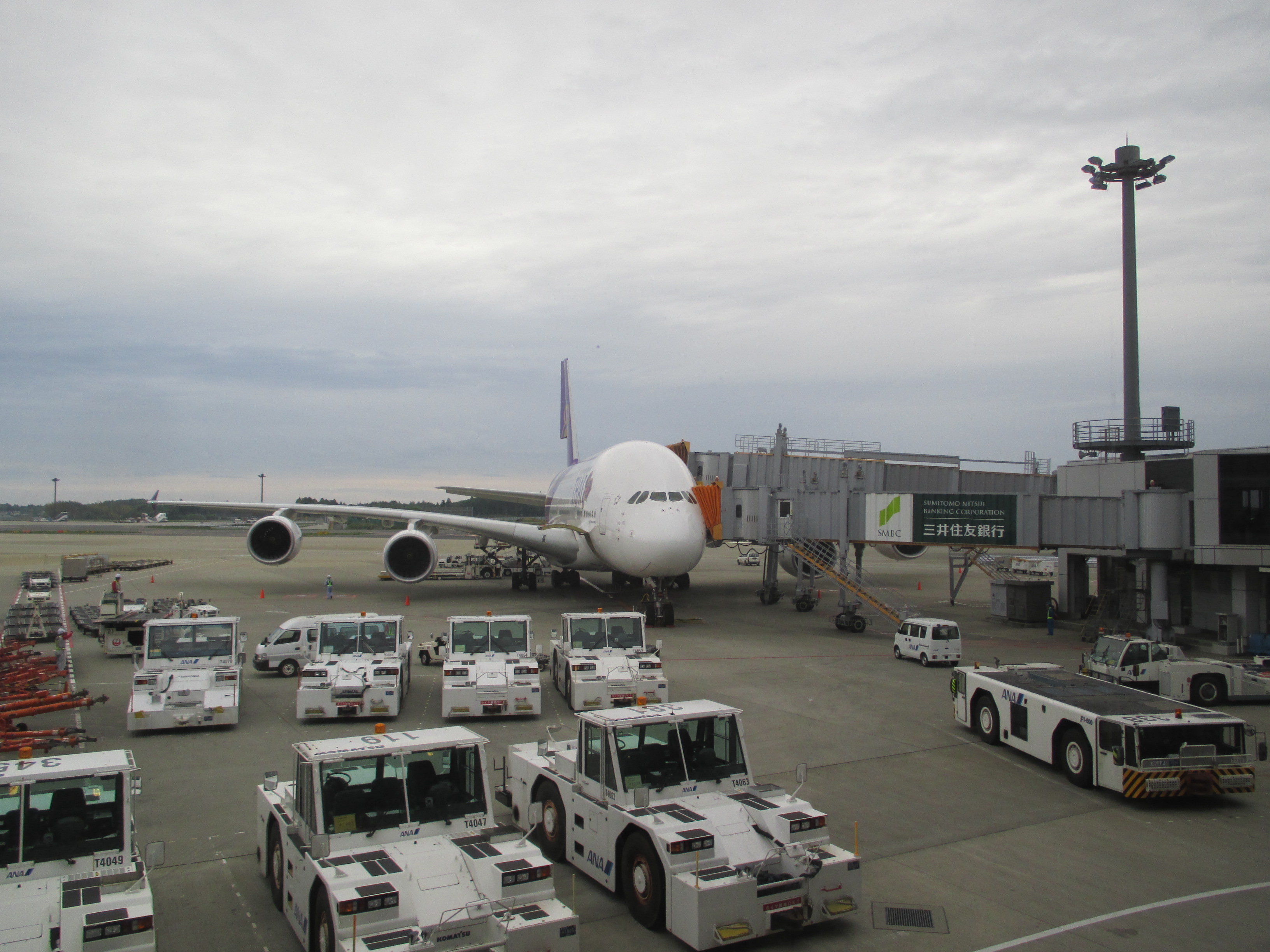
One part of the flight to Tokyo that we were looking forward to was the plane itself – it was our first time to ride on the giant Airbus A380. Our seats were towards the front of the bottom level of the double-decker plane, so we didn’t really get a feel for how big it was until we saw the outside after the flight. The flight itself was overnight, arriving in Tokyo at 6:30 AM, so we probably should have tried to sleep, but we mostly ended up watching movies on the fancy in-seat entertainment devices.

IMG_8008

Arriving into Tokyo was a little depressing, because Japan was to have been the final stop on our round-the-world trip. As we looked out onto Tokyo from the plane, we pondered what could have been. Our layover was ten hours, so we considered leaving the airport to get a taste of Japan, but ultimately we decided that we were too tired to really enjoy it. We would leave Japan for a full visit sometime in the future.

Our view of Tokyo as we flew in

Our view of Tokyo as we flew in

Instead, we used two United Club passes (another perk of the United MileagePlus Explorer Card) to spend the day hanging out in the United Club. This was much more relaxing that just sitting in the outside area. We were even able to get a nice nap in. As the day went on, we took frequent advantage of the free snacks that were placed out, including sushi. We also had some free sake and draft beer poured by a pretty neat machine.

The flight from Tokyo to Denver was thankfully direct, but long. It also went back in time, so to speak: since we crossed the dateline, we arrived in Denver (at 12:45 PM) earlier than we left Tokyo (at 5:00 PM). This flight was on another plane we were interested to fly on for the first time, the new Boeing 787 Dreamliner. The interior was quite nice and new, and we had another good personal in-flight entertainment screen to help us pass the time.

We hoped for a nice, sunny day to welcome us back to Denver, but unfortunately it was cloudy and rainy. Nevertheless, it felt good to be home.

Walking into the Denver Airport

Walking into the Denver Airport

Postscript: Cancelling Our Japan Flight

As we said, we had planned on making our last stop on our trip in Japan. We had gone ahead and booked our return flight home from Tokyo as well. The booking on this was fairly complicated: we used American Airlines miles to book a series of flights from Tokyo to Denver, one on Japan Airlines and another on American Eagle. This was especially complicated because we couldn’t book it on the AA site, since it doesn’t actually show Japan Airlines availability. You can see it on the British Airways site though, so we got the flight numbers from there and had to call American and feed them the flight info. This cost us 32,500 AA miles and $44.90 per person.

Once we came home though, we weren’t going to go back to Japan, so we wanted to cancel this flight and get back our miles. Cancelling was easy, but American charged a “reinstatement fee” of $175 to get the miles back. We tried to explain to the representative about our extenuating circumstances, but she couldn’t change the policy. So, we would like to again thank United Airlines for being considerate and waiving fees, since other airlines apparently can’t.

We are wrapping up the story of our earthquake experience in Nepal. We were extremely fortunate to survive and to be able to come home to the USA. Our stories are now over, but those in Nepal are not that fortunate. Huge numbers of people have lost their homes and their livelihoods. Please take some time to donate (any amount, large or small, can help) to help this beautiful country recover. We’ve collected list of organizations that you might consider here.

After the Earthquake Part 5: Returns and Reunions

If you’d like to contribute to help the people of Nepal recover from the devastating earthquake, please visit our page collecting some worthy causes.

We woke in the US Embassy one week after we had set out on our bus ride to begin our trek of the Langtang valley. It had been the most comfortable secure night we had since then. The US Embassy was extremely solid and we didn’t even feel any aftershocks while we were in the building.

The Embassy was still serving hot food to all those still sheltering there, so we had a nice warm breakfast with our companions, Corey and Kathleen. After some discussion, we all decided that we wanted to head back into Thamel, the backpacker center of Kathmandu. Kathleen wanted to continue to support the businesses there by buying some more souvenirs and we (and Corey) wanted to see if it was possible to pick up our things that we left when we went on the trek.

10404407_10152716733662531_6886806037399707314_n

We had spent our previous nights in Kathmandu at the Hotel Bright Star, which we really enjoyed. The owner was an unbelievably kind man who had gone out of his way to help us. We still had his business card and were able to reach him on his cellphone. We were thankful to hear that his family were all safe and that he would meet us down the street from the hotel that morning.

We wrote a bit more about the hotel before and after the quake in our post Kathmandu: Before the Quake. But, it still breaks our hearts. Hotel Bright Star was still standing after the quake, but the hotel right next door was completely destroyed. Unfortunately, there was also quite a bit of damage to Hotel Bright Star and we do not know when/if it will operate again. The owner had sent his family to Pokhara, but was waiting near his hotel for us (and several other trekkers) who had left stuff with  him. His kind spirit in the face of his own personal tragedy is something we will never forget.

We also visited Corey’s hotel and he was able to pick up his things as well. On our way back, Eric spotted someone he recognized on a scooter zipping past. It was Valerie (the French girl who had just celebrated her birthday with chocolate pancakes in Bamboo with us the day before) and her guide Srijan!! We called her name and they stopped to share their stories. We were so glad that they had both safely made it back to Kathmandu. We weren’t overly surprised though, as we knew the French had been waiting on helicopters when we left Dhunche the day before. We had a brief but welcome reunion with them before we had to head on our way.

We carried our bags back to where we had been planning to meet Kathleen. While we were waiting for her, Eric spotted a group of our Bamboo friends in the back of a taxi flying past us! (Yes, Eric is really observant and has good eyes!) We tried to follow them, but couldn’t catch up. Corey and Della grilled Eric to see if he could tell exactly who was in the taxi. He was pretty sure that it had been the South African couple and the Australian sisters. We were disappointed not to have spoken with them, but so thrilled that they had also arrived in Kathmandu from Dhunche. It had been quite hard for us to leave our Bamboo family there the day before.

Corey had an idea for a place for us to eat lunch, so after we met back up with Kathleen, we headed that way. We had sat down (happy to see that the place was relatively undamaged and was serving food) and began to order. Suddenly, as we were looking out the glass doors of the restaurant we saw more people we knew: Aviv, Yonaton, and another Israeli friend from Bamboo! We ran out the doors (probably to the confusion of the wait staff) and called them back. After several hugs and brief summaries of rescue, they invited us to a reunion at the Chabad House in Kathmandu where the Israelis had already been planning to meet. We agreed we would see them there.

We returned to our lunch but had to jump up again a few minutes later. We saw the Australian sisters walking by! Again, we ran to the street and experienced more hugs and short tales of helicopters before also inviting them to the Chabad house for the reunion. It turned out that the rest of our Bamboo team had all been taken from Dhunche to Kathmandu only that day via large Nepali military helicopters (aside from a few individuals who had made it on transports the day before). They told us that there was no one from the Bamboo team left in Dhunche when they left!

19597_10152716734372531_8661166855017425154_n

At 1 pm on May 1, 6 days after the earthquake that stranded us all together, we met with our Bamboo team at the Chabad house. Unfortunately, not everyone was there, but through discussion, we now knew that everyone we had been with on the mountain had made it safely away. We had even been in touch with the Lithuanian brothers (who had walked out of Bamboo) via Facebook and knew they were on their way home. It was extremely emotional and we were all feeling thrilled to see each other in a safe place!

We left each other that afternoon, only after agreeing to meet again for dinner to share each other’s company once more before people started leaving Nepal.

IMG_7987

By this point, the support operations at the embassy were clearly winding down. There were only a few others still sheltering there, and the staff were starting to take some deserved days of rest, so it felt quite empty at times. The Marines who guarded the embassy seemed to be ready to not have to worry about our security as well. We decided we should either leave the embassy or head home, and opted for the latter, booking a ticket back to the States for Sunday.

We spent one more day in Kathmandu and went into Thamel once more. We made an effort to spend all of the cash we had brought with us on the trek buying souvenirs and donating to people who were working for relief. We said goodbye to Kathleen tearfully as she left for home. We shared a lovely meal at another one of Corey’s favorite restaurants before we too had to say goodbye to this beautiful but devastated country.

IMG_7990

On our way to the airport on Monday, May 3, we had a sobering discussion with our taxi driver. “Nepal is finished,” he said, “finished! Homes are destroyed, all tourists are leaving. There is no work. Nepal is finished!” We hope with all our being that he is far from correct. While we know there is a lot of effort needed to rebuild, we also know that there are a lot of dedicated people our there working very hard to do so. See this link for just some of the stories of people working to support Nepal. We hope that you’ll join them. In addition, Nepal is a beautiful country and will continue to be beautiful. Don’t take it out of your travel plans – they need tourism now more than ever. Let’s all help prove that taxi driver wrong!

We will continue to tell the story of our earthquake experience in Nepal. We were extremely fortunate to survive and to be able to come home to the USA. Our stories are now over, but those in Nepal are not that fortunate. Huge numbers of people have lost their homes and their livelihoods. Please take some time to donate (any amount, large or small, can help) to help this beautiful country recover. We’ve collected list of organizations that you might consider here.

Use these links to read the rest of our Nepal Earthquake story:

After the Earthquake Part 4: Rescue

If you’d like to contribute to help the people of Nepal recover from the devastating earthquake, please visit our page collecting some worthy causes.

On April 30, we were quick to rise from bed at dawn (5 AM). We had slept well, since there were extra blankets now that there were just 22 people left. The night’s chill was still in the air, but we didn’t dawdle getting going for the day because the Dutch man who was keeping control of the satellite messaging device announced to everyone that rescue was coming “soon.” It was a beautiful morning in the valley, so we figured weather concerns would not stop the helicopters.

In addition to making sure our personal bags were packed and ready to go, we also all worked on getting the camp cleaned up and things put away as if we weren’t spending another night. We folded all of the blankets and stuffed them into the small cave, put all the remaining bottled water in one big box near the rock, did all of the dishes, and got all the food in one location under the tarp.

We did have time for a special breakfast that morning. It was the woman from France’s birthday, and one of the Australian sisters figured out a way to make pancakes as a special treat. They even made a special pancake cake with chocolate sauce on it, and we all sang “Happy Birthday.” It was another of those moments where it felt for a little while like a fun camping trip with friends as opposed to a survival situation.

Two of the Dutch people decided that it would be a good idea to post people constantly at the beach helipad to wave down any helicopters, especially if it was a large helicopter that couldn’t land at the small helipads that the other helicopters had used. They volunteered for the first shift out there.

The big worry for the morning (besides whether the helicopter would come) was the battery for the satellite message device. It originally had been draining slowly, and we had plenty of personal power banks to charge it, but with the increased message traffic as we all contacted loved ones, the battery had gotten critically low. Luckily, one of the side projects people had worked on over the past few days was getting the solar power systems from the teahouses set back up. Some of the inverter technology was broken, but they finally found a device that would charge the phone. One of the Dutch sat by the charging phone and made sure no one bumped it and broke our connection to the outside world.

As the morning went on, we got more and more antsy. No one wanted to do too much work since we thought rescue was coming soon. The skies were crystal clear, but not a single helicopter had come down the valley. (As it turned out, the delay was due to bad weather in Kathmandu). We all just sat, staring at the skies and straining our ears for the sound of rotors.

Around 8:30, there was a fairly significant tremor that caused a small landslide down the trail. By this point we were much less tense about the sound of falling rocks (once we knew it was in the distance), but it still didn’t help with the anxiety.

Finally, around 9, we heard the sound of a helicopter (one we had all become very familiar with, along with landslides). It took a moment to spot it – and then we saw it was coming in low! Not as low as the others though and it passed by Bamboo. But then it circled in the air near the beach helipad where those waiting had been waving flags, and then landed.

There was then a huge flurry of activity. The group that was drawn to go first grabbed their things, and so did the two of us, in case it was a helicopter for just the Americans.

Under normal conditions, to get to the beach from our camp took about a 5 minute walk over rocky ground. We guessed that the helicopter wouldn’t wait that long for its load, so we all ran as fast as we could praying that we wouldn’t trip. The more fit members of the group did an excellent job of pushing us all to go faster.

When we got to the beach we could see that it was another small, private Nepali helicopter, so we scanned the landing area to see if there had been a coordinator on board who could explain what the situation was.

We spotted two tall men, both wearing baseball caps (one for the University of Alaska), so we figured it was a helicopter sent by the Americans! They quickly found us and their accents confirmed it. They were two members of the Special Forces who were helping with the rescue operations. They confirmed that we were the Americans on our list and told us to get in.

The mix of emotions at this point was very powerful. On one hand, we were extremely excited to be rescued, and were not going to pass up the helicopter that had been sent for us. On the other hand, the thought of being whisked away while the rest of what now felt like a family to us sat back on the beach was heartbreaking.

But then as we headed to the helicopter, one of the Special Forces guys assured us, “Don’t worry, everyone is getting out!” With huge relief in our hearts we got on board. It was a very small helicopter, with three seats up front (one for the pilot – a Nepali) and only a small cargo area behind. We crammed into the small cargo area (with our bags). Soon after, three members of the first group crammed in the back with us, and one up front along with one of the guides. The Special Forces guys stayed back at camp to coordinate the rest of the rescue (and to take pictures of the camp and surrounding area as documentation to the higher-ups as to why our rescue was worth paying for).

The mood on the helicopter was jubilant. We all couldn’t believe we were getting rescued. The helicopter took us down the Valley we had hiked up five days before, and we tried to look out and see its current conditions.

We were taken to the army base at Dunche, the same town that we had passed through on our bus ride to get to the start of the trek. When we landed there was a flurry of activity as we had to be registered on the lists of a bunch of different uniformed men (probably from the same groups that were the checkpoints on the bus ride).

One stood out though – Tom, a US consular officer. He was the one coordinating the efforts of the Special Forces guys for the embassy. Della somehow heard him say he was the ambassador, which was later proved incorrect but made us feel pretty special at the time! He explained that the US had rented the Nepali helicopter for a block of time, which they would use to get all of the people from Bamboo out plus anyone else they could find in the valley.

The rest of his news wasn’t as great. They really only had authorization to get us out of the dangerous situation in the valley and to this town of Dhunche, which had been affected by the quake but was not still threatened by landslides since it was on top of a mountain. He said there was shelter in town, plus restaurants were open. Getting to Kathmandu was up in the air though; the road was (not surprisingly) broken, so we could try to walk for six hours down the road to Kalikasthan where there were buses. Or, there was a rumor that the Nepali Army would use big helicopters at some point to get the tourists out, so we could wait around in Dhunche for that. He did tell us to stay close though – the helicopter did have to go back to Kathmandu, and there might be some extra spots that we could squeeze into.

We left the army area to go see what the situation was. Up a small hill was a collection of big blue tents with bricks as the floor. There were some other trekkers there who we bombarded with questions to try and figure out what was going on. What we heard wasn’t great – it was pretty cold at night, and there wasn’t a clear way to get blankets. You basically just had to grab a tent and hope for the best. It was safer on paper than Bamboo, but actually seemed like it would be less comfortable.

As we evaluated the situation, we could see the other Bamboo people landing on their rescue helicopters. As they emerged from the army area and we saw that everyone was there, there were big hugs all around.

We had cell phone service, so we texted and eventually called our families. (A special thanks to T-Mobile, our cell provider, who after the earthquake established free calls and text to and from Nepal, so we and others in our group could get in touch). At first they didn’t even believe it was us, because their latest message had been that no rescue was possible due to the bad weather.

Someone suggested going into town for some food. We were torn, because we wanted to stick with our “family,” but Tom from the embassy had told us to stick close. We thought we might have time, so we headed towards the village with the rest of the group.
IMG_7918

On the way though, the group started talking to two other people who had been in Dhunche the previous night. Their accents sounded familiar – they were other Americans (from Alaska). Della told them that the US ambassador was on the helipad (again, not actually true but what we thought at the time) and they were very interested to hear what he had to say, since they had been having trouble getting in touch with the embassy.

We reluctantly split from the Bamboo group and headed back up to the gate of the army area with the other Americans. We tried to peer inside and see Tom, and we also asked the guard at the gate, but he wasn’t there. We couldn’t figure out where he had gone but stayed waiting outside the gate. Finally we saw him inside and called him over. Unfortunately, his news hadn’t changed, and our best bet was to wait until the next day or walk.

Some of the other Bamboo people were also waiting near the gate. There was a large group of French people who had been told by their embassy that they would be helicoptered out, and the Dutch (who still had the satellite device) had heard the same thing. It was interesting how quickly we shifted from “Team Bamboo” to allying ourselves by country. It was a little sad, but seemed to be the reality of how the next steps were being handled.

We were sitting in the gate area but with not much hope of anything happening. Then, Tom appeared again! He said they would have three spots on the helicopter taking them back to Kathmandu. At this point there were five Americans: us two, Corey from Bamboo, and the other American couple. The couples weren’t going to split, so it would be Corey and one of the couples. We offered to let the other couple go first, since they had been in Dhunche a night already, but they said they didn’t think that was necessary. They proposed a coin toss, with an American quarter. Eric called it in the air – “heads.” It was heads.

We gave hugs to the others, and headed back inside the army area with Corey, Tom and the Special Forces guys to wait for the helicopter, which was out doing something else. We ended up waiting for quite a while and having a nice conversation. Tom and the Special Forces guys were just the nicest people and so calm – it really helped in the situation.

We got word that the helicopter was delayed, so Eric and Corey went down to use the restroom behind an army truck. Just as they were finishing, one of the Special Forces guys came to find them – the helicopter was landing! They raced back up to the helipad and jumped on board with the rest.

We think they must have had to do some special convincing, because they crammed a huge number of people on board the aircraft. The two of us lucked out and got to sit up front with the pilot. In the back, they fit Corey, the two Special Forces guys (not small guys and with big bags), Tom, a Nepali woman with a broken arm, and a ground coordinator.

IMG_7924 (2)

The ride back to Kathmandu, which had taken over eight hours by bus, took about 20 minutes. We felt very lucky to be sitting up front and getting great views. (We also remarked on the irony of us getting a helicopter ride – we had only a couple of weeks earlier discussed that taking a helicopter ride would be fun some day). We looked out at the countryside as the ride went along. There were plenty of flattened buildings along the terraced hillsides.

We held our breath a bit as we crested the final hill and got our first look at the Kathmandu valley. At first glance, it seemed like the devastation was less than we had feared, as most buildings were still standing. Upon closer inspection though, we could see many distinctive patches of orange, which were the tarps that the residents were sleeping under, too afraid to move back into their cracked homes.

We landed at the Kathmandu airport, which was abuzz with activity. There were many planes from other countries, including big ones from the Chinese and Thai Air Forces. We rode on a pickup to the parking lot of the airport, where the commander of the Special Forces unit met us in a different pickup (which turned out to be armored) to give us a ride to the embassy.

Our eyes were wide open on the ride to the embassy, taking in the sights of Kathmandu and trying to ascertain its status. There was actually less damage than we expected, but we did still see many people living outside. The embassy itself was quite a sight to see – it looks like your average American office building, which stands out quite a bit among the traditional Kathmandu atmosphere.

After going through a security check and a registration with the front desk, we were taken into the consular area for a debriefing with those who had been working to get us rescued. We were asked for any information we could give about the large number of unaccounted for trekkers, but we had to say that unfortunately we hadn’t seen them, since we were just on our first day and had just trekked a short distance.

Someone went to go find Kathleen, the American woman who had gotten out on the Israeli helicopter. She had been staying in the embassy since her rescue and had been feverishly working to get the rest of us out as well. It was a very emotional reunion for all of us.

But we didn’t have too long to sit and reminisce, because the PR woman at the embassy asked if we would be willing to immediately do an interview with Good Morning America. We were a little shocked that our story would be of that much interest to anybody, but she explained that we were one of the first feel-good stories that the embassy could promote. Before we even had a chance to shower, we were whisked away to a filming location outside of a fancy hotel for our interview, so if you watched it, you saw us as we looked on the mountain. We also discovered how the media can misinterpret things – for example, we were not living in an “ice cave” like the ABC news report said, and we had to correct a few people that we were not caught in an avalanche on Everest.

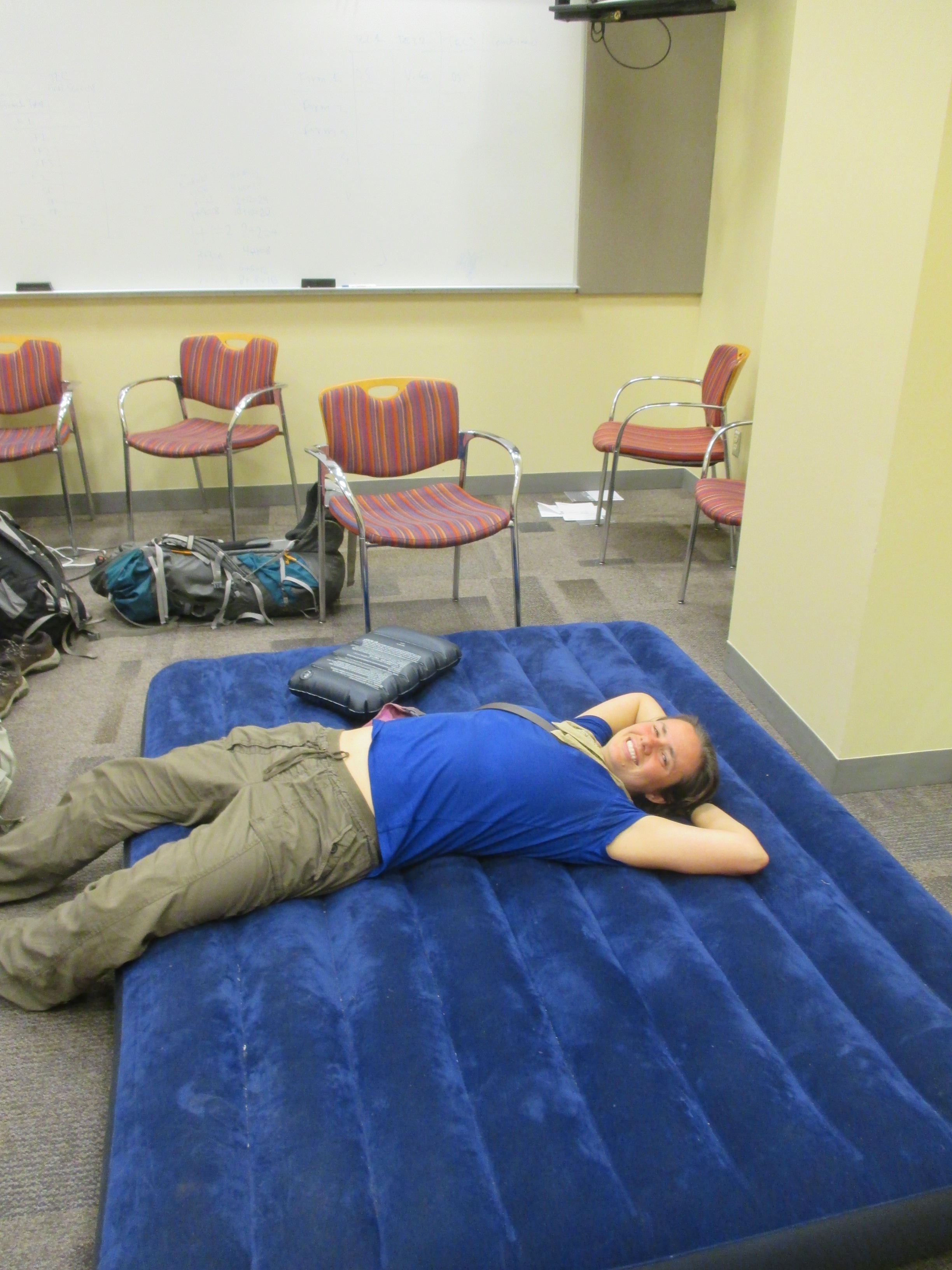
After the interviews, we returned to the embassy where Kathleen showed us around. The embassy had been doing a remarkable job of sheltering people in Kathmandu, both tourists and those who lived locally who were afraid to move back into their homes when aftershocks were still going on. Kathleen told us that maybe 200 people had been spending the night; this isn’t a normal thing, so people were having to sleep in hallways and share the one shower per gender. By the time we arrived though, many people had either left the country or moved back outside the embassy, so the PR woman found a nice conference room with air mattresses that we could stay in for as long as we needed to.

IMG_7969

One great thing the embassy had was a library with computers that had Internet that we could use. We opened up our email and Facebook for the first time since before the earthquake, and we were just blown away by the amount of activity we saw. One thing to understand is that we were living in a bubble out at Bamboo, with the only contact being Della’s father. We naively assumed that he was making a few phone calls and perhaps had let a few people know on Facebook that we were safe. We had NO IDEA how many people had mobilized to help, or were even just posting messages of support. If you were one of these people, and you are reading this, thank you from the bottom of our hearts. We can’t say it enough.

Our glimpse at Facebook was overwhelming, but was interrupted by an in-person visit with a reporter from Time Magazine. He wanted to write an in-depth story, so he let the two of us and Corey tell the story of our time at Bamboo as we wanted to. This was the first time we had really gotten a chance to tell the whole story to an outsider, and we overloaded him with overlapping narratives, diagrams, and so on. We even had to finish the interview over the hot dinner being served by the embassy. The resulting piece was a really good representation of our story. (The dinner itself was also really good, even if it was just served out of cafeteria trays – we skipped the rice and went straight for the mashed potatoes and meat dishes).

While we were finishing up our interviews, one of the Special Forces guys came by and asked to talk with us when we got the chance. We were worried this meant we had done or said something wrong, so we were nervous as the conversation began. But as it turned out, we had nothing to worry about. He just wanted to make sure we were doing ok, since he was worried that he had rushed away after the rescue. He told us that after they got everyone out, they had taken the helicopter further up the valley to Langtang village and seen the devastation there. He seemed to be a bit shaken by this, and reiterated to us how happy he was to have been able to help us. He did ask us for one thing… a big hug.

Then, we finally, blissfully, got to take our first hot shower in days. The amount of dirt that came off was pretty gross. Luckily the two of us had saved an extra clean change of clothes that we could get into.

As night fell, the embassy got pretty quiet as most people headed home. It was hard for us to believe, as we sat in nice padded chairs, that just earlier that morning we had been sitting under a rock in Bamboo Village. After such a long day, we figured that we would crash, but we all felt still too full of energy. Eric and Corey worked on catching up the journals that they had been keeping throughout their respective trips, comparing notes and trying to remember the details. The PR lady hosted us in her office for a debriefing session with a secret stash of beer and wine. We did another brief check of email and Facebook, then went to sleep, not on top of rocky dirt under a tarp, but rather on top of an air mattress with the solid roof of the US Embassy overhead.

We will continue to tell the story of our earthquake experience in Nepal. We were extremely fortunate to survive and to be able to come home to the USA. Our stories are now over, but those in Nepal are not that fortunate. Huge numbers of people have lost their homes and their livelihoods. Please take some time to donate (any amount, large or small, can help) to help this beautiful country recover. We’ve collected list of organizations that you might consider here.

Use these links to read the rest of our Nepal Earthquake story: