Making Links to Refugees from Myanmar in Mae Sot, Thailand

Most people only head to Mae Sot, Thailand for a visa run from Thailand or as a border crossing into Myanmar, but we had different reasons for heading to this border town. Mae Sot is located near some of the larger refugee camps on the Myanmar/Burma and Thailand border. Because such a large percentage of Della’s students are refugees from this area, we thought we would come see if we could make some connections that would help her better serve that population back home.

Originally (before we left home), Della had hoped to visit the camps herself. However, after a lot of unanswered emails, and research, it seemed unlikely. We had read that Mae Sot was a good place to meet NGO workers who might go in and out of the camps. We had hoped we could meet someone who worked in the camps who might be able to give Della a little bit more of an idea of what schooling for refugees might be like.

Unfortunately, we didn’t really succeed in our goals. However, we still really enjoyed our time in Mae Sot.

Where We Stayed

We found the excellent Pha Nu House in Lonely Planet and online. We booked via phone and were very happy with the place. It was a good location in town and the rooms were spacious, lovely, and had nice ensuite bathrooms. We really felt like we got a lot for our money.

What We Did

We had read a couple of blogs that mentioned hanging out with NGO workers at the “Canadian Bar” in town and at the Exppact Café. Unfortunately, when we arrived, we found out that the Exppact was closed. We had also heard about the BorderLine café and store which sold crafts made by refugees.

After an afternoon arrival, our first stop was to head to the Borderline. We enjoyed perusing the crafts, books, and documentaries about the situation in Burma. We chatted with one of the workers, asking if they had any information about schooling for refugees. She indicated that her boss would be there the next day and that we might be able to talk to him. We agreed to come back at 1 pm the next day.

Our next stop was the Krua Canadian restaurant in the main downtown area. This place is run by a Canadian immigrant and we had heard that it might be a good source for local information. We first started with drinks while we tried to decide if we would eat there. The wine was pretty cheap so we split a carafe with Peggy. The menu was a gigantic book, so we had a hard time deciding what to eat. We split a “Maesot” poutine for an appetizer and then for dinner we both got Mexican food since it had been a while! Eric got enchiladas and Della got a quesadilla.

We eventually talked with the owner and while he didn’t know much about education, he was able to give some general information about the camps. One of the more interesting things he mentioned was that he thinks the camps will be shutting down by the end of the year. He mentioned that because some of the world leaders (including President Obama) have given a sort of “all clear” relating to the current situation in Burma, that the money for the NGO support and camps is drying up. He didn’t know what might happen to all of the current refugees. He also told us that Thai school was out for the semester and he believed that the camps probably followed a similar schedule, so we began to doubt whether we would necessarily find someone currently working at the camp schools.

We headed home feeling slightly bummed that we hadn’t met anyone from the camps, but optimistic about our meeting at Borderline the next day.

The following morning, we headed out and went to the local market, which we had heard was quite lively. And that turned out to be true! It felt like we were back in Myanmar – almost everyone seemed to be from there, with lots of thanaka face paint and plenty of Muslim people. There were all sorts of food, clothes, and other goods. It stretched on for multiple blocks. At one point, we were excited to find a stall that sold Burmese/English dictionaries and some posters with Burmese/English letters. Della bought some! We went through some large market buildings and also down some small side streets. Finally we reached a point where it felt like it was ending so we turned around and made our way back through. We took a slightly different route to get out and thought we had found a dead end until we saw a local squeeze through a narrow alley to get back to the street! Overall, this was one of the more exciting street markets we have ever been to!

We then headed back to the Borderline. Unfortunately, the time we had been given was wrong and the boss had come by earlier that day so we missed him. We were bummed, but there wasn’t much we could do. Instead, Della struck up a conversation with one of the other workers who was, herself, a Karen refugee who had grown up in the camps. Della learned a bit more about the schools and the curriculum used, though not a lot that was hugely helpful. The most fun part of the encounter was when the woman agreed to help Della add to her new posters with Karen lettering. Now the posters have Burmese, Karen, and English. Della thinks her students back home will enjoy them! We bought a few souvenirs and then headed back to our hotel.

Where We Ate

Our favorite meal was actually at the Borderline where they serve vegetarian Burmese food. For a drink Eric got Burmese iced tea with lime and Della got ginger juice. We shared a wide variety of dishes: ginger salad, pickled tea leaf salad, potato curry, fried noodles, Mandalay noodle salad and curried chickpeas. All were good.


For dinner we decided to try another Burmese restaurant we had seen listed on TripAdvisor called Wadee. This was in the other direction and about a 15 minute walk away. The menu was much less interesting unfortunately. We got mango smoothies for drinks, then Eric got a chicken curry and Della got a big plate of fried noodles (she even had some leftover).

IMG_6196

We also enjoyed the Krua Canadian listed above for something a little bit different.

Final Thoughts

We didn’t exactly meet our expectations of magically connecting with a teacher in the refugee camps, but we really ended up enjoying our travel there anyway. It was fun for us to relive, ever so briefly, our trip to Burma. We had a lovely place to stay, met a few nice people, and ate good food. The market was one for the most interesting we’ve ever encountered, so that was worth a lot.
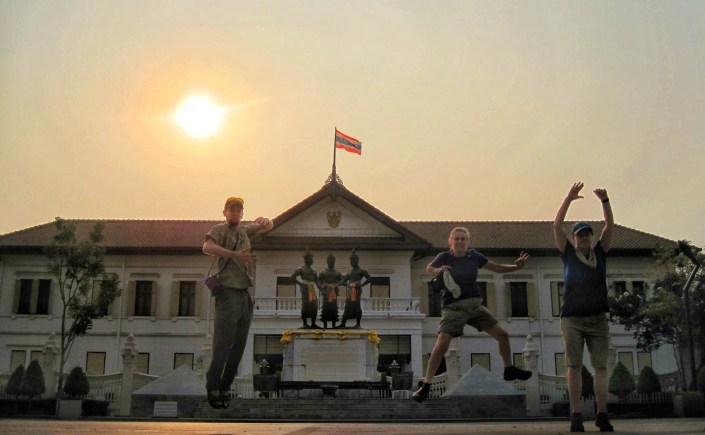
 

Did We Love Chiang Mai, Thailand?

We had high expectations for our visit to Chiang Mai, the biggest city in the northern part of Thailand. We have read about many people that have fallen in love with the city and chosen to move there, so we anticipated that we would have the same feelings during our five-day visit along with Della’s parents. But did we??

Where We Stayed

Choosing a place to stay in town proved to be tough, not because there weren’t enough choices but rather because there were too many. There were quite a few fairly highly rated places in town, with none standing out above the rest.  So we shifted our strategy and only pre-booked two nights at Nonni Guesthouse. This turned out to be a nice and friendly place, although it was on a fairly busy and noisy street and our room was tiny (and had a shared bathroom). So, on our first evening in town we scouted out other locations in the old city area and found the Anoma BB 2 on a quiet side street. It was only a few dollars more and had a private bathroom and included breakfast, so we spent the last three nights there.

What We Did

Chaing Mai’s importance stems from its history. It was founded in the 13th century AD as a new capital for the Lanna kingdom which covered what is now northern Thailand. Chiang Mai had its own independent monarchy up until merging with what is now Thailand in the early 20th century. Many of the sights around town date from the era when it was the capital of the flourishing kingdom. The “old city” in town was originally the center of the Lanna government. Today it is still surrounded by a moat and a few crumbling walls and gates.

Elephant Experience – There are a plethora of opportunities to play with elephants around Chiang Mai. We were pretty happy with our choice!

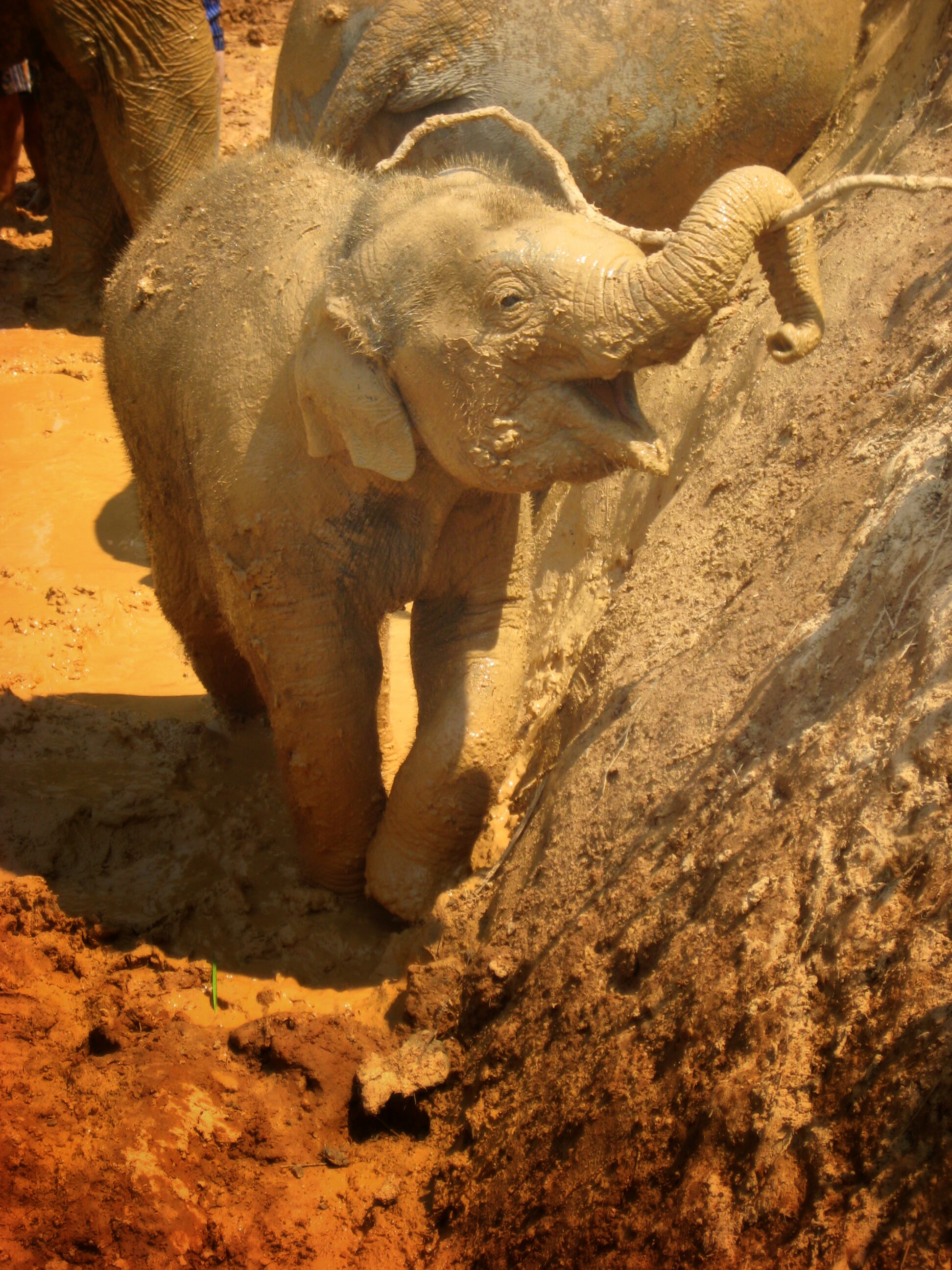
This baby couldn't look any happier

Check the above link for more!

Cooking Class – We also took advantage of a fun cooking class in town!

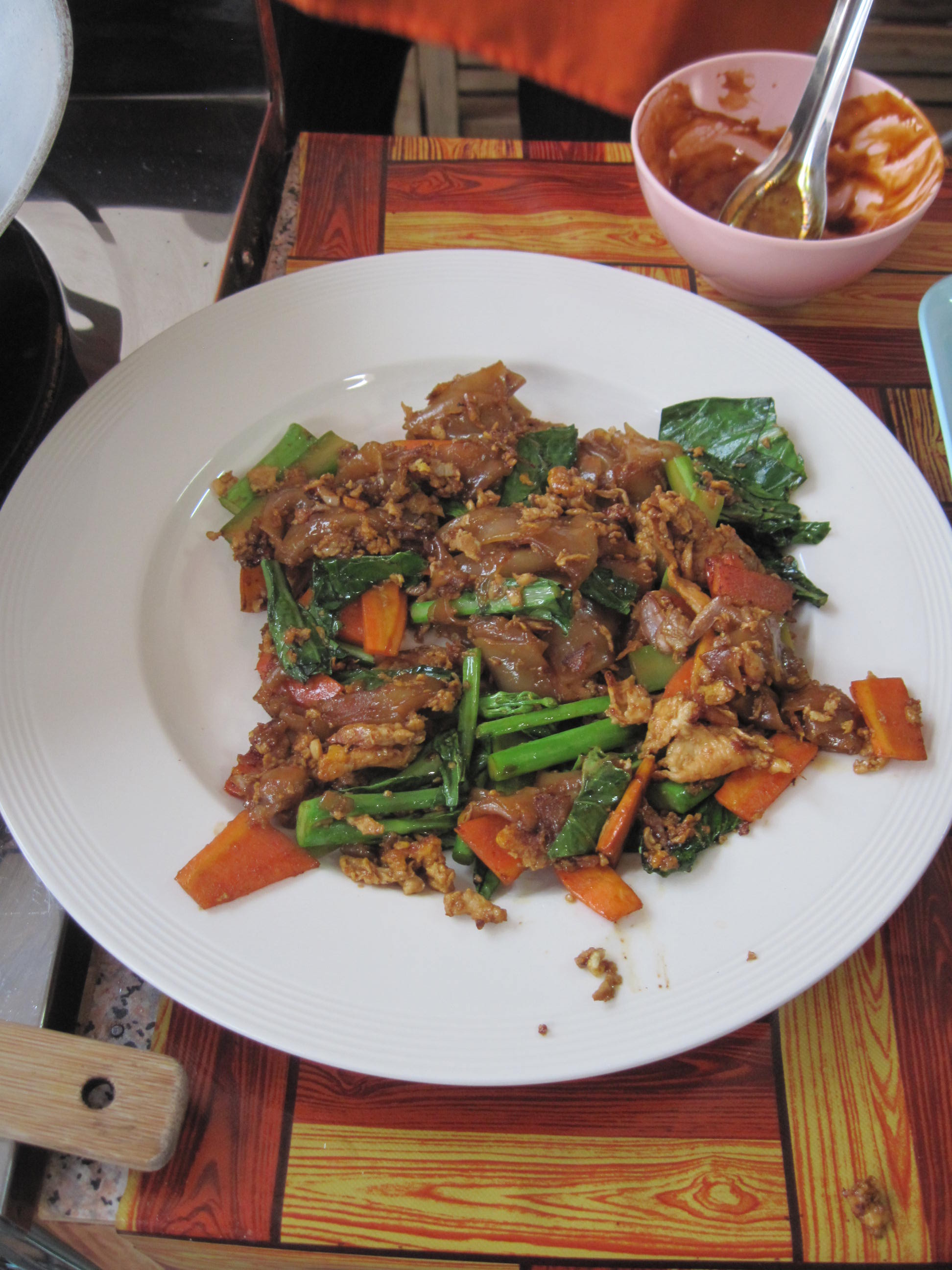
finished pad see ewe

Check the above link for more!

Wats in the Old City –Within the walls are a large number of wats (Buddhist temples), since the Lanna kingdom was Buddhist. We visited the two biggest wats: Wat Phra Singh and Wat Chedi Luang. Wat Phra Singh is the home of the Phra Singh Buddha image, although we got a little confused because we expected the image to actually be a lion (Phra Singh means Lion Buddha), but instead it was just a Lanna-style Buddha.

The main attraction of Wat Chedi Luang is the remains of a large chedi (the same thing as a stupa, a large conical structure that holds relics). We also found the wihan (the main hall) to be pleasing.

Over the course of our wandering we also found a temple made of teak (Wat Phan Tao), a temple made of silver (Wat Sisuphan) and a few other scenic ones scattered about.

We also got to observe some fun events surrounding a celebration at the wat near the Nonni Guesthouse. In honor of its anniversary, there were many events, including one evening where there were multiple processions with dancing, music and monks. The dancing was pretty interesting to watch: there were some groups dancing a traditional Lanna dance with long metal nails on their fingers and then one small group of Hmong women doing their own style at the same time.

Wat Phra That Doi Suthep – One of the most famous wats in Chiang Mai is not in the city itself but rather in the hills to the west overlooking the city. One evening we shared a taxi with some travel friends from the slow boat and headed up the curving road to the base of the wat. From the parking lot, we took the 300 steps straight up the hill to the site of the impressive wat. The main attraction is a large gold chedi which looked especially splendid as the sun began to set. There was also a nice viewing platform overlooking the city, but the air was so hazy from the farmers burning their fields that we could hardly see anything.

History and Culture Museums – Chiang Mai has three museums in the center of the city that one can visit using a combination ticket. We ended up visiting all three. The Chiang Mai Historical Centre told the story of the city from its founding to modern times with some nice modern displays, although it was a little hard to follow some of the translations. The Lanna Folklife Museum had various informative displays on the customs and artwork of the Lanna people. The Chiang Mai City Arts & Cultural Centre was a bit of a combination of the previous two, with some history and some cultural information, although it felt a bit more dated than either of them.

Museum of World Insects & Natural Wonders – A friend back home recommended that we visit this quirky museum set up by a husband and wife team that have dedicated their lives to the study of mosquitoes and malaria. It’s kind of hard to describe what we found here as a museum; it is more like the personal collection of the couple of any natural object they found interesting, including rocks and many different types of beetles. Also scattered through the displays were some of their paintings and some information about mosquitoes, their history and advice on life.

Thai Massage – After a successful first massage for Eric in Bali, we decided we had to check out the Thai massage to compare. After a little bit of research, we discovered that some of the most popular and cheapest places to get massages in Chiang Mai share one thing in common: they are staffed by female convicts or ex-convicts who have gotten trained as part of a rehabilitation program (seems like it might even incentivize someone to go to jail so they could get a job!). We went with the company staffed by ex-convicts. Beyond the interesting story about the personnel, we did notice quite a bit of difference between the Thai and the Balinese massage. This time we were wearing a provided outfit, no oil was used, and the massage felt like much more of a workout than the relaxing Balinese one. They bent us into a few shapes that were pretty extreme!

Wayne in the special provided outfit getting ready for his Thai massage

Wayne in the special provided outfit getting ready for his Thai massage

Where We Ate

We continued to enjoy the relative cheapness and good variety of Thai food to be found on the street and in small restaurants. For the most part, we ate at small restaurants because it was pretty hot and humid outside, and a little relief with shade and fans was appreciated. One notable exception was a meal of street food we picked up at the Saturday Walking Street, a large night market on Saturdays that was just around the corner from the Nonni Guesthouse (a little too crowded for our taste though). None of the restaurants stood out over the others: all had a good selection of fried noodles and curries. We did have an annoying trend for a few days where one person’s dish would take way longer to arrive than anyone else’s.

Final Thoughts

We obviously found a lot of fun things to do in the city – we spent five nights and didn’t have much downtime. The people were friendly and the food was affordable. Nevertheless, we’re a little sorry to say that we only just liked Chiang Mai, not loved it. The heat and the haze from the fires outside the city were pretty oppressive, the narrow streets made the pace a little hectic at times, and it was a little hard to get around without having to call a cab. Maybe it is an issue of expectations: if we had come in not expecting to love it, we may have decided that it was a fun place to visit with an interesting history. Or, maybe it was  an issue of timing; if we had come at a time when it wasn’t as hot and hazy, we might have enjoyed exploring more of the city. But since we had heard such great things, we instead just had to say it didn’t quite live up to it.

Tasty Thai Food at Tom Yum Thai Cooking School in Chiang Mai, Thailand

Food in Thailand – yum! This has been one of our absolute favorite places in the world when it comes to eating.

Della is in heaven eating her fried noodles – whether it be pad thai or pad see ewe – every day! Eric has loved all the different kinds of curries! Everything is delicious and we could probably eat here forever.

For that reason, we were super excited to do a cooking class. We had some time in Chiang Mai and we knew that there were several classes offered. Della picked one where one of the main offerings was Pad See Ewe.

The one we chose was called Tom Yum Thai Cooking School and we loved it.

Our first step was to get picked up by our teacher Oun from our hotel in a minivan. He brought us quickly to one of the markets in the city. Here he showed us many of the different vegetables and herbs we needed to know for cooking Thai food. Some of the more interesting things we learned were:

  1. Ginger and Galangal are almost the same, but different.

    Ginger and Galangal

    Ginger and Galangal

  2. Raw turmeric looks a lot like ginger.
  3. There are 3 different kinds of basil used in Thai cooking: holy, lemon, and sweet. (We mostly used sweet)
  4. There are a ton of different kinds of eggplants – the Thai ones we used were tiny.

    two different kinds of tiny Thai eggplants

    two different kinds of tiny Thai eggplants

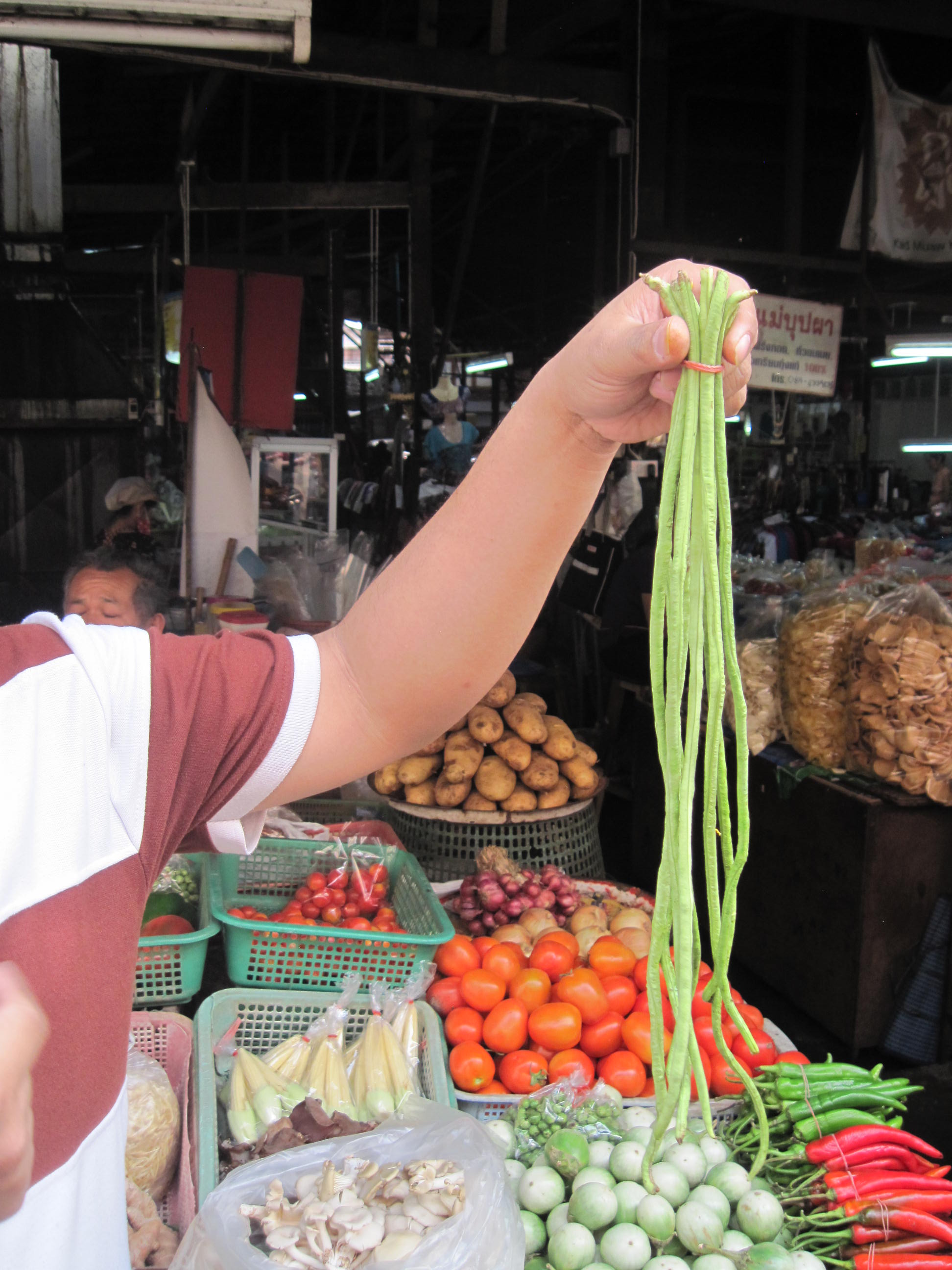
  5. Long beans in Thailand are truly long!

    Loooong beans

    Loooong beans

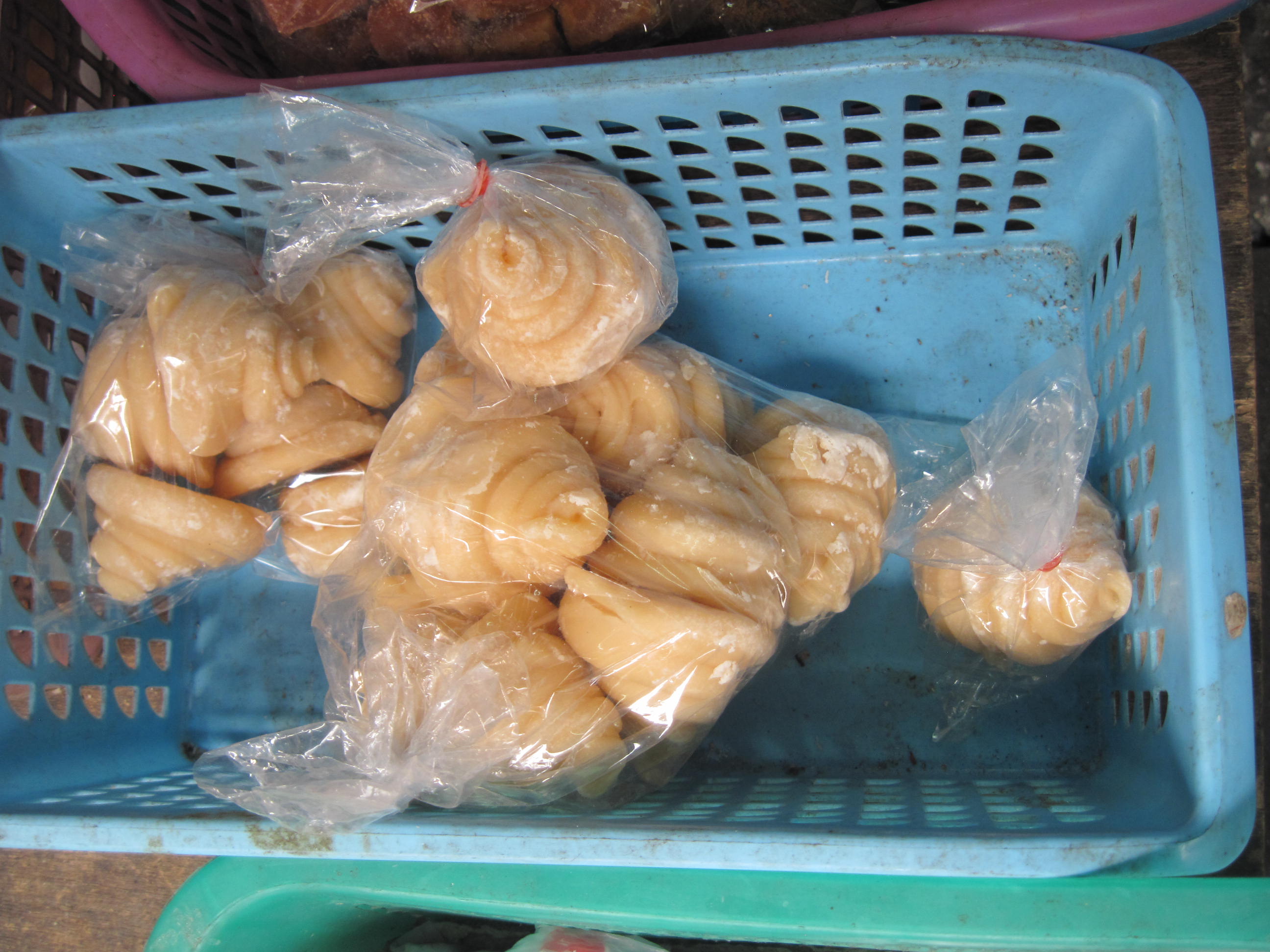
  6. Palm sugar is a thing and can be sold in different ways.

    this is palm sugar

    this is palm sugar

We also just enjoyed wandering the market with someone who knew what everything was.

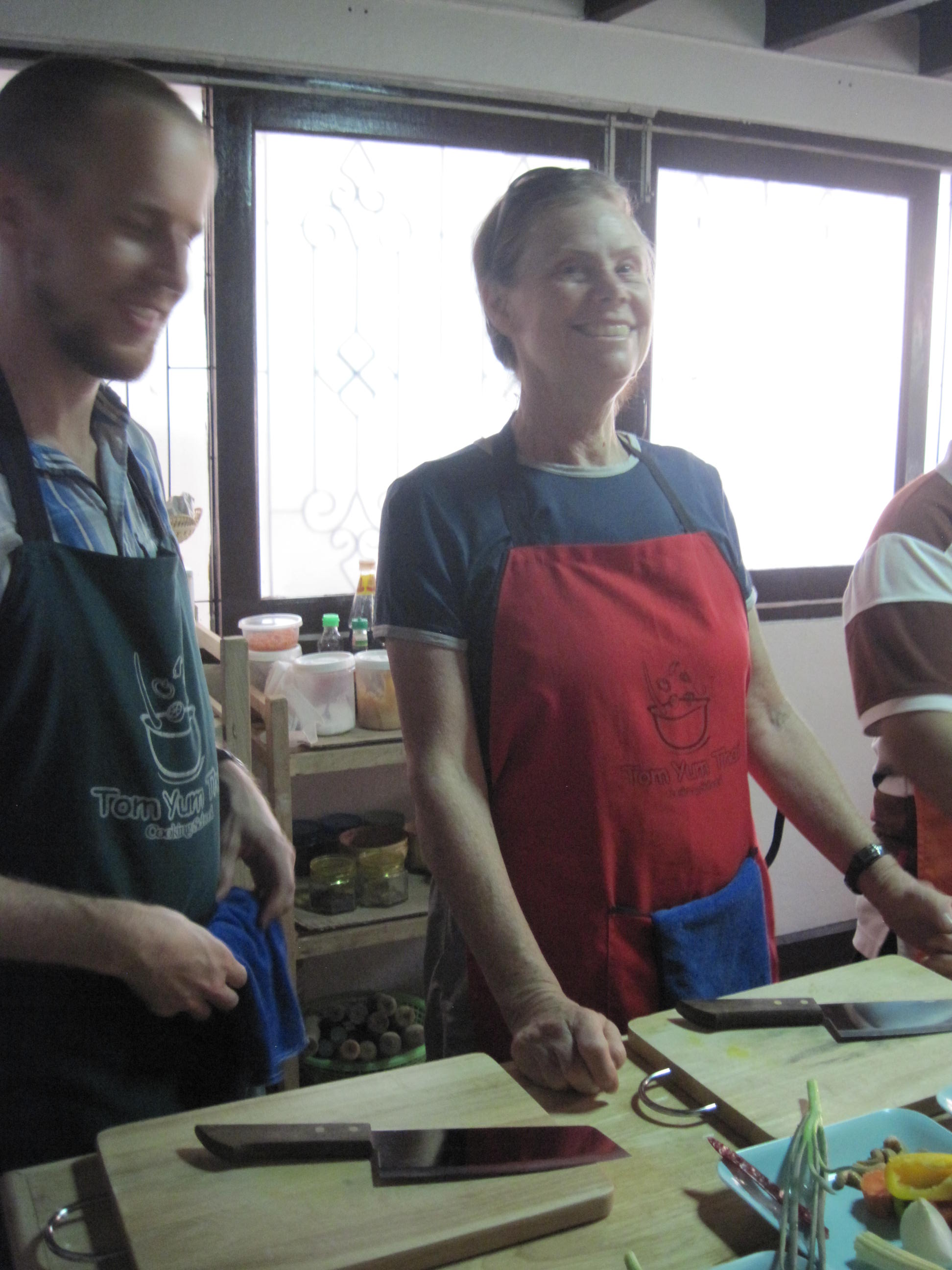
After shopping for our food, we hopped back in the van and headed to Oun’s house.  Here we quickly got dressed up in our aprons, ate a quick snack of prawn crackers, and then began to cook.

Eric and Peggy getting ready to cook!

Eric and Peggy getting ready to cook!

Throughout the cooking class, we had the chance to cook and eat 5 different courses. For each course, we had a choice of three different things to learn to make. For the most part, because it was Eric, Della, and Peggy taking part, we each did something different.

Course 1: Stir Fry

Della learned Pad See Ewe, but both Eric and Peggy learned Pad Thai. For each course, we learned our ingredients, the best way to prepare them (chopping, smashing, etc), and then the order in which to cook. We won’t tell you too much more: you’ll have to go take the class yourself! Cooking these dishes did make us want to buy a fancy wok when we get home.

Course 2: Soup

Della learned Tom Kha (chicken in coconut milk soup), Eric learned Hot and Spicy Pork Soup, and Peggy learned Hot and Sour Prawn Soup. The base of the different soups was actually quite similar, and there were only a few ingredients that distinguished them. For example, Eric’s soup did not use coconut milk but the others did.

Course 3: Salad

Della learned Cucumber Salad, Eric learned Mixed Fruit Salad, and Peggy learned Papaya Salad. All of the salads used the same homemade dressing, which was a flavorful mix of sweet, sour, salty and spicy ingredients.

Course 4: Curry

Della made Green Curry paste, Eric made Khao Soi Curry Paste, and Peggy made Panang Curry Paste. After all the pounding and grinding to get the paste, we each made the corresponding curry. Eric’s was slightly different as his was more of a curry noodle soup (a Chiang Mai specialty) and his was quite a bit more complicated. He was also the only one in the class who chose this dish so had to do the grinding of the curry paste all on his own! He didn’t report being too sore though!

Course 5: Dessert

We all learned how to make Mango Sticky Rice. Yum! We learned a lot about making sticky rice that we didn’t know: for example, it is steamed, not boiled!

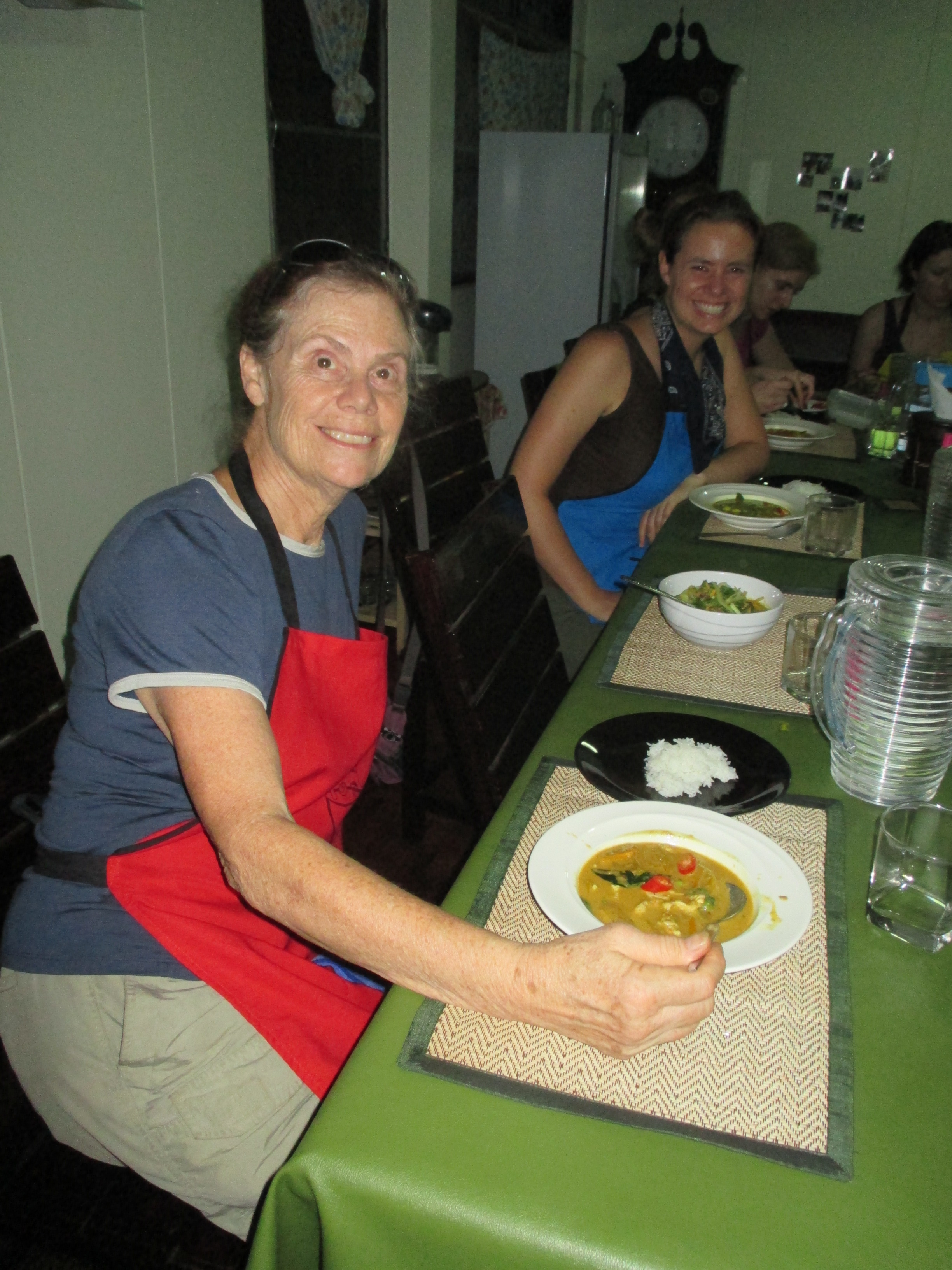
One of the best parts of the class was that we got to eat everything we cooked. It was all delicious and we were quite stuffed by the end!

IMG_6153

Enjoying our meals


We can’t wait to get home and try out our new, mad Thai cooking skills. We are hoping that we are able to find all of the proper ingredients at home in Denver. We know we might be making quite a lot of trips to HMart in our future!

Excellent Experience at Elephant Jungle Sanctuary

We knew we wanted to experience some time with elephants while we were in Chaing Mai, Thailand. It was something that had been on our (especially Della’s) list for a long time. However, we had read a lot about elephant tourism and the pro and cons.

Choosing an Elephant Park

One of the biggest negatives we had heard about was some of poor practices that have traditionally been used in elephant tourism. Often elephants are ridden or trained to do shows for tourists. In recent years, there has been a lot of effort in educating tourists on the dangers some of these things cause for elephants. We had read several articles like this one by the blogger Nomadic Matt with the same theme: elephants have been treated poorly during training, so we were thinking hard about the place we would like to visit. Almost all of the articles mention the Elephant Nature Park as a place using proper practices.

But, as we arrived in Chiang Mai and saw the plethora of options available to us, we decided to do a little more research. The most highly rated elephant park offers elephant riding (without a seat), feeding, and bathing the elephants. After reading several lovely reviews of that park though, we came across this blog. It describes a counterpoint experience between two places and mentions that the most highly rated camp both chains its elephants and uses bull hooks on them. This turned us off. However, the description of Elephant Nature Park, while lovely, seemed a whole lot like an experience we had in Africa with actual wild elephants. We weren’t sure we needed to pay for that.

But finally, we found a brochure for the Elephant Jungle Sanctuary and further research led us to this blog. We scoured the pictures and saw no chains or bull hooks. It also showed that the elephants were rescued by and living in a Karen village. Many of the students Della teaches are Karen refugees so we were excited to visit an active village in Thailand. That sealed the deal.

Visiting the Park

We were more than excited on our day to visit the elephants! We were picked up by Ken (maybe Chem) in the morning in a songthaew and drove the almost two hours up to the village. The majority of the road is highway, but the last hour or so were on curvy mountain roads. We were very happy when we arrived as we were on the verge of car sickness. We walked a short way through the currently dry rice fields to arrive in the village. We were given our uniform for the day: beautiful Karen shirts!

Our group consisted of 9 people plus our leader Ken. There were about 2 other groups of about the same number. Each group headed off to a different group of elephants. The first group we met was a male and female elephant, both retirees of logging. Ken explained that they were “boyfriend and girlfriend” and enjoyed spending time together. The female elephant was indeed pregnant and we were told she had one year left to come to term. We enjoyed feeding the elephants bananas and stroking their trunks. They were calm and friendly and we saw no chains or hooks. The mahouts used verbal commands when needed. Each elephant wore a bell, which we were told was how the mahouts locate them at night as they are never chained. Ken also pointed out many times that both the elephants seemed fat and happy. He showed us some remnants of their time as logging elephants though, as shown by their ragged ears.

Our next stop was to visit what we’ll call the Old Lady Elephant. She was very calm, but loved her bananas!

Our final feeding stop was really the most exciting. We met two momma elephants and their two babies. We can’t quite remember the ages, but we think the larger baby was more than a year and the smaller one was less. The larger baby was quite rambunctious and enjoyed shoving some of the mahouts around. We truly enjoyed interacting with these super cute creatures!

After feeding the elephants, we headed back to the main area of the village for lunch. It was delicious Karen food which we enjoyed while overlooking the river. With a little time to relax, Wayne headed down to take a swim (of course)!

The next part of the day consisted of the “mud spa.” The mahouts brought down Old Lady elephant and Momma elephant with the Big Baby. They were SO excited to enjoy the mud. It was a lot of fun to go into the mud and experience their glee! They would pick the mud up in their trunks and fling it all over themselves, catching us in the process sometimes. They rolled around and rubbed their faces on the mud wall. We were invited to help them by throwing mud on them and rubbing it on their bodies. We really enjoyed this, as did all of the other tourists. The only thing we worried about was that the elephants (particularly Momma and Big Baby) were so excited that they were practically running around. Without keeping watch and being ready, we could see an accident happening. The mahouts believed that the elephants would never have trampled the humans, but we were content to keep our space while they were moving and hope that future visitors will also be thoughtful about not getting themselves in dangerous situations. The elephants are clearly happy and well treated here, but we are concerned that this might change if there was an accident with one of them hurting a tourist.

After the elephants (and us) were thoroughly muddy, we headed down to the river. The elephants loved splashing and rolling in the water. We were given buckets and scrub brushes to help clean and cool them off. We never got on top of the elephants, and we kept our distance when they were so excited that they were rolling their big bodies around and climbing on top of one another.

At the end of the day, we cleaned the rest of the mud off in the river and headed back to camp. We were given the opportunity to buy Karen souvenirs before we headed out. Della bought a Karen bag and Wayne wanted a different kind of souvenir. He asked for and was sold an elephant bell!

A new elephant bell for Wayne

A new elephant bell for Wayne

Overall, we absolutely loved our experience here and everything we saw indicated that their elephants are happy and treated well. We hope that future visitors will show proper respect to the animals and make sure not to get in their way so that no accidents will happen!

Logistics

The cost of the day was 2400 baht (about $73) per person (so quite a splurge!!), but when we booked through our guesthouse, they gave us a small discount.

The trip up and down took about 2 hours each way, so be prepared to spend a lot of time on the road.

Wear swim suits that you don’t mind getting muddy. The mud stained some of the white portions of Della’s suit.

Be careful and enjoy these amazing creatures!

Black and White in Chiang Rai, Thailand

To our email subscribers, we are sorry for the email you received of this post before. It came in error. This post, however, should have all functional links!

After Laos, our next plan was to travel through the northern part of Thailand back down to Bangkok. We debated which towns to include in that journey. We considered heading straight to the large city of Chiang Mai, but pictures and stories of quirky white and black temples convinced us to head to the far northern city of Chiang Rai for a couple of days.

Where We Stayed

We found a nice place online called the Jansupar Court Hotel with two large AC rooms with their own private bathroom. We were happy to take advantage of the cheap washing machine and also enjoyed some late afternoon drinks in the small bistro onsite. The family that runs the place was also fun to interact with. The main downside of Jansupar was that it was located somewhat far outside of town – about a 20 minute walk – so sightseeing wasn’t as convenient as it could have been.

What We Did

The two main attractions in Chiang Rai provide a nice counterpoint to each other – one white and one black. We took a local bus from the main bus station to both which was really quite easy to figure out!

We first visited Baan Dum, the Black House. This attraction houses many different somewhat traditional structures, most painted black. It was built by the Thai National Artist Thawan Duchanee using his own money. The interior decorating for the buildings was mostly done with furniture made of animal bones and plenty of animal hides. We could only go inside the largest temple-shaped structure, but could see into many of the smaller buildings.

The next day we took a visit to Wat Rong Khun, the White Temple. As the name suggests, this is a large, elaborate temple painted in all white (plus some shiny mirrors). This is definitely a modern take on a temple, with some very strange designs on the outside. It was constructed by a different Thai artist, Chalermchai Kositpipat, also using his own money. The main temple is reached by crossing a bridge over a sea of outstretched hands said to represent desire. Inside the temple itself, we spent a long time trying to decipher the murals. At first glance it seemed like typical Buddhist scenes, but the lower level included many images from popular culture, including Neo from the Matrix, Darth Vader, Michael Jackson and Elvis. We never could quite figure out what it was supposed to mean. In this room and on many of the other buildings we could see visible damage from the strong earthquake that hit the region in 2014. We were a bit bummed that we weren’t allowed to take pictures inside.

Outside the main temple, there are a few other small attractions in the complex that were worth a visit. We paid the equivalent of a dollar to buy a charm to we wrote a small message on and hung up with others. Even the bathroom building was quite fancy.

We had a fun experience on the way back from the White Temple. We had visited with another couple that we had met on the slow boat and we ended up having to wait for the bus back for a long time. It just wasn’t coming, so we tried to hail a songthaew , but the only one that came by was too full for 6 to fit in. Finally, a man in a truck drive by and asked if we wanted a ride. We thought he might be a songthaew but we were confused when we asked how much and he sort of shrugged. We clambered in the back and rode off towards town. Wayne had gotten in the front and chatted with guy who was enjoying the company and trying to teach him Thai. Wayne told him the way and he took us all the way back to our hotel (even stopping once to ask directions). We tried to give him money at the end, the equivalent of what we would have given the bus, and he even tried to give some back. It is times like this when our hearts are warmed that there are people who just want to meet others and help!

Our ride back from the White Temple

Our ride back from the White Temple

We only saw a few of the sights in town itself since it was somewhat of a walk to get there. We did walk by a pretty clock tower in town – it looks quite a bit different from the ones we saw in Europe! We visited the Hilltribe Museum, which felt a little similar to the museum in Luang Prabang but focused on the Thailand hill tribes. There was also a large display here on the opium trade, since the “Golden Triangle” area nearby was once an epicenter of production by the hill tribes. Della was quite excited because she found a new wallet in the gift shop after many years of searching! On the way to the Hilltribe Museum we came across an interesting city park filled with mannequins dressed up in fairy tale costumes made from fake flowers. There was also a night market where both Della and Peggy both bought scarves (yes… more scarves!)

Where We Ate

Everyone talks about the cheap and good street food in Thailand, so we were excited to again have to the opportunity to try it out. Our favorite meal was probably some fried noodles we ate from a stall in front of one of the ubiquitous 7-11s (where we got a cheap beer to wash it down with).

Street noodles!

Street noodles!

We also ate a dinner in the night market food court, which was filled with stalls offering many different items. The most popular seemed to be a hot pot that allowed you to cook at your table, but we stuck with fried noodles here as well.

One day for lunch we found a simple place near us (that we later think we learned was recommended in Lonely Planet) and got a nice noodle soup. Each one of these meals cost us about a dollar each!

Enjoying our khao soi

Enjoying our khao soi

Final Thoughts

Compared to larger cities, Chiang Rai may not have had as much to offer, but in terms of unique attractions it seems to have a plethora! We are glad that we spent a couple of days here to experience the white and black sides of Thai art.

Meandering up the Mekong on the Slow Boat to Thailand

After Luang Prabang, our next major stop was to be Chiang Rai in Thailand. One can get there a variety of ways, including a long bus ride or a plane trip, but instead we decided to take the “slow boat” up the Mekong River. It is so named because the journey takes two fairly long days of travel just to get up to the Thai border. But, we figured that it might be more scenic and more of a unique adventure.

Day One: Luang Prabang to Pak Beng (Laos)

The Lonely Planet says that the boat dock is in town, but luckily we had done some extra research and discovered that the boats now leave from a dock 11 km north of town. We made sure to get a sŏrngtăaou (pickup taxi) to get us there in plenty of time so we could make sure to get good seats. We were the first people to get our tickets at the ticket office, but then panicked because a large group beat us down the hill to the dock. Luckily, they ended up heading to a different boat and we were able to choose good seats.

Waiting for the ticket office to open

Waiting for the ticket office to open

The boat looked as expected, a long narrow configuration with a roof. The seats seem like they should be in passenger vans and are mounted on bases which are moveable. When it became apparent that the boat was not going to be full, we spread out so each of us had a set of two chairs. A good number of locals got on board but all sat in the forward cabin. We also had to wait while some motorbikes and roofing tiles were loaded up front. They asked us to take off our shoes as well, like we were in their house.

As we cruised along the river, life moved pretty slowly. At first it was a little chilly with a cool breeze coming off the water. We managed to stay in the shade as well. We all read our various books – Eric even finished one! The only food on sale on the boat was chips and instant noodles, but we had planned ahead and had some snack foods to eat for lunch.

The scenery outside was pretty nice. Lots of wooded hills on either side. Plenty of water buffalo lounging by the water. A few fisherman using large nets in the river. Not too many other people except for at a village where we stopped and unloaded the roofing tiles.

The river moves quite fast, especially when going through some of the narrow rocky stretches. Since we were moving upstream, it was kind of fun and bumpy in these stretches.

We arrived at Pak Beng, our stop for the night, at around 4:45. There were already a lot of boats tied up at the pier, so getting off was a challenge. We first waited for them to get two motorbikes off the front, then we went off the front and had to scramble up some rocks and sand before finding steps.

As we walked through town there were plenty of guesthouses offering rooms for about the same rate. We had expected this and didn’t even book ahead, which is a first for us in a long time! Wayne had read about one called Monsovanh and zeroed in on that. They got a room with AC for 130,000 kip ($16). Eric wanted to negotiate more so we headed on further. We ended up with a room with a fan at a place called Vassana for 80,000 kip ($10). The room was pretty nice and clean actually.

As the sun set, we found a nice wat in town which gave a good vantage point over the river. Restaurant options were not very exciting in town, so we just chose one that seemed cheap and had a nice terrace looking out over the river. The food was ok, but took quite a while since there just seemed to be one person working there.

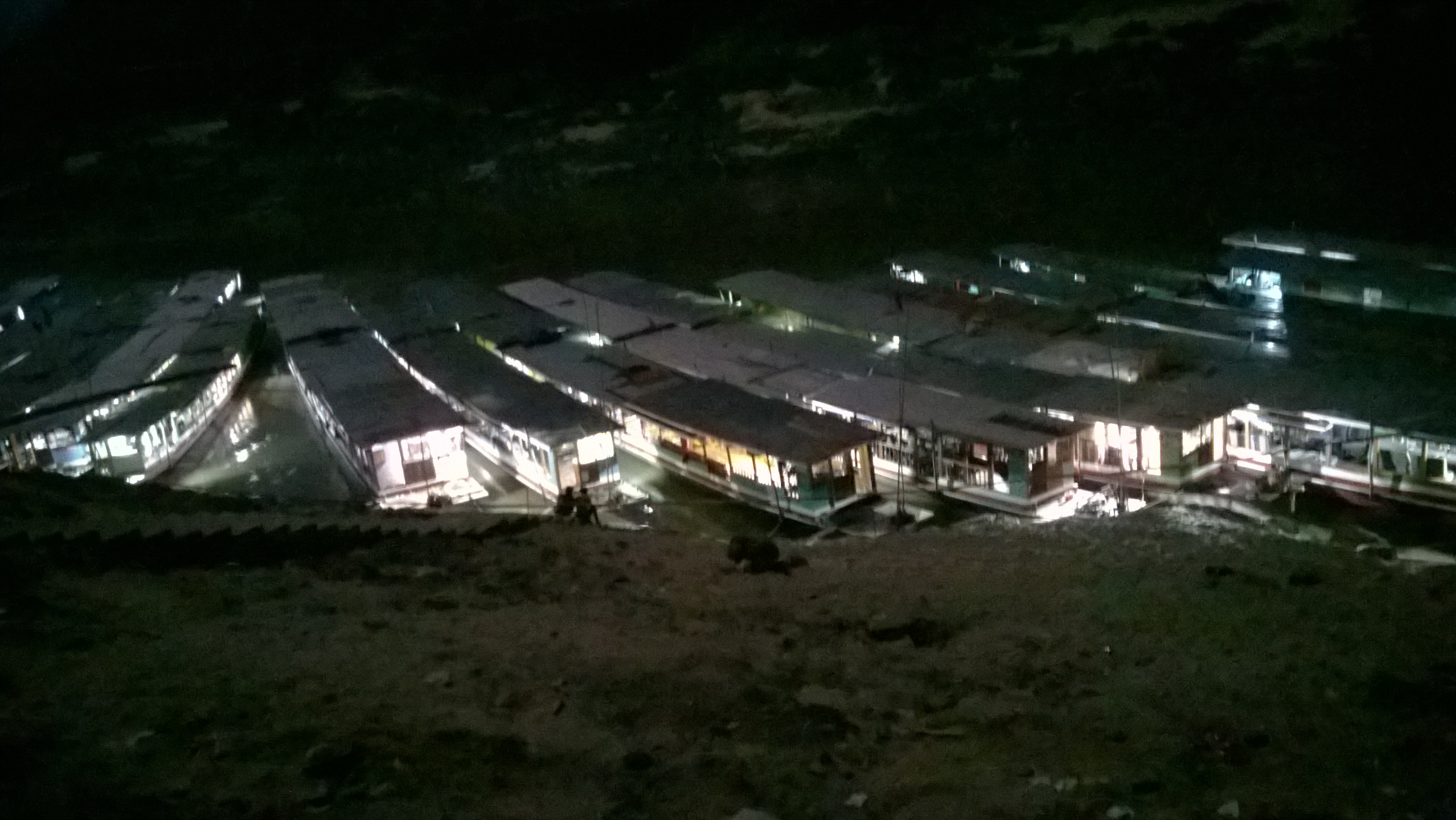
We picked up some snacks at a mini-mart in town in preparation for the next day. It was also pretty interesting to walk down to the docks and see all of the boats tied up for the night.

WP_20150303_20_19_11_Pro

Even though we didn’t have AC, it got cool in the evening and we didn’t even use the fan. Overnight we had to hush a loud cat outside our window but other than that it was a pleasant sleep.

Day Two: Pak Beng to Houay Xai (Laos)

We got up early to make sure to get to the pier in plenty of time to get a good seat… and to confirm that the seat was on the right boat, since it wouldn’t necessarily be the same one!

Even with our early arrival, we weren’t the first ones there. Most of the other people from the previous day were already on board, so we only got ok seats. (And it was a different boat with a different crew.) This time we got four seats in a group from the start. There were even less locals on board, and it seemed a few people had stayed longer in Pak Beng, so the boat felt maybe only a third full. The boat was a little less nice as well – it felt a little narrower and the railing was higher so it felt like you saw less.

IMG_5938

As we got going, we realized that the motor also seemed louder. We tried to have some conversations but realized that reading would just be easier. As the morning went along we all read and relaxed. The scenery was a little less impressive but the time still went by quickly. We read and relaxed – Eric finished another book – and chatted with some fellow passengers (Wayne especially).

At one point in the late afternoon, we noticed two of the passengers helping bandage the hand of a local guy on the boat. Then we realized he was missing a finger! Apparently he had just lost it in an accident – although not on the boat. Wayne dug out some extra painkiller to give to him. What was amazing was that the patient was just smiling the whole time!

We knew we were close when we went under the big cross-border bridge. After that it still took about 30 minutes to get to the jetty in Houay Xai.

Tuk-tuk drivers were waiting there to take us into town, but it seemed like it was just a kilometer so we decided to get some exercise and walk. A few other passengers from the boat had the same idea so we walked into town together. We formed a group and went door to door to a few guesthouses in the “center.” In the end we went back to the first one we had tried since it was 10,000 kip cheaper and got rooms for 70,000 kip – about 9 dollars.

IMG_5954

We found another basic restaurant for dinner along with our new travel friends. We were a little sad that our last meal in Laos wasn’t at a fancier place, but we were still able to get one last laab.

We returned to the room and got ready for bed. While Della was showering the power went out! We looked out in the hallway and all the lights seemed off, so we figured the whole place had lost power. But the Internet was still working, which seemed odd… We opened up the windows to let the cool night air in and headed to bed.

IMG_5951

Day Three: Houay Xai to Chiang Rai (Thailand)

When we woke up in the morning to roosters crowing and a loudspeaker blaring, we noticed our power was still out. Preparing to write a scathing TripAdvisor review, we then noticed that the power was back on in the hallway. This seemed odd… we finally went down to the front desk to ask and they saw that the circuit breaker for our room had tripped! So the whole time it was just our power and no one else’s that was out. Della is afraid that it was because her hot shower caused the breaker to flip. Oops!

The shower that might have caused the whole problem...

The shower that might have caused the whole problem…

The previous night we went ahead and booked a combination ticket through an agent in town that would get us to Chiang Rai, our first stop in Thailand. Some of our friends from the boat also booked the same thing, so we were happy to have some nice travel companions along as well.

Buying our tickets

Buying our tickets

Step one was a 15-minute sŏrngtăaou ride to the Laos immigration office, where we got stamped out of the country. Step two was then to ride a shuttle bus (included in the ticket price) over the Friendship Bridge and onto the Thailand side of the river. Getting stamped into Thailand went quite smoothly. We were especially happy because we got a 30-day visa – everything we had read suggested that land crossings would only give us 15 days, and we weren’t sure that gave us enough time in the country. But 30 days should be plenty!

Unloading from the souengthaw

Unloading from the sŏrngtăaou

The final step was a minivan transfer from the border to Chiang Rai. This seemed the most dubious step because no one accompanied us over the border. Instead, we were just given stickers with the name of some guesthouse and were told that someone in Thailand would come pick us up using the stickers to identify us. No one was waiting when we got over, so we were a little nervous. After about 30 minutes they finally showed up and turned out to be legit, so we got our ride into Chiang Rai.

The ride was pretty nice, although we were annoyed that the driver asked us for an extra payment to take us to our guesthouse in Chiang Rai. He claimed that otherwise he would have to drop us off at a bus station way outside of town! This seemed somewhat silly to us, but he was only asking about $1 a person ultimately so we just decided to pay it anyway.

Final Thoughts

We are happy that we used the slow boat to get to Thailand from Luang Prabang. It helped us see some parts of Laos that we wouldn’t have otherwise, and also to get more of a feel for the rural areas in general. The ride was very comfortable and relaxing, and allowed us plenty of time to catch up on reading and just enjoy the serenity of watching the scenery go by.

Bangkok, Thailand Part 1

Our first stop for the second half of the trip was the capital of Thailand, Bangkok. We arrived on the evening of the 7th, and were leaving for Myanmar on the 10th, so we didn’t have much time in Bangkok. Therefore, we decided to not try and see everything we wanted to in Bangkok and instead take it easy and recover from jetlag. We know that we will be back through this Southeast Asia transport hub at least one more time.

Where We Stayed

Choosing a place to stay in such a large city is pretty overwhelming, especially when there are so many budget options. We saw good reviews for the U-Baan Guesthouse on hostelworld, and it sounded like it might be a little quieter than other places since it was in a non-tourist neighborhood. There was no double room available, but there was one with two twin beds, which is fine.

We ended up enjoying our time at the U-Baan, but didn’t really feel a connection to it. This was probably our fault though, because we never chose to hang out in the common area and interact with the other guests. The best part of the U-Baan is the owner, Joy: she was a great help with many of our needs while in Bangkok, most importantly coordinating with the airline to get our bags delivered the day after our flight.

What We Did

Since we had the limited amount of time in Bangkok, we chose to focus on activities that were easily reached via the Skytrain (the elevated rail system), since there was a stop near our accommodations. This meant foregoing visiting the Royal Palace and the biggest temples, but we definitely plan to see them the next time through.

Our first afternoon in town, we were still pretty tired so we just took a walk around the neighborhood surrounding the U-Baan. We walked through a small local market then headed up a big road with a vague plan to make it to the river. On the way, we saw a temple of to the side and ended up investigating. It turned out to be the Wat Phitchaya Yatikaram, a minor royal Buddhist temple. There was hardly anyone else there, so we just strolled through the grounds. We weren’t really sure of the rules for visiting yet, so we didn’t linger. This was enough for the moment so we just headed back to the guesthouse.


In the evening we rode the Skytrain downtown to check out the MBK Center, one of Bangkok’s giant malls. We thought the mall we saw on Istikal Caddesi in Istanbul was large, but this one blew it out of the water! It was seven stories tall, and each story covered a huge amount of ground. This is known more for discount options, so instead of big chain stores it is dominated by small booths selling discount clothes, electronics and other merchandise. We took a while walking a loop on each floor to get a glimpse of all that was for sale. We also visited to try out the food court, which had come recommended – see Where We Ate below.

The next day we hopped back on the Skytrain towards downtown, this time hopping off near Lumphini Park, Bangkok’s version of New York’s Central Park. We wandered through this shaded urban oasis and found a nice spot to relax and read our books for a while.

We then walked past more fancy malls and headed to the Jim Thompson House, the impressive complex of old Thai teak structures that an American expatriate put together to house his art collection. After his disappearance, it was turned into a museum. To see the interior of the main living quarters, we had to take a guided tour. The interior is quite impressive, with beautiful dark teak wood and Thompson’s art collection displayed throughout. After the guided tour we were able to wander through the other houses that made up the complex. Thompson made his fortune in the silk industry, so there were also some interesting displays on how the silk thread from the worm is turned into the fabric that is so highly prized in the garment industry.

The MBK Center was in the area, so we returned there for dinner, then headed home on the Skytrain. While in the Skytrain station, we got to see a pretty cool Thai tradition: at 6 PM, the national anthem is played over the loudspeakers. Everyone froze in place and stood at attention as the anthem played. As soon as the song was over, everyone un-froze and continued on with whatever they were doing.

Where We Ate

We were very excited about the food, since we both love Thai food and we had heard that it would be very cheap! We were not disappointed. 🙂

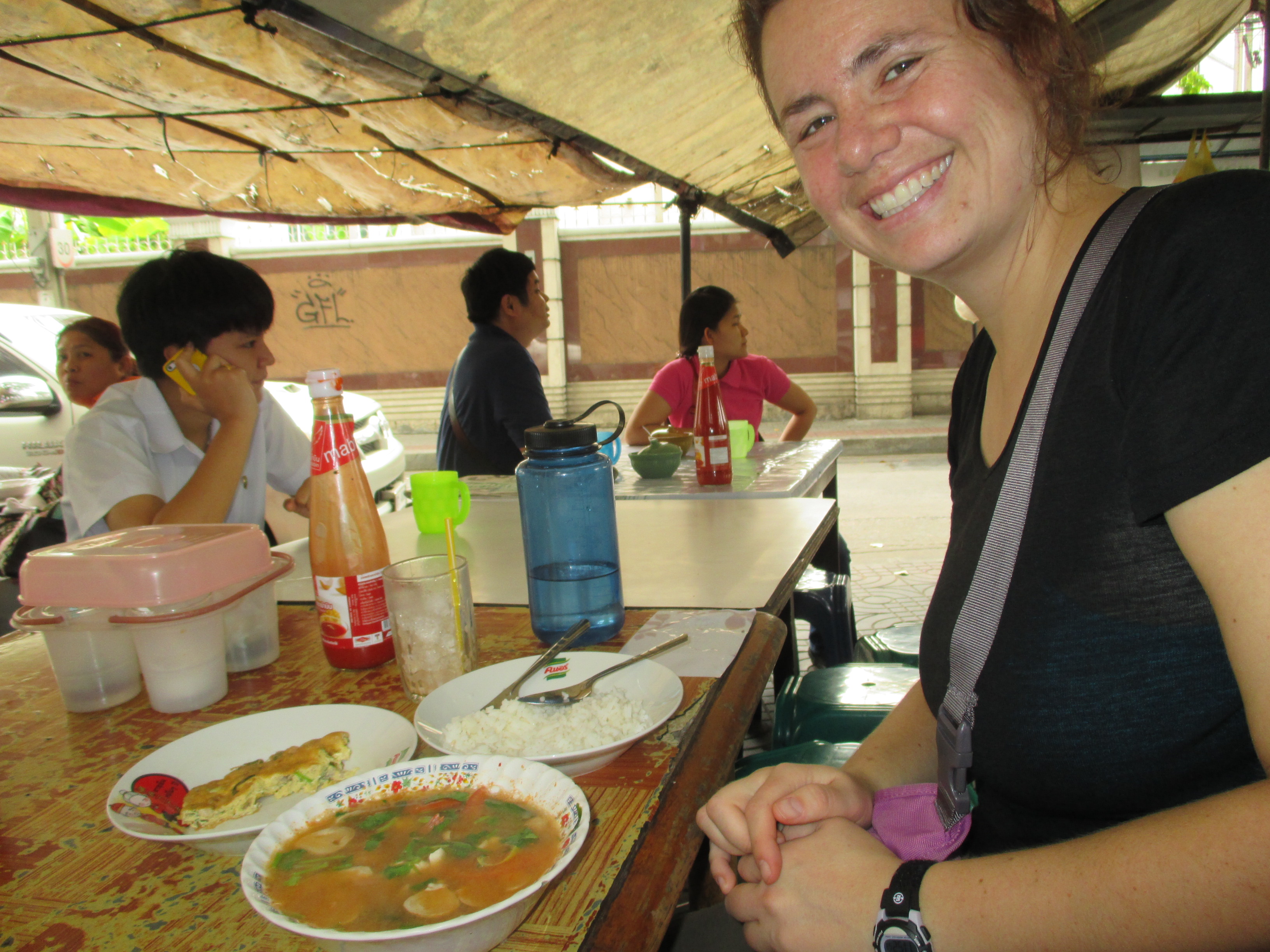
On our walk the first day, we saw a small food stand on the side of the road that seemed pretty popular with locals. We wanted to jump right into the food scene, so we grabbed a plastic seat and waited for the magic to happen. Unfortunately, the cook didn’t speak English, and our effort to gesture at what someone else had didn’t work. Luckily, a traffic cop saw this and came over and helped translate. We ended up getting a tom kha soup with meat and seafood in it. It was quite tasty, and only $2.55 (plus $0.45 for a Thai iced tea).

IMG_4040

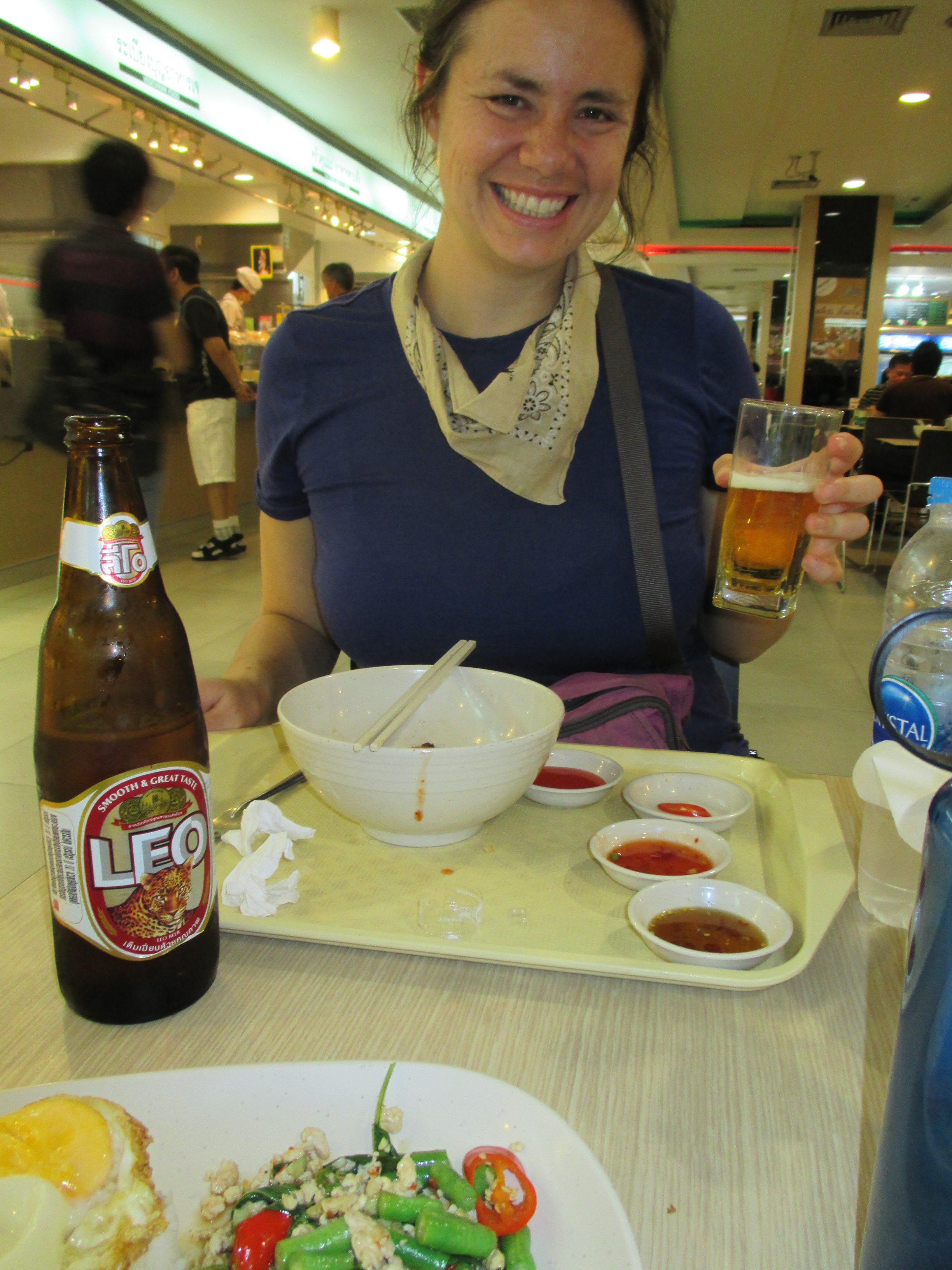
At the MBK Center, we were on the lookout for a food court where you could choose from a wide variety of international options for cheap. On the fifth floor, we saw the International Food Avenue and figured it must be it. We were given a plastic card loaded with a large value, and then you could go between different stalls and order what you wanted. They would then swipe your card for the appropriate amount. Della found a pad see eew (her favorite Thai dish) and Eric got a red curry with duck. The total with two beers worked out to be close to $20, so still cheap by American standards but not as cheap as we were expecting. Right after eating, we went up to the next floor and found a different food court that was almost half the cost, so we then realized we had ended up at the wrong place!

So, the next day, after visiting the Jim Thompson House, we returned to the MBK Center and ate dinner at the food court on the sixth floor. Here you also got a card to swipe at different stalls, but it was definitely less fancy but cheaper. Here Della got a fried noodle dish and Eric got a fried rice dish. The total with a beer was only $8.40, which was more in line with our cheap expectations!

Whoops, almost finished before we even take the picture!

Whoops, almost finished before we even take the picture!


Small Comforts: Our Own Bags and Soap

As we mentioned in our post about getting from Denver to Bangkok, we had a tight connection in Beijing. Fortunately, we made the connection… Unfortunately our bags did not.

We always keep a small bag of toiletries with us in carry on for plane use, but this mostly consists of toothbrushes and lotion. We were very thankful to have that for our first night in Bangkok!

Thai Airways promised us that they would deliver our bags the following day, and lucky for us, they did. Our bags arrived about 5pm the day after we did. It seemed like a smooth process, but we had help from our hostel owner who had dealt with this before…

IMG_5425

When we received our bags!!


It is so nice to have access to soap again! Especially in a sticky, humid environment!

image