We’ve Finished our RTW, so What Were Our Favorite… Ruined Cities?!

We’ve finished our RTW trip. We get a lot of questions about our favorite things on the trip. We’ve decided to start a new series called “So, What Was Our Favorite…” We visited 29 countries on our RTW: Egypt (just 1 day), South Africa, Botswana, Zimbabwe (just 1 day), Namibia, Germany (just 1 day), Czech Republic, Poland, Slovakia, Hungary, Croatia, Slovenia, Bosnia Herzegovina, Montenegro, Albania, Greece, Turkey, Ireland, USA, Myanmar, Singapore, Indonesia (just Bali), Cambodia, Laos, Thailand, Vietnam, Hong Kong, Macau, and Nepal.

This edition looks at our top 10 favorite ruined ancient cities. These are not in order from best to worst. They are just our top 10 favorite in the order in which we visited them.

Butrint (Albania)

Butrint was the first large ruin we visited in Europe. This archaeological site has a fascinating history: it has been the location of Greek, Roman, Byzantine, Venetian and Ottoman settlements. Old structures from all of these are scattered throughout this small park located on a peninsula in a lagoon off the Straits of Corfu.

IMG_2615_edt

Delphi (Greece)

The ancient site of Delphi was a pilgrimage site located in the Peloponnese of Greece. The biggest part of the site is the sanctuary of Apollo, the big destination for those coming to consult the Oracle. Delphi was an active site from at least the 8th century BC up until the 4th century AD (meaning even the Romans kept the site active). Since it was such a popular site, many of the different Greek city states built “treasuries” containing offerings to Apollo to thank the oracle for her advice. The most well-preserved of the treasuries is the Athenian Treasury, built by the Athenians to commemorate their victory at the Battle of Marathon.

IMG_2891_edt

Olympia (Greece)

Olympia was the host site for the ancient Olympic Games from the 8th century BC all the way until the 2nd century AD. These ancient games were not just an athletic competition: they were also a chance for the Greeks to pay tribute to their Gods. Therefore, the site has quite the collection of ruins, both for athletic and sacred events.

Temple of Zeus with fallen columns

Temple of Zeus with fallen columns

Mystras (Greece)

Mystras is the ruins of the medieval fortified Byzantine city located near Sparta. It is considered as one of the last remaining centers of Byzantine culture until the empire fell in the 15th century. It is located on a mountain with the ruins of the castle at the very top, with monasteries, the palace, and residences on the way down. The monasteries were both abandoned and active with some old but well-preserved frescoes that gave a glimpse into the Greek Orthodox culture as it existed during the late Byzantine period.
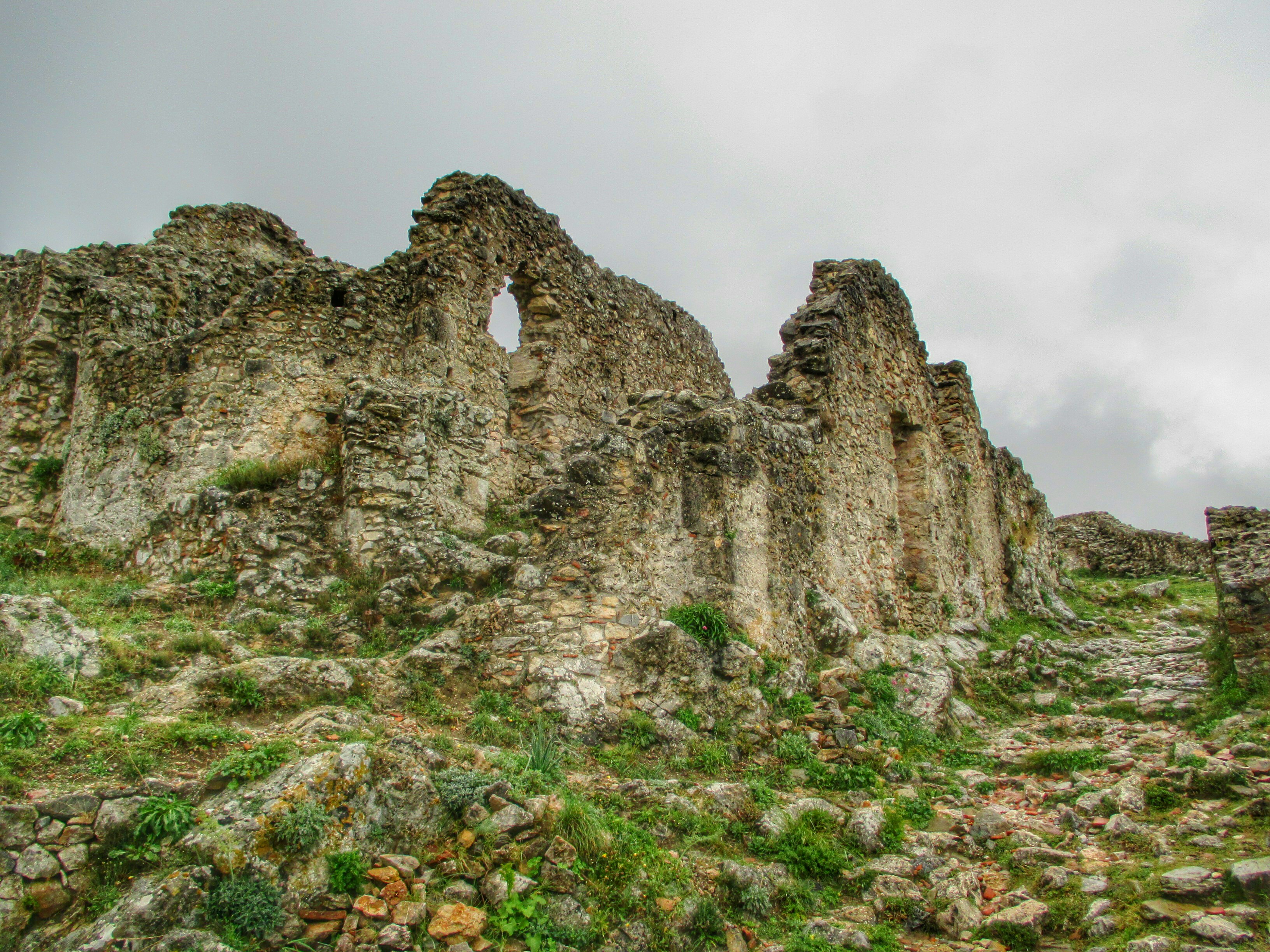
The ruins of the castle of Mystras

The ruins of the castle of Mystras

Ephesus (Turkey)

Ephesus is on the western coast of Turkey. According to Lonely Planet, it is the most complete classical metropolis in Europe. It started around the tenth century BC and was once part of the Ionian League. It also served as the Roman capital of Asia Minor. Its Temple of Artemis was the biggest on earth and one of the Seven Wonders of the Ancient World. Unfortunately, all that is left of that Temple is one solitary, lonely, rebuilt column. The rest of the site is quite extensive and includes a large marble-paved sacred way, lined by different structures, such as temples, fountains, public baths and even a public lavatory. The most impressive piece of architecture is the restored facade of the Library of Celsus.

Library of Celsus

Library of Celsus

Tlos (Turkey)

Tlos was one of the most important cities in ancient Lycia. It is a fascinating site because it has been pretty much continually occupied from the time of Lycia all the way up to the Ottoman Empire in the 19th century! It has the distinctive rock tombs of Lycia, as well as an a Roman-era acropolis, theater, stadium, and baths. In addition there are Byzantine church ruins and an Ottoman-era fortress atop the peak. Another thing that makes Tlos impressive is its absolutely awesome setting, situated in the foothills of the Akdağlar mountain range.

Distinctive Lycian rock tombs and sarcophogi

Distinctive Lycian rock tombs and sarcophogi

Bagan (Burma/Myanmar)

The area of Bagan  is a large plain next to the Ayerawaddy River that is covered with over 3000 Buddist temples built from 11th to 13th century.  After years of neglect, many of the temples have been restored and Bagan is one of the highlights of any itinerary in Myanmar. This site was the largest that we had seen thus far on the world trip.
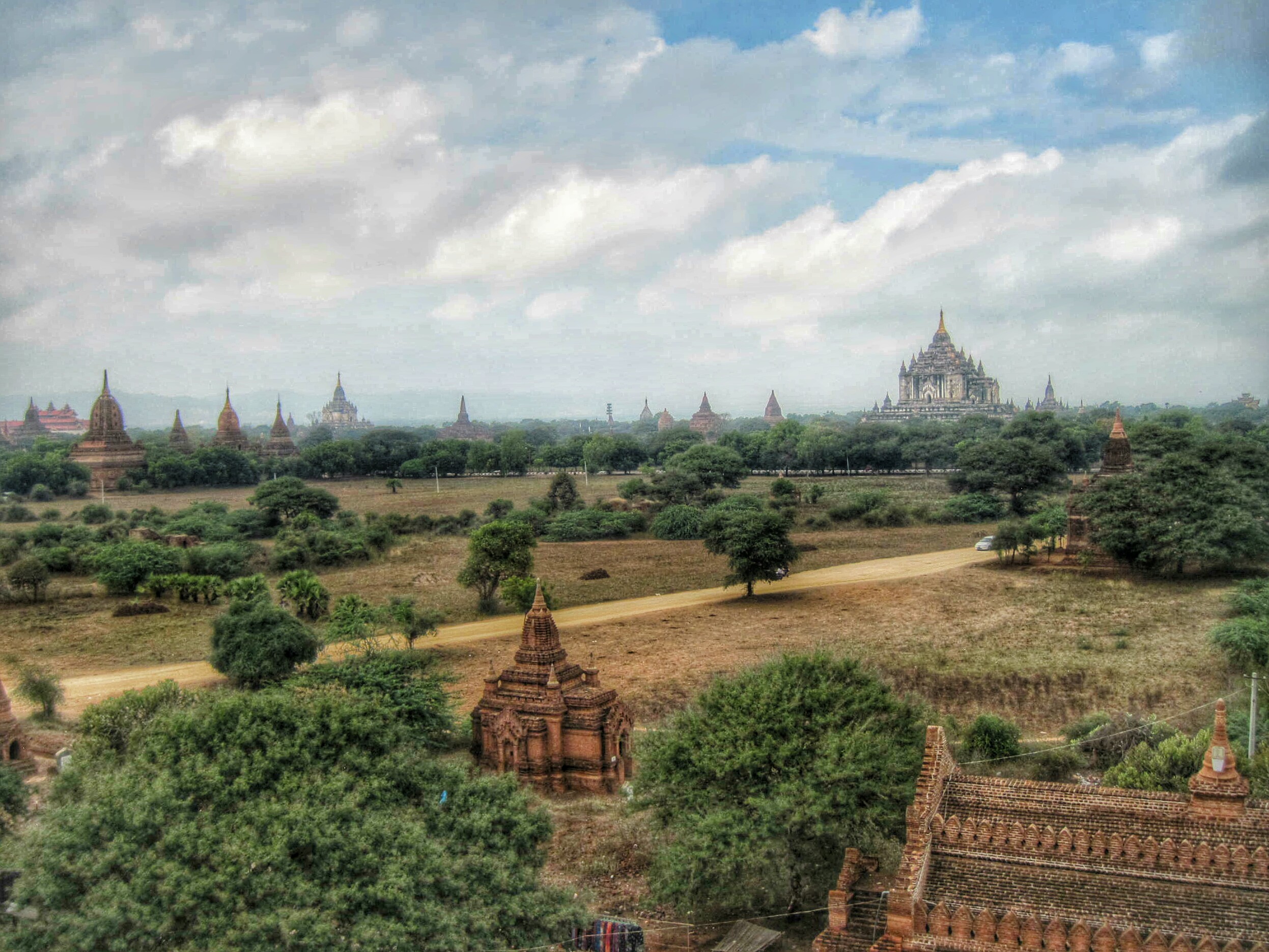
View from Shwesandaw Paya

View from Shwesandaw Paya

Angkor (Cambodia)

This was another site that was extremely large, stretching over some 400 square km. Angkor  contains the magnificent remains of the different capitals of the Khmer Empire, from the 9th to the 15th century. The kings who ruled over the empire constructed large numbers of temples in the city as befitting of its status. They include the famous Temple of Angkor Wat and, at Angkor Thom, the Bayon Temple with its countless sculptural decorations, and many others.

IMG_7779_edt

Sukhothai (Thailand)

The Sukhothai kingdom came into prominence in the mid-13th century AD after the Khmer empire began to decline. It grew into a strong regional power and is known today for the unique artistic style that can be seen in the remaining temples. There are a large number of ruins to be seen which are spread out over a moderately-sized range. We particularly enjoyed Wat Si Chum, which contains an impressive large Buddha that is a great example of the Sukhothai style of art. The location of this image helps amplify its impact: at first you can only see the face, until you slip through a narrow passage and find yourself at the base of the immense seated figure.
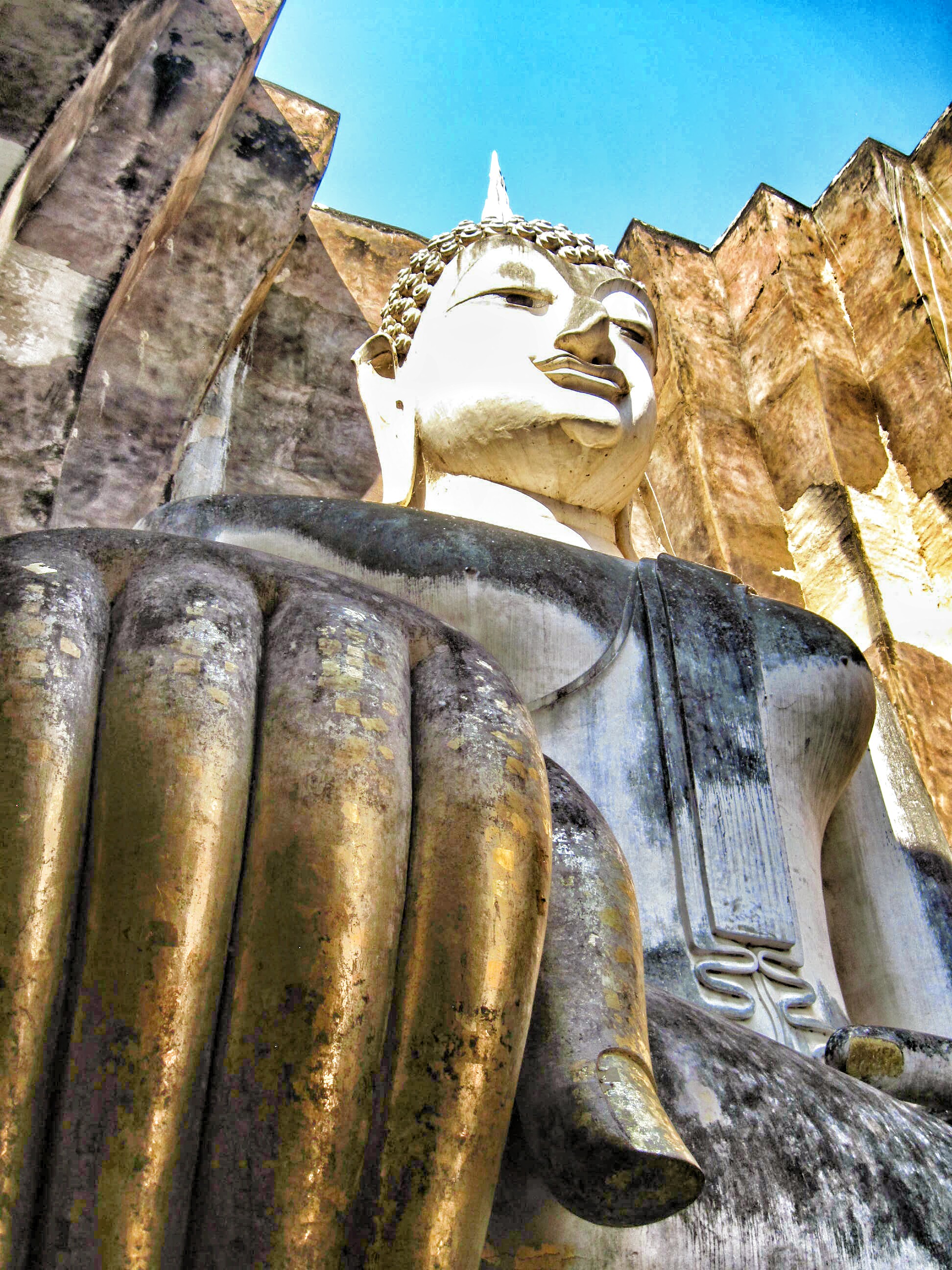
Looking up at Buddha

Looking up at Buddha

Ayutthaya (Thailand)

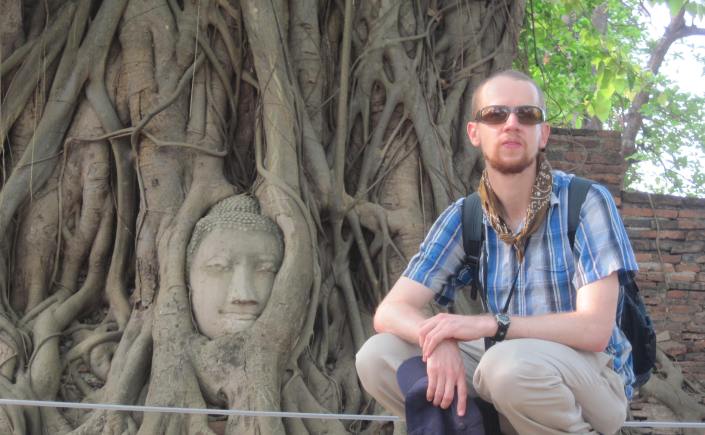
The kingdom of Ayutthaya, located on an island in the middle of a river about 50 miles north of present-day Bangkok, came into prominence a couple of centuries later than Sukhothai. It was the capital of the kingdom of Siam and the major trading port with the outside world. An invading Burmese army destroyed most of the city in 1767, but some restoration has been done. Our favorite part was a unique and curious sight: the head of a Buddha image wrapped up in the roots of a tree. No one is sure how this got here.

IMG_9198_edt

The Ancient Thai Kingdoms of Sukhothai and Ayuthaya

In between Chiang Mai and Bangkok are two sites of special historic significance in Thai history: Sukhothai and Ayuthaya. Both were the seat of ancient kingdoms that are seen as predecessors to the modern government of Thailand, and now both are UNESCO World Heritage listed sites. We debated only visiting one, but ultimately decided that we needed to see both to better understand Thai history.

Sukhothai

The Sukhothai kingdom came into prominence in the mid-13th century AD after the Khmer empire (the one that was based in Angkor) began to decline. It grew into a strong regional power and is known today for the unique artistic style that can be seen in the remaining temples.

There are a large number of ruins to be seen which are spread out over a moderately-sized range. We rented bicycles by the entrance booth to make sure that we could reach the further-out sites. We also rented audio guides, which proved to be quite helpful both for understanding what we were seeing and helping us choose which of the sites to focus on. (One tip for future visiting couples – each guide player has two headphone jacks, so if you bring an extra pair of headphones you can share a player).

The park is split into a few different zones that each require their own ticket. We focused our visit on the Central Zone and the Northern Zone.

The Central Zone contains the majority of the interesting sites worth visiting. One of the most impressive is also the biggest: Wat Mahathat. There are many ruined columns of old gathering places, and Buddha statues and chedis (a.k.a. stupas, cone-shaped structures that hold a relic).

The biggest attraction of the Northern Zone is Wat Si Chum, which contains an impressive large Buddha that is a great example of the Sukhothai style of art. The location of this image helps amplify its impact: at first you can only see the face, until you slip through a narrow passage and find yourself at the base of the immense seated figure. Buddha’s tapered fingers are now golden after having gold leaf applied to them.

There are many other temples worth seeing in the two zones as well. We visited the different sites listed as stops on our audio guide. One interesting feature we noted was the influence of the Khmer empire was still felt: many of the temples had towers that would have looked at home in Angkor Wat.

There is also a National Museum on the grounds that we visited mostly to try to understand more about what we had seen but also to escape the oppressive sun and heat outside! The air-conditioned space had a decent presentation of artifacts from the various periods of Sukhothai history.

Ayuthaya

The kingdom of Ayuthaya, located on an island in the middle of a river about 50 miles north of present-day Bangkok, came into prominence a couple of centuries later than Sukhothai. It was the capital of the kingdom of Siam and the major trading port with the outside world. An invading Burmese army destroyed most of the city in 1767, but some restoration has been done.

The sites in Ayuthaya can be divided into two areas: on the island and off the island. We rented bicycles to visit the sites on the island, and took a boat cruise to see those off the island.

The largest and most important site on the island is Wat Phra Si Sanphet. It is just south of the what’s left of the palace, and its convenient location made it a popular temple for the kings to visit. Today the most important pieces remaining are three large chedis that house the remains of former Ayuthaya rulers.

The other big temple to visit on the island is Wat Phra Mahathat. It was also an important temple during its heyday, but now is a big tourist draw because of a unique and curious sight: the head of a Buddha image wrapped up in the roots of a tree. No one is sure how this got here.

At both of these two large sites we rented an audio guide. Whereas in Sukhothai the guide covered multiple sites, in Ayuthaya they had detailed guides only for the two big sites.

We also took short visits to the modern Wihan Phra Mongkhon Bophit, which houses a large bronze Buddha statue, and Wat Thammikarat, which has a chedi with lion statues at the base. Unlike Sukhothai, which sold a pass for each zone, Ayuthaya charges a fee at each site, so there were a few larger temples we just admired from a distance.

There is a national museum on the island, but instead of paying money to visit it we decided to follow the Lonely Planet recommendation and visited the Ayuthaya Tourist Center, where we got more information about what to see (they are really good about giving maps in Ayuthaya) and also enjoyed visiting a free exhibit about the history and culture of the site.

Our accommodations in Ayuthaya offered a boat cruise to see a few of the different sites off the island and just off the river. Our small boat took us and a few other people on a big loop around the island, stopping at three different places. Wat Phanan Choeng had a large Buddha image and a platform out on the river where one could earn merit by feeding the fish below (and the fish certainly knew this). Wat Phuttai Sawan  had some ancient ruins, a reclining Buddha, and a large Khmer-style prang.

The highlight of the boat trip was definitely the last stop at Wat Chai Wattanaram. It also felt very much like something that could have been plopped down in Angkor. The setting sun made for some nice light against its different Khmer-style prangs.

Logistics

In Sukhothai, we stayed in the town of New Sukhothai, which is about 10 km away from the historic center but has the majority of the accommodation options. To get to and from the historic park, we took the local “bus” which was basically a large pickup. We stayed at a slightly fancier place, Pai Resort, than we would normally because it had a pool. We took advantage of this in the heat of the afternoon each day and it was quite appreciated.

Our dining options in Sukhothai turned out to be a bit frustrating. We were staying near a few different restaurants that were in the guidebooks, but they were all closed on both days we were there! It seemed like the town was already shutting down for the low season. We ended up eating at a neighboring guesthouse twice because they were the only ones open. We did enjoy one nice meal at the night market, where we had a variety of street food. The most fun part of the market was when Della got to dance… (more on this later).

In Ayuthaya, there were plenty of accommodation options on the island that the historic park is on. We chose to stay at the December House, a small guesthouse that is a bit far from the park but is very near the ferry that will get you to the train station. They also rent bikes which allowed for a quick ride into town.

We ate dinner in Ayuthaya at two different night markets. These were a little smaller than other markets, but had a decent variety of food. We ate lunch during our day of temple exploring at a local noodle shop where we were able to get a basic noodle soup for very cheap.

Final Thoughts

On one hand, we are glad that we visited both sites to be able to understand more about the Thai history and to see the evolving styles of art and architecture. On the other hand, by the end of our time looking at temples we were starting to get a little burned out, and the sites weren’t that different from each other. It’s hard to say which is “better”: the tourist infrastructure and town of Ayuthaya seems to be set up better, but the ruins in Sukhothai seem to be in better shape. So we can’t give a simple recommendation, but can assure you that whatever you chose, you won’t be disappointed!