After the Earthquake Part 3: The Politics and Money of Rescue

If you’d like to contribute to help the people of Nepal recover from the devastating earthquake, please visit our page collecting some worthy causes.

The morning of April 28th dawned clear and sunny. We had had another fairly comfortable night. We were really lucky throughout the whole ordeal with weather at night. It was cold, but not too cold; it never froze. We were able to use the blankets and mats from the village which helped tremendously.

We all got up, wondering what the day would bring. It was really a beautiful morning, and we tried to enjoy the lovely sun through the trees! There were not many other projects we could think of to do. The two of us ended up working on one of what was becoming a daily job: herding cattle. There were several cows who lived at Bamboo village who had started to become a nuisance. They became quite nosy and tried to steal the food from our kitchen area. While the villagers were still there, we had observed that the cows were driven up the trail toward the beach (on which we had built a helicopter pad) during the day and came back near the village in the evening, so to get them out of our space we tried to keep this pattern going.  To get them to move, we picked up the sticks and began  yelling at them and tapping their behinds.

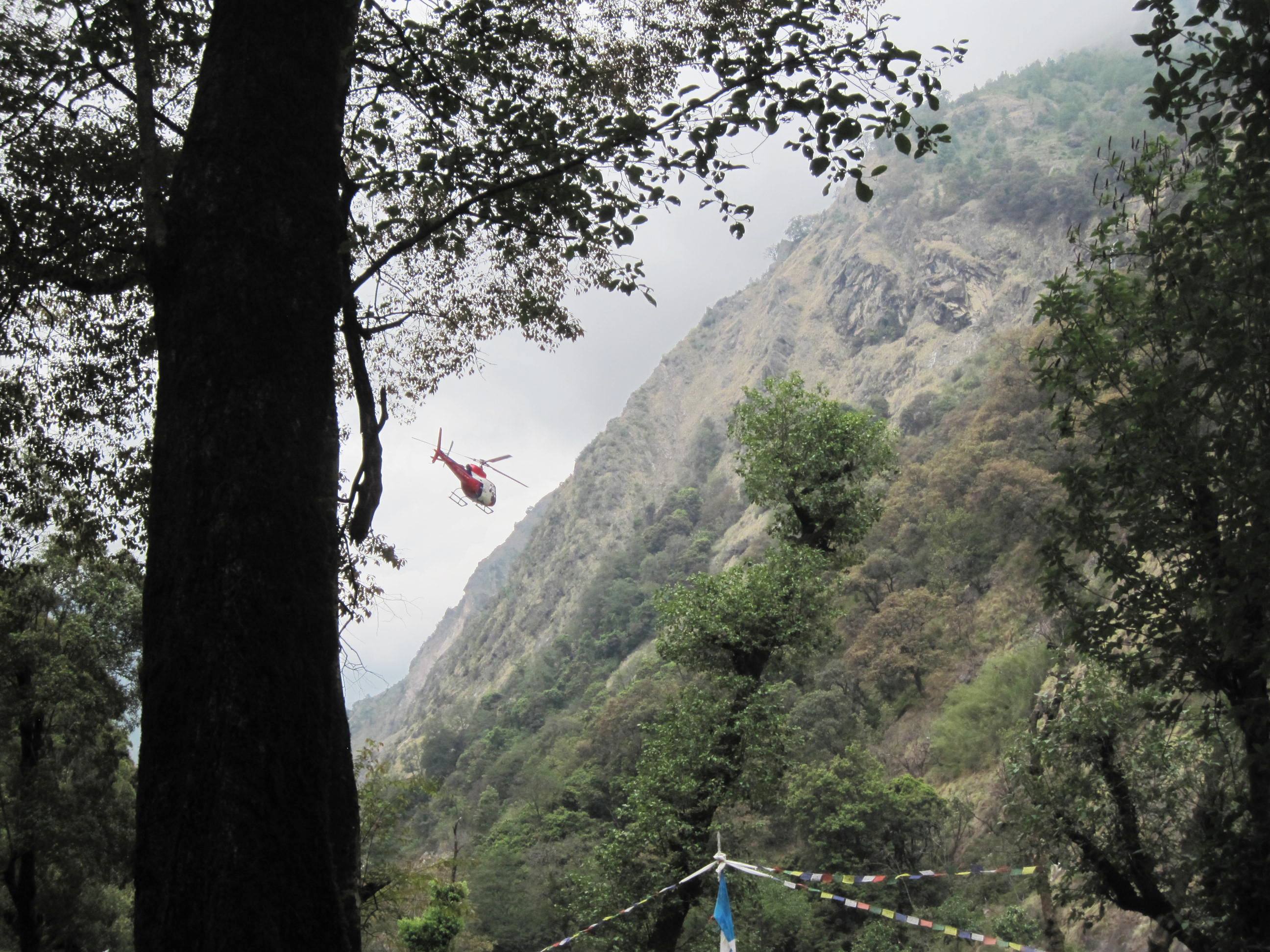
We finally got the cows headed over the bridge toward the beach and headed back toward Bamboo. Suddenly we heard a noise. There had been many helicopters that had flown over camp in the prior days, but they were all high in the sky. We all hoped that if they weren’t stopping for us then at least they were heading up to rescue people who had been stranded higher on the trail where it was higher and colder. But this one sounded different. We came over the rise and were overjoyed at what we saw. A helicopter was flying up the valley towards us. It was low… it was going to land!

The first helicopter landed at about 8 am on April 28th

The first helicopter landed at about 8 am on April 28th

We broke into a run, simultaneously laughing and crying. We were going to be rescued!! The mood at camp was amazing, people laughing, calling out in joy, hugging, even jumping up and down. It was wonderful! We hurriedly helped Willem, the man with the broken arm, to collect his things and head down the hill. The other people we had all assumed would be in the first helicopter, including the Nepali guide with a head injury, a slightly older woman from Maine, and her guide and his 16 year old son, also collected their things. There was hugging and promises of messages to be taken away and a lot of tears.

But, most of that turned out to be unnecessary. Even as the people we assumed were going first had started moving down toward the smaller helipads, we noticed that the trekkers from Japan had quickly collected their already packed baggage, and raced down the hill with their guide. They crammed into the helicopter and it took off, leaving the rest of us completely confused.

“What happened??” was the question on everyone’s lips, followed quickly by “Are they coming back?!”

One of the girls had been close enough to the helicopter to get a few details. Apparently the helicopter had been sent by the Japanese tour office and the pilot had been their guide’s brother, so they were only taking that group. She did say that they had said they would be back!

We all considered this and it seemed to make sense. We all believed that a helicopter would return for the rest of us. We seriously began to think about how we could be packed and ready to go should they arrive again. For us, that meant putting the most important of our possessions on our bodies (IDs, cameras, money, warm clothing, and our Steripen). We packed the next most important things in our small backpack (food, more warm clothing, etc.) and left what we judged to be least important in our large pack. This was all in case we were told that we couldn’t take our bags with us (hopefully we could fit more people if there were fewer bags?)

We waited for what seemed like forever. That first helicopter had come just before 8 am. Our hopes were again raised at about 10 am when another helicopter appeared. They were coming back for the rest of us!!
The second helicopter to arrive

The second helicopter to arrive

This time we were ready. All of the injured and the rest of whom we had deemed to be the first group were close to the helipads with their stuff. But, as we watched from above, they didn’t get in. There was some delay. What was happening?

Why aren't they getting in?

Why aren’t they getting in?

That’s when the message was passed up to those of us waiting above: the helicopter had been sent by an Israeli insurance company, so all the Israelis needed to come down and be ready to leave. Our hearts sank again.

While we were not there to hear it, we saw from afar that our group of Israelis had convinced their helicopter to take our two injured men out with their first group who left right away. There was a man, a coordinator, who worked for the Israeli insurance company who stayed on the ground after that first helicopter left. (At least we knew it would come back!)

He did come up to talk to the rest of us. However, the message was not really what we wanted to hear. He worked for a private insurance company, and his job was to evacuate all Israelis out of the valley. He had been further up the valley and the destruction there was absolute. We were all horrified to hear that there had been terrible avalanches at towns further up the trek at Kyanjin Gompa and Langtang. Tears sprang to our eyes as he explained that the town of Langtang was leveled, destroyed completely. It had been overrun by a massive sheet of mud and ice. There was little left there. He told us that the roads into the mountains were also destroyed. He did tell us that if we could make it to Dhunche (a two days walk), we could be evacuated from there. We all looked at him in disbelief… Walk? Through the constant landslides for two days?? Really?

When the helicopter came back, we were relieved that the coordinator had been convinced to take the woman from Maine and her two guides (a father and son) along with two Israelis. The next time it came back, there was only room for four, and there were six Israelis remaining, so Aviv and his trekking partner Yonatan agreed to wait until the next trip. Aviv had handed over control of the satellite messaging device to a few non-Israelis, but it still seemed like they had chosen to be the last since they felt a responsibility to the rest of us. But then the clouds and rain moved in for the rest of the day, and no more helicopters came… meaning their rescue along with ours was delayed until at least the next day.

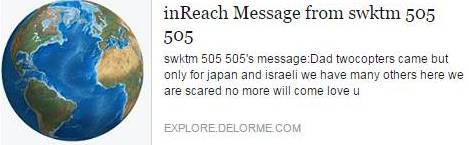
Needless to say, we were all disappointed… terrified and heartbroken might be more apt. As a group, we realized that we needed to be more active on the sat device. If we were only going to be evacuated by country, we were all going to need a lot more help from home. It was at this time that Della sent a message to her dad… one that ended up being spread all across social media, which might have helped in our eventual rescue. It read:
Picture1

Della remembers being in tears when she wrote this message. In some ways, we hate to say this, but we still thought that the US would come get us. Not all of the trekkers felt this way about their own governments, and it was frankly hard to believe that a government would send a helicopter for only one of its citizens. We did have several people who were the only person from their country there.

It’s hard to accurately describe the roller coaster of feelings we felt this day. Our emotions were already very heightened by the anxiety and constant fear. Then we were at a miraculous high when the helicopters arrived which swooped to a super low when they left… without us.

We spent the rest of the afternoon trying to comfort each other and keep our spirits up.

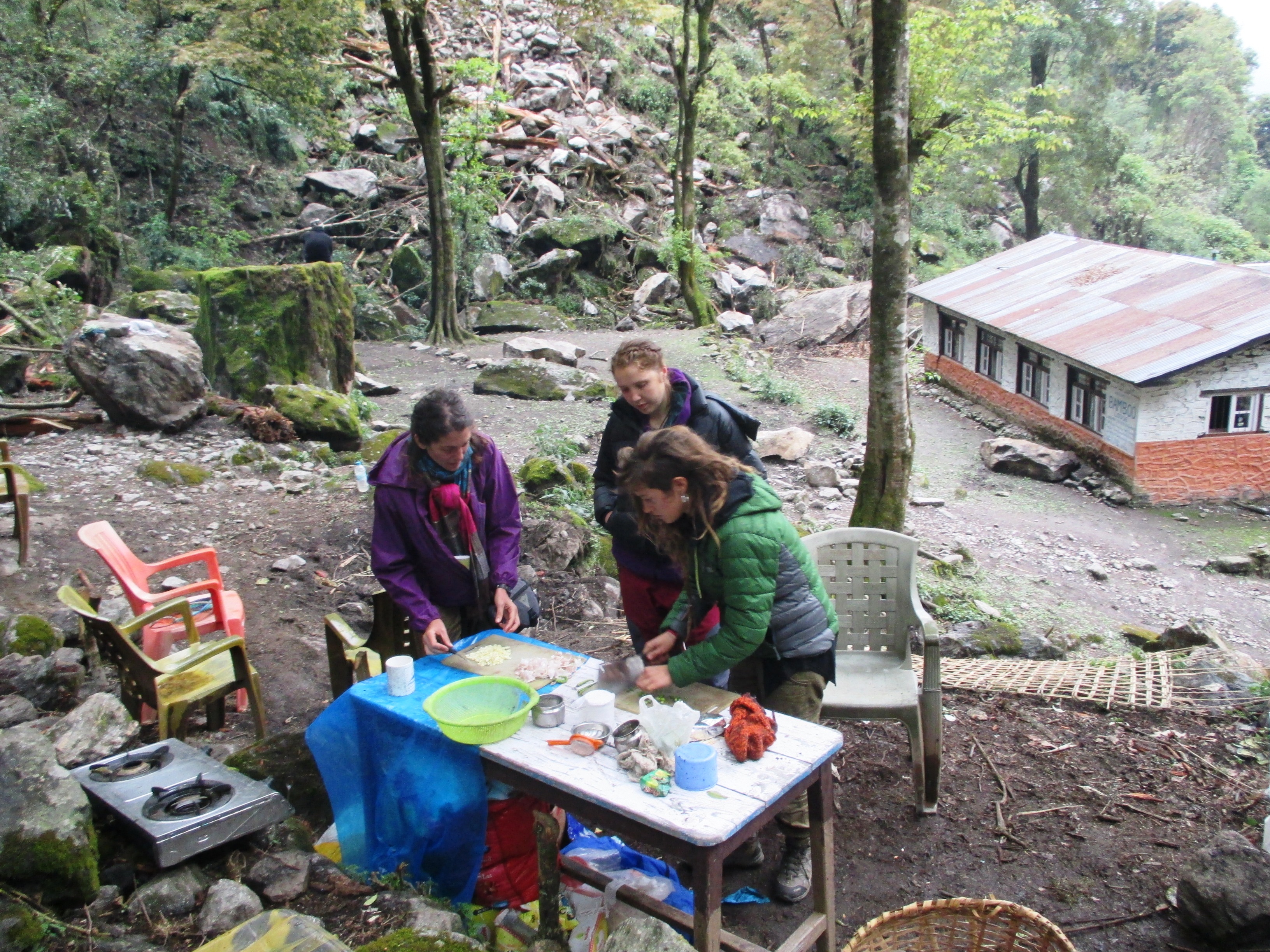
Sara, from Italy, made a delicious lunch of pasta that day. One spark of hope arrived at that time. Sara had been trekking with friends and was planning on meeting her boyfriend in the town of Rimche the evening of the earthquake (Rimche had been our planned destination of the night as well). In the days following the earthquake, she had no idea whether her boyfriend was alive or dead, or where he might be. While she was cooking lunch that day, in the midst of a camp of depression, she got news via the sat device that he was alive and well in the town of Syabrubensi! (Check out the NGO that the couple has founded to help Nepal).
IMG_7837

The rain came in that afternoon, causing us all to retreat to the tarp (and causing the Israeli helicopter not to return). We were all quiet, still feeling quite down and hopeless. But, Sara got out her ukulele.

We’ll always be grateful to her for the sing-a-long she led as the clouds came in covering our camp in a gloomy mist. It built our spirits and our group strength quite a bit.

We were grateful to have Aviv and Yonatan there with us one more night. It allowed us all to get used to the idea that we were going to be without their leadership soon. In their decision to stay (and to help convince their helicopter to take our injured, old, and young) they became heroes at home. We found out that evening that the story in Israel was that they had “refused to be rescued.” In fact, the following day, they received a message via sat device to ask if they would be “willing to evacuate” if the chopper returned!

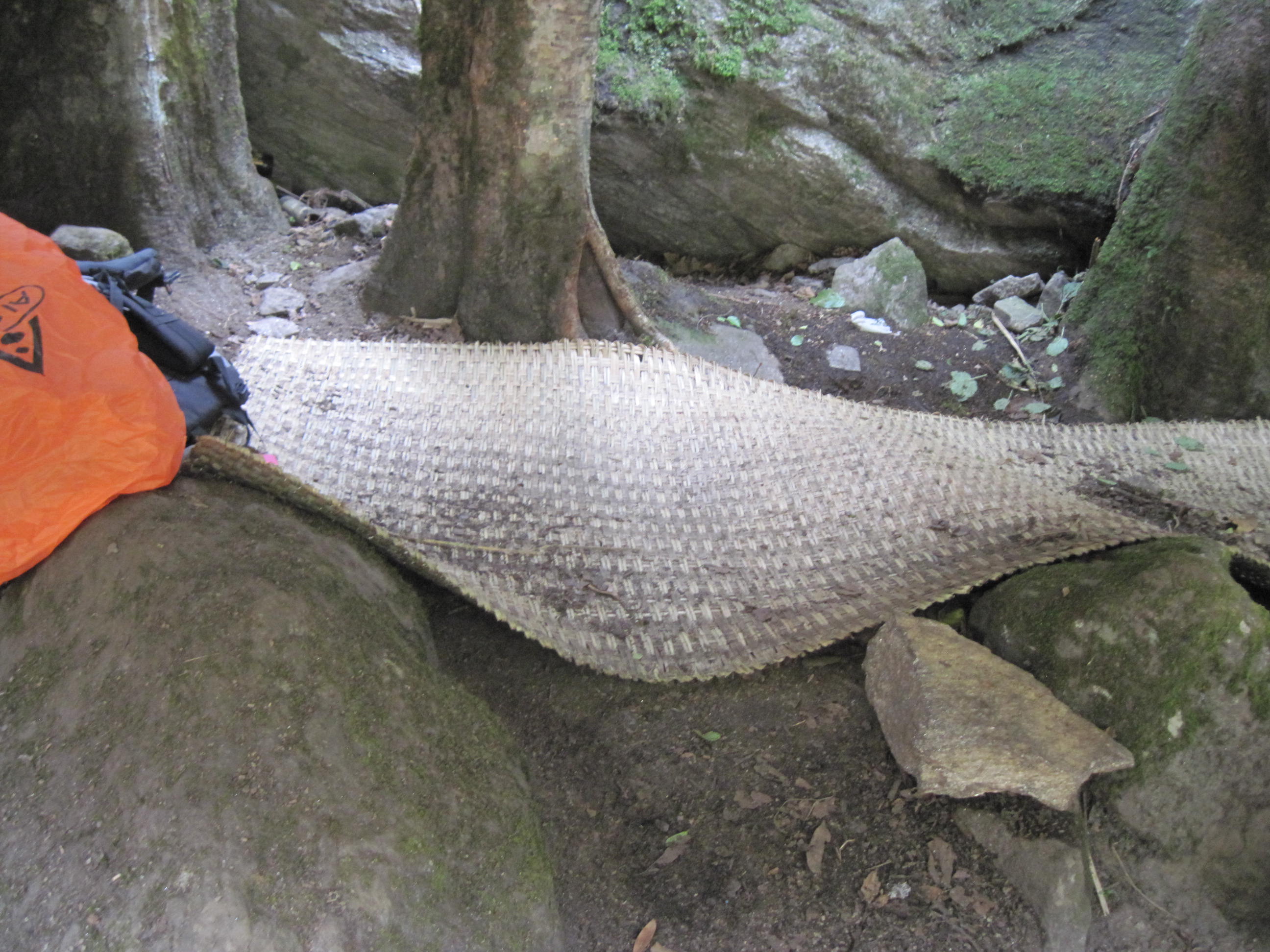
So that night, the group was down to 27 people. We thought it might be nice to get back under the big tarp for sleeping. The area we had been sleeping comfortably the last two nights was under a hole in the less good tarp and after the afternoon rain was quite wet. We attempted to squeeze in to the rows of people sleeping under the big tarp, but it turned out it was really just too tight. We couldn’t stand it. So, we stole one blanket and headed off by ourselves. We found a place where it wasn’t wet. It also wasn’t at all flat… or comfortable. Still we could breathe, so we were able to get a little bit of sleep.
IMG_1237

See that spot on the mat… on the hill between the rocks. Yup, we slept there.

The following morning, April 29, again dawned bright and beautiful. The group all awoke with a new purpose: contact the outside to our loved ones directly using the sat device and get ourselves help. The two of us specifically had one more reason to be optimistic, as we had received a message from Della’s dad. It said something to the effect of: no matter what you hear, be ready to get on a chopper at any moment. It will either be a small one from the US Embassy or a large one from the Nepali Army.

This was both a welcome and dreaded message for us. We were thrilled that the US might be sending some help our way. However, we couldn’t stand the thought of facing another issue of politics or money (only our own citizens or only those who paid would be rescued).

This day was spent with some silly projects as most of the important ones were done. We made a comfortable spot near the water fire that we called the cafe. And yes, signs were made to memorialize our different places. People enjoyed each others’ company under the tarp or chatted together in the sun. Journals were written in and naps were taken. At some point, people began to learn and practice acro-yoga! Della made an attempt to clean herself up a bit… after days of not showering. One of the highlights was a delicious dal baht made by the guides. It was the best we’ve ever had.

There were moments where it felt like we were just on a fun camping trip with friends… except that the ground would still shake occasionally and every now and then you’d hear rocks fall up or down the canyon. And helicopters were flying high over our heads almost constantly.

This made our next task seem clear… though daunting. We knew at this point that the Israeli chopper would be coming back once again sometime that day. We knew that Aviv and Yonatan would go, but that would leave two more spots on the chopper. We all agreed that an elderly French couple should be the ones to go with them. However, after that, there was no reason or order that seemed clear for the rest of us.

So, we decided to draw lots. We split ourselves into groups of four that seemed to make sense (our group comprised of the three Americans who were left, us and Corey, and Corey’s trekking partner Kees). After this was done, we numbered each group. Then we pulled numbers out of a hat (actually it was out of a hand… but still). Della ended up drawing the numbers. It’s hard to know what to feel as this happened, hoping that your group will be first, but also dreading the feeling of potentially leaving everyone else behind. Della managed to pull our group last…

Because of the message we had received from Della’s dad earlier, we knew that if the US sent the helicopter, that there was also a chance we’d be the first… or the only. So, there it was. We’d be first or last to leave. It was a little hard to sit with.

Finally, about 5 pm on the 29th, the Israeli chopper arrived to pick up its last load. It went smoothly; they agreed to take our two remaining Israelis as well as the French couple. Apparently, that meant that the coordinator had to stay. We had a brief moment of hope thinking that they would have to take more people with them when they came back to pick him up. However, the coordinator told us that they actually had to head up the valley to continue the rescue in Langtang and Kyanjin Gompa. We were glad that the people up there were going to continue to get rescued… until we realized he was lying. The helicopter returned, he got in, and they headed down (not up) the valley, with at least two open seats.

We were angry and frustrated yet again. But, we were slightly comforted by some of the beautiful views of the mountains that evening afforded.

Beautiful

Beautiful

Perhaps we will be rescued tomorrow, we thought, as we settled into another night.

We will continue to tell the story of our earthquake experience in Nepal. We were extremely fortunate to survive and to be able to come home to the USA. Our stories are now over, but those in Nepal are not that fortunate. Huge numbers of people have lost their homes and their livelihoods. Please take some time to donate (any amount, large or small, can help) to help this beautiful country recover. We’ve collected list of organizations that you might consider here.

Use these links to read the rest of our Nepal Earthquake story:

After the Earthquake Part 2: Decisions and Projects

If you’d like to contribute to help the people of Nepal recover from the devastating earthquake, please visit our page collecting some worthy causes.

We woke up in our makeshift camp above Bamboo Village on the morning of April 27, two days after the large earthquake that rattled Nepal, with mixed emotions. On one hand, we had a solid night of sleep and were feeling refreshed. On the other, the messages coming through the satellite messaging device were still pessimistic about a rescue being sent for us any time soon.

One thing we saw firsthand during our experience was how easy it is for fear and even panic to spread through a group in a survival situation. It was clear on this morning that the locals were still not feeling safe in our shelter area. They would motion up towards rocks higher up both sides of the canyon walls, and indicate that they thought that a landslide could reach what we considered to be our safe space. This sense of dread spread through the rest of us and we all began to wonder if it made sense to stay or whether we should go somewhere else.

We talked it out and try to think about it scientifically, and it seemed like logically we were in a good situation. It looked like landslides would be funneled away from our shelter. Also, we had plenty of food and shelter from the elements, and we didn’t know what it would be like elsewhere. So our initial reaction was to stay.

But then it came out that the villagers thought it was safest to head to higher ground, improvising a path up the canyon wall to head to the village of Thulo Syabru. Again we questioned whether we should follow our instinct to stay or follow theirs to go up (especially since they had been almost right about the aftershock the previous day). A few of the guides thought that the locals were right, and headed up with them along with their clients. The two of us though decided to stay with the larger group. We felt our decision was somewhat vindicated when after an hour or so the guides and trekkers returned; the scramble over the rocks to get up the canyon seemed too tough. (We did later hear that those who continued on made it safely).

Around the same time a smaller contingent – one guide and two brothers from Lithuania – decided to head down the trail back to Syabrubesi. This was a bit more appealing, because we knew that Syabrubesi was a sizable town with a road link back to Kathmandu (although we didn’t know the condition of the road). We might have been more tempted by this option, but many of the landslides that we had seen during our time sheltering had hit sections of the trail that we would have had to hike through. It seemed like an unnecessary gamble given that we had our necessities taken care of at Bamboo.

Still, it was quite tough to make the decision to stand still when we had no clue how long we would have to wait for helicopter rescue. The main group stayed, including the Israelis with the satellite messaging device, so we stayed too. (We did later learn that those who walked down made it safely, but ended up having to walk two more days until being able to catch a bus to Kathmandu).

A guide and the Lithuanian brothers heading down the trail

A guide and the Lithuanian brothers heading down the trail

After all of the departures, we had a full group meeting to discuss our updated situation. During this meeting we discussed what projects needed to be done around camp, and made sure everyone was updated on what messages from the outside world had been received. We briefly brought up whether we should establish a priority order for evacuation, but it seemed the consensus was the wounded and older first and we didn’t go much beyond that. We also went around the group and introduced ourselves – even though we all felt like a team already, we had missed some introductions in the heat of the moment and it was nice to get a chance to hear everyone’s names again. We also counted off – we were 47 people.

Again, it felt like we had been through a full day and it was still the middle of the morning. We still had a big chunk of the day to get through, so many of us started to work on projects that had been identified in the group meeting.

One of the biggest projects was water. Among the group we had a sizable amount of purification supplies, but we had made the decision that we should conserve those for later and boil water while we could. We had realized that with as many people as we had, we needed a large volume, and it was hard to boil that much water when having to share the fire with meal preparation. Therefore, the first task was to construct a second fire that would be constantly boiling water. They ended up making two small fires just big enough to accommodate the large kettles we were using.

The boiled water was safe to drink, but it still looked pretty murky. The clear mountain rivers had turned a muddy brown after the landslides, and it resulted in a pretty gritty drink. A few people came up with a way to filter the water by using gauze stuffed into the tops of water bottles with the bottoms cut off. Running water through these filters would remove many of the particulates. They even came up with a great system where four filters could run at once.

The next issue with the water was that the boiled water was too hot to put into the plastic water bottles for storage, as they would just melt. Someone had the idea to cool the water by running it inside a hose that was in cold water – we think we heard this was based on a beer cooling system! A rubber hose was found, and then a system to run it downhill through a bucket of cold water was set up.

This was a cool system, but then another limitation became apparent: it could only fill one bottle at a time. With 47 of us, that seemed pretty tedious. Then, one of the Israelis, Yonathan, began to construct a “bottling” station. At first we were confused, but the end result was quite impressive. He set up a platform that the hose would run over horizontally, and then poked small holes in the hose for water to drain out into bottles. He even fashioned small straws out of bamboo to direct the drips.

With this water system up and running, there was a need to go get water to boil more frequently. The whole group was pretty good about jumping up and helping, and we took a few turns ourselves. It was actually easier to get the water from a side river just up the trail rather than from the big Langtang River.

Marta and Eric getting some water from the side river

Marta and Eric getting some water from the side river

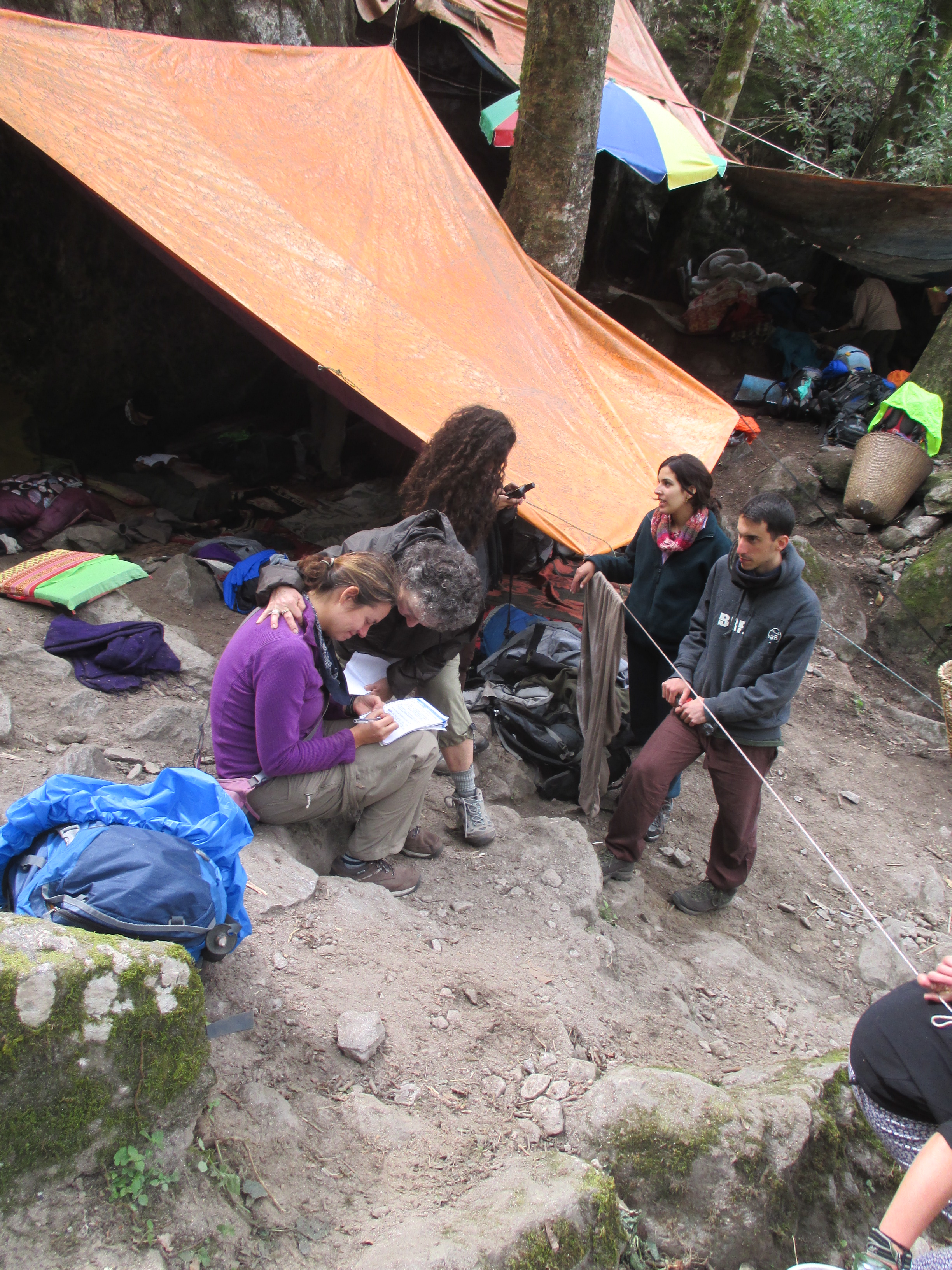
We were still concerned with making contact with the outside world. The holders of the satellite messaging device had figured out how we could send an email to any address, so some of us started sending messages to our loved ones to see if they could work a rescue from a different angle than the Israelis. The two of us were able to get a message out to our families with insurance information in case that helped. The messages had to be 160 characters or less so we worked hard to squeeze as much as we could in.

Della working on our message with Kathleen's encouragement

Della working on our message with Kathleen’s encouragement

A few of the guides also decided that our helipad on the beach might not be enough, so they cleared some of the nearby eating terraces and created two new helipads – giving us three in all! They marked the “H” on these with flour – which seemed like a good idea until the cows that also lived in the village started to eat it.

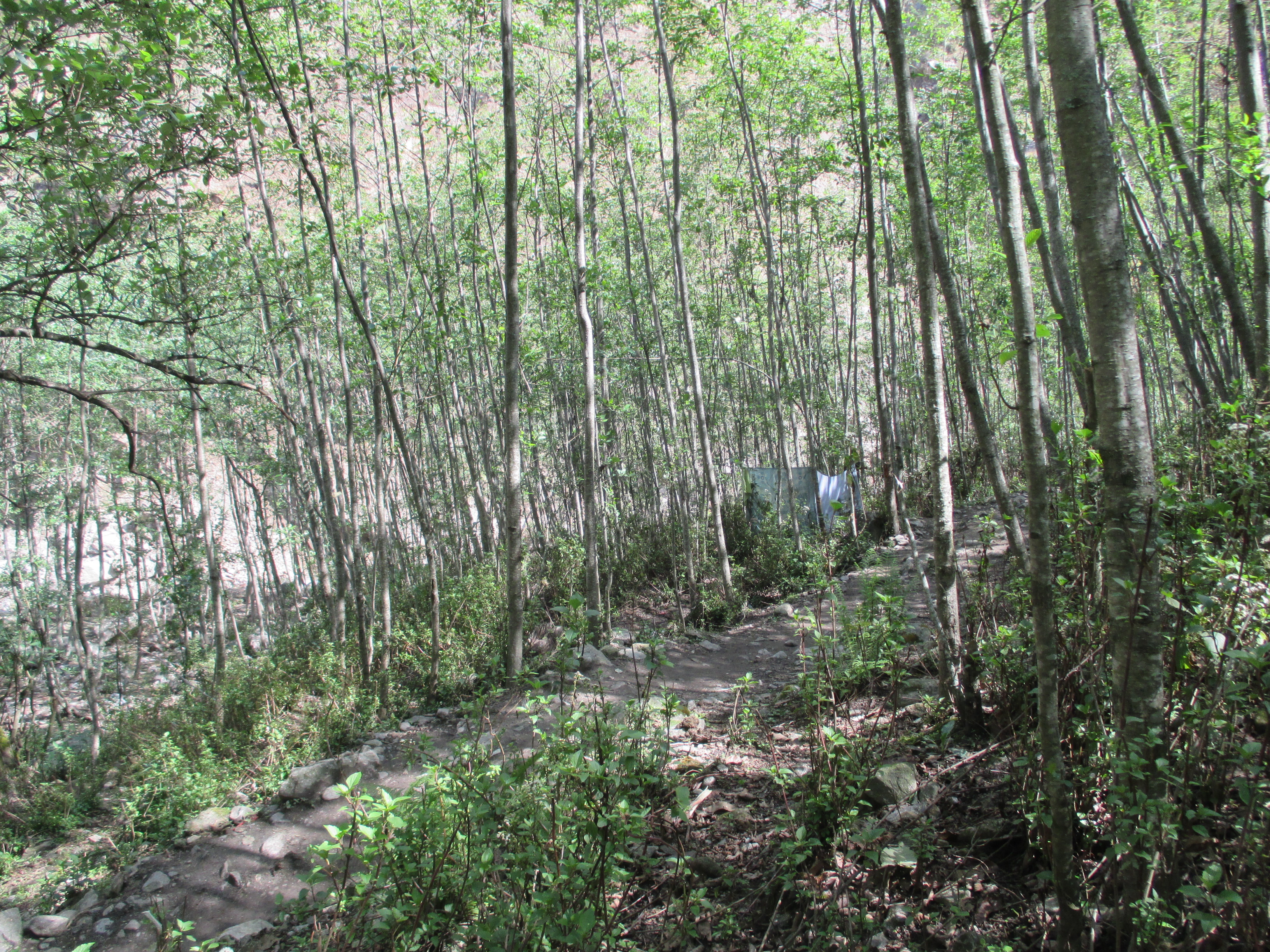
Another group formed and moved the location of the latrine. The original latrine had been nice but was in a location beneath the area of one of the original rockslides, so it was always a bit scary to use it. They moved it to a location in the flat area above our rock that had so far been untouched.

You can see the sheets that made up the latrine privacy walls hidden among the trees

You can see the sheets that made up the latrine privacy walls hidden among the trees

Even with all of these projects, there is so much time in the day that we had to find ways to fill. There were a few diversions like playing cards, singing songs, and reading, although we personally found it a little hard to focus on things for too long. Most of the time was filled just sitting around and chatting with one another about the situation we had found ourselves in.
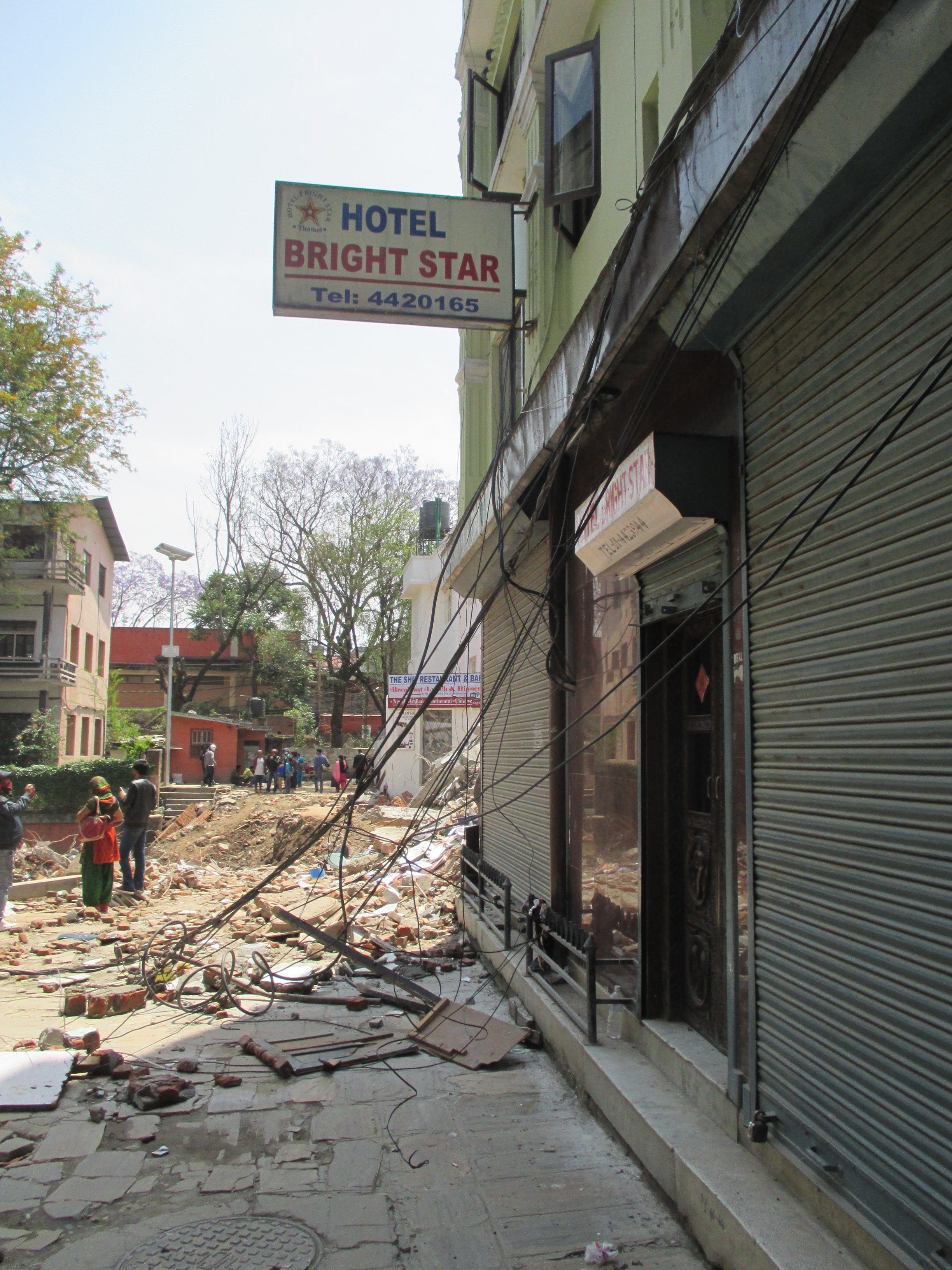
We were graced with another sunny late afternoon, and again it helped to lift our spirits. The group of Israelis volunteered to cook dinner, and they made an excellent shakshuka.

As the sun set, we were able to get our old sleeping spaces back and snuggled back in with our same “roommates” from the previous night. It had been a good day with a lot accomplished, but we were still anxious about just how long our camp improvements would have to last us. Was rescue coming soon, or would we have to walk out like the others had?

Sun sets over Bamboo

Sun sets over Bamboo

We will continue to tell the story of our earthquake experience in Nepal. We were extremely fortunate to survive and to be able to come home to the USA. Our stories are now over, but those in Nepal are not that fortunate. Huge numbers of people have lost their homes and their livelihoods. Please take some time to donate (any amount, large or small, can help) to help this beautiful country recover. We’ve collected list of organizations that you might consider here.

Use these links to read the rest of our Nepal Earthquake story:

After the Earthquake Part 1: Sheltering at Bamboo/Survival

If you’d like to contribute to help the people of Nepal recover from the devastating earthquake, please visit our page collecting some worthy causes.

We sat with our backs pressed up against a house-sized boulder, shivering, trying to process what had just happened…

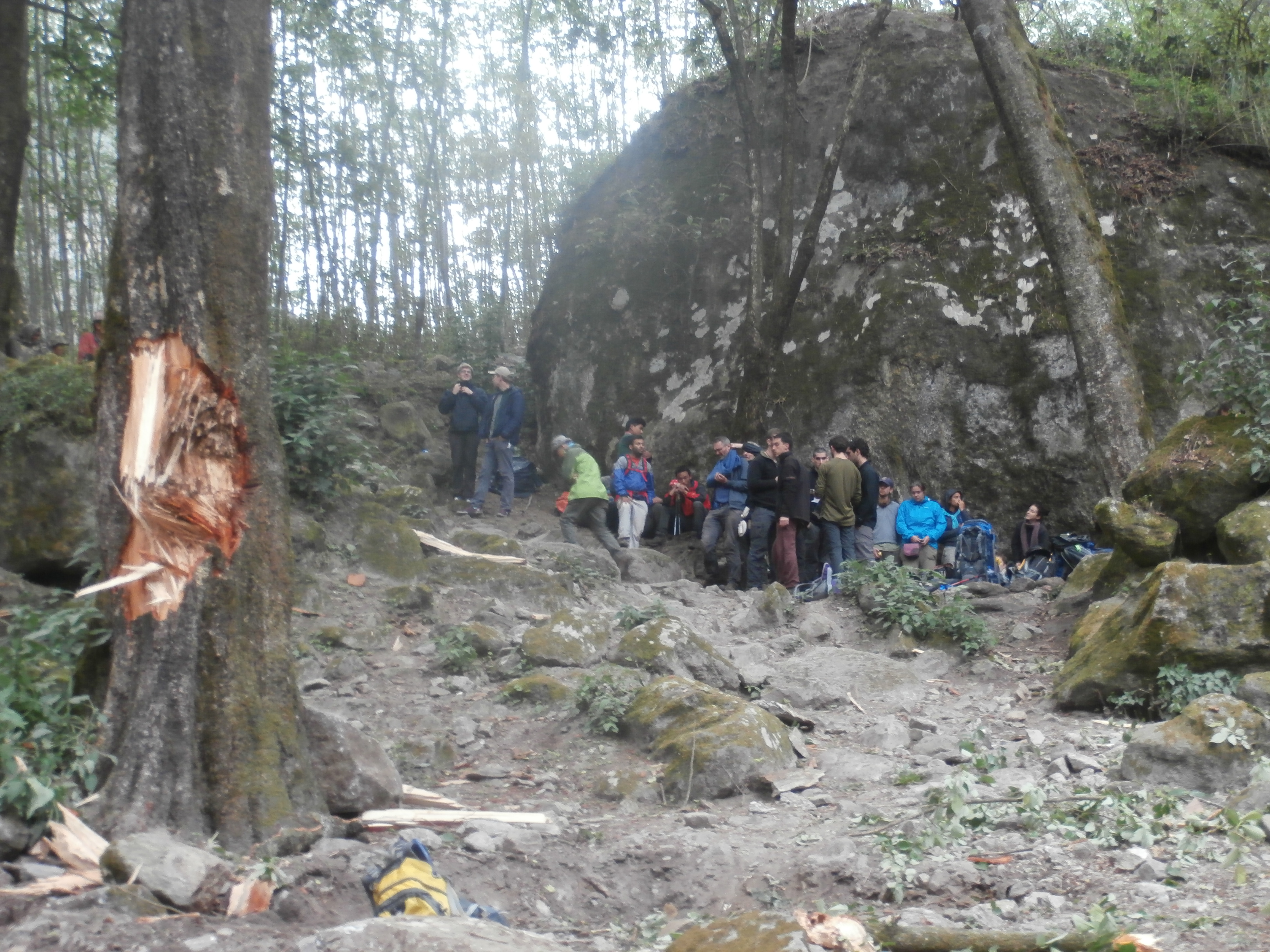
After we survived the big earthquake and the initial landslides, we followed the villagers and other tourists through the remains of Bamboo village and up the trail a bit. They were heading to two large boulders, both the size of buildings. They came together in the shape of a V, with a small cave between them. The rocks seemed solid, buried deep in the ground. The area directly behind them was relatively flat, as far as canyons go. They were not directly next to a steep slope. They created at least the illusion of safety from any further falling rocks.

This photo was taken by fellow trekker Corey: http://www.gofundme.com/tjssd5h9

This photo was taken by fellow trekker Corey: http://www.gofundme.com/tjssd5h9

We sat there, mostly quiet, shivering. Shivering, not so much from cold, but from shock…

Our thought process had been slow. We realized gradually that our long-planned trek was probably not going to continue. Going up after such devastation seemed silly. But, we realized, going down wasn’t much of an option either. Our only option, then, seemed to be to stay. So, we stayed, sitting against that boulder, shivering.

One of the other trekkers, or guides, we’re not really sure, went down to the village and began to collect supplies from one of the ruined teahouses. He brought blankets and water. While his intentions were great, the act of entering the villagers’ homes without permission would cause problems later.

The ground continued to shift and sway. We constantly felt betrayed by this: the ground isn’t supposed to move. It felt a bit like being on an airplane… a steady sense of movement, slight, but always there. This was punctuated by bigger shakes. These bigger shakes would send all of us racing to press our bodies against our solid house rock. This was the only way we felt even remotely safe. And truly, it wasn’t that safe. While we were semi-protected from further falling rocks, we were a bit panicked. We’re amazed that no one got further hurt by the pressing of bodies against that rock.

Eric's expression: Can you believe this happened?!? WTF

Eric’s expression: Can you believe this happened?!? WTF

As the afternoon went on, we had to take stock of what had happened. We refocused, realizing that yes, we were not going to be moving on with the trek. We evaluated our position and decided that, yes, it was one of the safest places we could be at the moment. More tourists and guides began to join us at our rock. We were thrilled to see a group from our bus ride the day before (2 Aussies, 2 South Africans, 1 Brit, and 1 Italian) come down the trail from above. Their story of sheltering on the trail as rocks fell around them terrified us. They had to cross a semi broken bridge and climb over recent landslides for an hour before they reached Bamboo. They had left almost all of their supplies behind. People came up from below the village as well. One man had a broken arm and had somehow climbed over the landslides to reach us.

As the afternoon dragged on, a nervous chatter began to develop. People began to talk, to let out their anxiety. They shared their stories of the quake, where they had been, what they had felt and seen, and also their fears for the future. What should we do?

But people did begin to organize. Several guides figured out how to get supplies from the village to make coffee for the entire group. Trekkers began to share their water and food (and cigarettes) to help calm others. Two medical students checked the man’s broken arm the best they could. As a group, we were able to come up with a large enough collection of pain medication to keep him somewhat comfortable. We were glad we had some oxycodone left over from when Della’s back went out. A group of guys organized to go down to the worst hit part of the village to see if there was any way to help the man who we all knew had been hit by rocks. Unfortunately, there was nothing they could do – he was already cold.

An Israeli girl who had been with us on the bus the prior night and whom we had leapfrogged with all day, had a satellite messaging device. She had rented it for the trek and we were all so grateful, it’s hard to put into words. She spent the afternoon figuring out how to make it work and sending messages to an emergency contact in Kathmandu. By that evening, we knew that the earthquake was a nationwide disaster. We heard that Kathmandu was in shambles. So, we knew that help would not be quick in coming. She also was able to get a message out to her mom in Israel. We were able to send email addresses to her mother so that she could contact all of our families to let them know that we were alright.

IMG_1181

The sat messaging device in the hands of our fearless leader Aviv. Standing nearby, Shani, the one person who thought to bring a satellite device on our trek. Thank goodness.

One of the Israeli men (who had been on our bus and who we had leapfrogged with all day) stepped naturally into the role of leader of our ragtag group. He was calm and prepared and had a presence that lent itself to leadership. He suggested that we figure out how to make ourselves comfortable for the night. Several others went with him to collect a tarp that had covered the outdoor seating area below and then strung it up above our rock for shelter. The villagers also (reluctantly) allowed us to use some of the carpets from their lodges to cover the rocky ground.

The tarp was a great idea as that night, it rained and rained. We hadn’t organized how we would sleep for the night so all of us just crowded under the tarp in a haphazard fashion. It was one big jumble of people and bags. Dark fell about 7:30 and there was nothing to do but try to sleep. Our group was close to 80 people that night. The villagers slept in the cave and the tourists and guides crowded under the tarp and a few of the large table umbrellas we had brought up from below.

Della was able to share a sleeping bag with two others, though she mostly slept with legs over or under other bodies, or curled up in a ball, just barely fitting in a crook of a tree trunk. Eric started in the jumble, but found a spot later in the night stretched out on the edge on top of many bags. He was able to stretch out, but lacked the warmth of the shared body heat. He wished for a blanket and then miraculously found one underneath the bag he was on top of… in the morning he discovered it was the large shawl of one of the fellow trekkers. Not much but enough to keep him warm through the night.

The earth continued to tremble and shake all night, effectively keeping everyone awake. It was punctuated by bigger shakes, or by the noise or cracking of falling rocks in other areas of the canyon. When this happened, the entire group would leap up and press against our rock for safety. We were lucky, no more rock slides came down on us. But, needless to say, no one got much sleep. We think we might have gotten 30 min…. maybe.

At one point during the night, we were woken by our leader. A message had come through on the sat device from the American Embassy! It was clearly a generic message, but it asked for names and situations of American citizens of those of us who needed assistance. We wrote a response, but never heard back.

Dawn came at 5. We all awoke with a new purpose. The only messages that had come in overnight from the sat device told us that help would be coming, but it was unlikely to be soon. We had to make our rocky shelter a sustainable home.

It was truly amazing to witness how people worked together. If a job presented itself, there were many people ready to make it work. The two of us helped to construct a helipad in an open beach area next to the river about 5 minutes up the trail from our house rock. Others worked on making fire, and then collecting water and boiling it for purification. Still others worked on building a comfortable latrine away from our sleeping and kitchen areas.

There was friction with the villagers. They had just witnessed their lives falling apart. They had lost their homes and their livelihoods. They had lost a person… Understandably, they were unhappy with the thought of sharing their supplies with a group of tourists who were likely to be gone in a week. It took a lot of people working together and a wonderful middleman guide for us to make an arrangement. We agreed to pay for a certain amount of food/drinks and the use of rugs, carpets, and blankets for a few nights.

hearty breakfast

hearty breakfast

The day wore on. Della remembers it as one of the longest days of her life. We had done most of the tasks listed above, gotten to know each other, eaten a meal, washed dishes, started to build a life for ourselves on that mountain… And when we looked at our watch it was all of 9 am.

With not much to do, rumors and theories floated around like crazy. For example, the villagers were convinced that there would be a second big quake 24 hours after the first. Most of us dismissed this as a silly superstitious idea. But then at 1 PM, 25 hours after the first quake, a large aftershock hit. A few people had been collecting supplies in the village and had to race back up. Luckily no one was hurt. We later found out that this aftershock registered 6.8, so quite large. This set off a few rockslides but none near us. The most visible damage was that the nearest teahouse had even more cracks in its walls as a result. It served as a visible reminder not to be lulled into a sense of complacency.

At the end of the day, there were some moments of happiness as the sun poked its way out of the clouds. A beautiful, warming light filled the whole valley. This was a brief period when we could forget the constant fear of the moving earth and falling rocks and enjoy the beauty of our locale.

We had continued communication with contacts in Israel via the sat phone. We were assured that rescue would be on its way within the next few days.

The second night, we were much more organized about our sleeping arrangements. More tarps were strung up. The two of us found a nice cozy spot where we could lay ourselves out. We shared our spot with two fun, wonderful people (an American man from Chicago and a woman from Spain) and slept well. The fear was still there and we woke several times in the night ready to sprint to our rock as we heard the rumbling of aftershocks and further landslides. But luck was still with us, and no rocks fell near or on the village. We were renewed with a night of hours of real sleep.

Our version of the picture that made it out early... We're alive, we're safe, and the sun is out =)

Our version of the picture that made it out early… We’re alive, we’re safe, and the sun is out =)

We will continue to tell the story of our earthquake experience in Nepal. We were extremely fortunate to survive and to be able to come home to the USA. Our stories are now over, but those in Nepal are not that fortunate. Huge numbers of people have lost their homes and their livelihoods. Please take some time to donate (any amount, large or small, can help) to help this beautiful country recover. We’ve collected list of organizations that you might consider here.

Use these links to read the rest of our Nepal Earthquake story:

During the Nepal Earthquake: Our Experience

If you’d like to contribute to help the people of Nepal recover from the devastating earthquake, please visit our page collecting some worthy causes.

At 11:56 AM on Saturday, April 25, 2015, a 7.8 magnitude earthquake struck Nepal. The epicenter was 80 km northwest of Kathmandu.

At this time, we were sitting on an outdoor terrace for a teahouse in the village of Bamboo on the Langtang trek, located approximately 70 km north of Kathmandu and 80 km east of the epicenter.

The actions that happened next are a bit muddled to us, so the timeline of the events below may not be entirely accurate.

We definitely felt the ground start shaking, which was surreal for us since neither of us had been in an earthquake. We were not used to the sensation of the entire ground moving beneath our feet. Della recalls asking Eric “What’s happening?,” and he said “I think it’s an earthquake.”

We then wondered what to do and where to head to have the most safety. Eric’s instinct was to head for the teahouse, since he had heard that a doorframe was a good place to be in an earthquake. He stood up to go in that direction, but then we saw the server running out of the house with his arms up in the air as if he was telling everyone to come to where we were. We decided to stay put.

This was a good decision, because moments later there was a giant cracking sound as the walls on both side of the canyon started to break apart and boulders started to rain down.

At first we just watched, because our spot in the middle of the canyon was not in the direct path of any of the rocks and also because we were in complete shock. Rocks from the north side of the canyon were falling into the river, and those from the south side were falling onto the teahouses themselves. We watched in horror as a car-sized boulder crushed the teahouse that our server had just exited from. Other buildings were also smashed or toppled by debris falling from the hillside above.

Smaller rocks, bouncing from both sides of the river started to fly through the air as well. It seemed like there was a chance that some of these rocks from either side could make it up to where we were standing. We ran as far to the edge of the terrace as we could go and still felt unsafe. We saw some wooden tables and benches and huddled underneath them with some of the other people who had been eating there, covering our heads with our hands to protect them as best we could. We were really lucky because those flying rocks would injure two badly and kill one.

The shaking and landslides settled down, so we got up to take in the situation. But then rocks started to rain down again (we can’t remember if this was due to another shake of the earth or not), so we jumped back under our wooden barriers. The slides subsided again, and we came out to see what was going on.

You can see what our view was like from our friend Corey’s video. (Make sure to check out his GoFundMe project linked with the video)

We didn’t really know what to do, but then we saw some of the villagers and  the other groups heading up the trail. We didn’t have any better idea, so we followed them.

This went through an area that had clearly been impacted by falling rocks, so we jogged quickly up the hill. The group headed for an area protected by two large boulders with a cave in between. There was already a large collection of people settled here that we would join.

We stayed in this area of safety for five nights.

We will continue to tell the story of our earthquake experience in Nepal. We were extremely fortunate to survive and to be able to come home to the USA. Our stories are now over, but those in Nepal are not that fortunate. Huge numbers of people have lost their homes and their livelihoods. Please take some time to donate (any amount, large or small, can help) to help this beautiful country recover. We’ve collected list of organizations that you might consider here

Use these links to read the rest of our Nepal Earthquake story:

Our Langtang Trek (Before the Quake)

If you’d like to contribute to help the people of Nepal recover from the devastating earthquake, please visit our page collecting some worthy causes.

We set out on our Langtang Trek at 7:30 AM on April 25, 2015.

IMG_7697

After another registration check, we headed off onto the trail. We took the large bridge over the Trisuli River, walked through Old Syabrubesi, and then followed the trail upstream along the Langtang River.

There are two ways to start your Langtang trek: the “high way” and the “low way.” The “high way” provides better views, but requires more climbing. Our guidebook suggested that the “low way” would be a more gentle introduction, so as novice trekkers we decided to choose that.

Even the “gentle” route involved mostly climbing up, as the river is descending rapidly through the entire valley. We enjoyed the wide variety of plant life – it was quite green, as we had not yet reached the elevation of the snow-capped peaks that you think of when you hear about the Himalayas. The terrain actually looked quite a bit like the mountains back home in Colorado.

As we walked, we encountered a few different groups of hikers heading up the trail, some of whom we had seen on the bus the previous day. Our pace was a bit slower than the others, so we would end up being passed by them. But, we tended not to take the longer breaks at villages along the way, so we would pass them there and then get passed 15 minutes later again. It became somewhat of a running joke with a group of three Israelis and their guide (who had been on our bus the previous day as well).

An hour into the trek, we crossed another large suspension bridge over the Langtang River to the south bank, then continued trekking up. There was one more small suspension bridge over a side stream near the small village of Domen. At the village of Pairo (also known as Landslide), the Israeli’s guide had clued us into a hot springs on the north bank, which we walked over and checked out but didn’t get in.

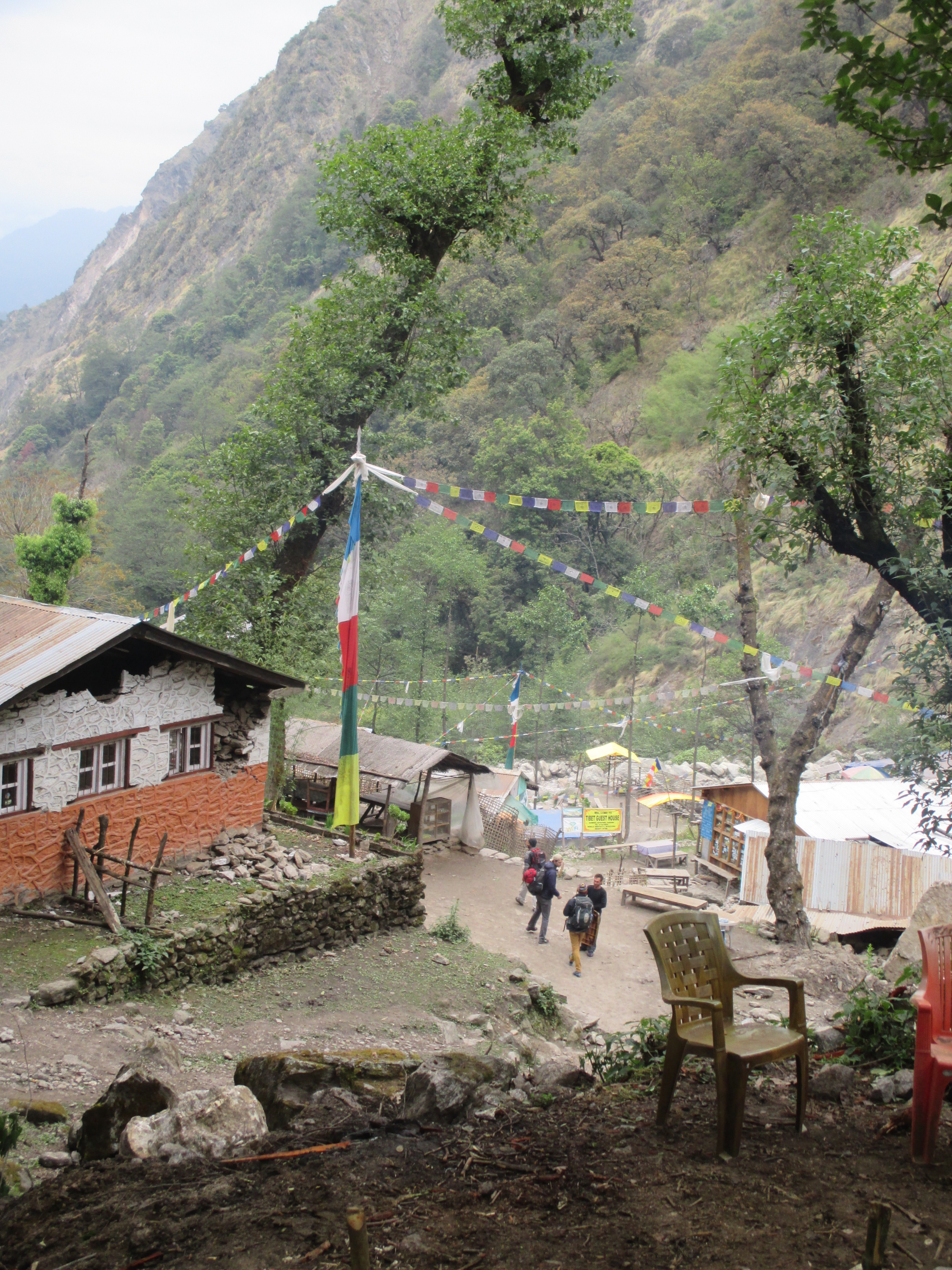
After Pairo, it was a semi-steep climb to the next village of Bamboo. It was almost lunchtime, but we weren’t feeling too hungry. Rimche was not too much further along the trail, so we considered pushing through to our final destination. But, as we approached Bamboo we saw many of our trail-mates had stopped for lunch, and there was a waiter ready to promote his outdoor terrace as the best right at the first place, so we decided that a small rest wouldn’t hurt us.

Approaching Bamboo village. We would take a seat under the yellow/orange tarps just barely visible in this picture

Approaching Bamboo village. We would take a seat under the yellow/orange tarps just barely visible in this picture

We sat down at the outdoor eating area on the terrace of the first teahouse and ordered a cup of tea each and some chapati. The tea came out pretty fast so we took our first few sips as we rested our feet. The seating area was in a nice location in the center of the valley, right out over the river.

The view from our table at the teahouse

The view from our table at the teahouse

The time was 11:55 AM.

We will continue to tell the story of our earthquake experience in Nepal. We were extremely fortunate to survive and to be able to come home to the USA. Our stories are now over, but those in Nepal are not that fortunate. Huge numbers of people have lost their homes and their livelihoods. Please take some time to donate (any amount, large or small, can help) to help this beautiful country recover. We’ve collected list of organizations that you might consider here

Use these links to read the rest of our Nepal Earthquake story:

Bus Ride: Kathmandu to SyabruBesi

If you’d like to contribute to help the people of Nepal recover from the devastating earthquake, please visit our page collecting some worthy causes.

It was 6:30 am on the morning of April 24, 2015. We had just been dumped out of our taxi at the Kathmandu “bus station” where we would catch our Super Deluxe Bus to Syabrubesi, which was the start of our 8 day trek through the Langtang Valley.

At the time, we were overwhelmed by the cacophony of noises and abundance of smells at the bus station. Finding our bus was a challenge. At the time, the bus ride seemed like a fun, long and uncomfortable adventure. Now we know it was the beginning of a fateful journey that not everyone survived.

IMG_1122

That morning, we had woken before dawn to do our final preparations for our trek. We had to wake the manager of our hotel to check out and leave our bags. We found a taxi which zipped us off to the “bus station” as the sun was rising. We were glad that we had been told to travel there the day before to purchase our tickets as it saved us some time and confusion. Even so, we didn’t know quite where to head.

There were many buses there, though not a lot of identifiable signage. We knew we had purchased the Super bus, which we had been told would be a faster ride. We did see several other tourists in the area and asked most of them where they were heading and which bus they were waiting for. Later, we would come to know most of these tourists extremely well.

IMG_1123

Finally, through some help from local vendors we saw our bus trundle in to the “station.” We were surprised to see that the roof rack was completely full. We jumped onto the bus and took our assigned seats, A1 and A2, right at the front. We were even more grateful that we had purchased the day before as the rest of the passengers started to file onto the bus. Those who joined us were a group of 6 independent trekkers, a group of three Israeli trekkers and their guide, a single Israeli trekker, and two Israeli families (3 young children each!!), their guide and 3 porters. The aisle was full of bags which made it a climb to get to the seats behind. It also meant that all of us had to ride with all of our bags on our lap. Somehow there had been some errors made in the selling of the tickets and there weren’t enough seats. As you can probably imagine, this made for a pretty uncomfortable ride.

Despite it all, we were excited. This was going to be a big adventure and we were anxious to get our first views of the majestic Himalayas that would be our home for the next several days. The driver pumped up the music, and we were off.

The Super Deluxe ticket that we purchased had promised a faster ride than the local bus. So, were a bit annoyed when we had to stop over and over again. First for a bathroom break, then for “lunch” at about 10 am, where we were asked to make photo copies of our TIMS cards. Then 2 more times for checks of our paperwork by the Nepal army and the Armed Police Force- luckily, the photocopies sufficed for these.

We stopped in the town of Dhunche and unloaded the bus. It turned out that the roof and aisle had been full of food and supplies destined for this village.

We stopped again at the entrance of Langtang National Park where our paperwork was checked by the park staff. Only 15 min later, we stopped yet again, for our paperwork to be checked by the police. We wondered how many different forces were in Nepal and how many more times our paperwork could possible be checked. Especially since the bus had been traveling all day on a one lane road on the side of mountains. There didn’t seem to be a lot of changes that could happen between each check.

We arrived in SyabruBesi at around 2:00 pm where we were dropped off at the beginning of town. We expected to be attacked by touts hoping to lead us to hotels… But there was no one. In fact, we entered a hotel and could not find a manager of any sort to check us in, so we left.

We did eventually settle on SuryaPeak Guest House because it had a balcony with a nice view over the town and the beginning of the Langtang Valley. We paid 2 dollars that night for accommodation. We read on the balcony, enjoying the crisp mountain air. We went down for an early dinner and our guesthouse prepared us fresh momos and a large plate of dal baht. We had been concerned that we hadn’t been drinking enough water, so we decided to go for a “medium” pot of tea. We were shocked with the “medium” pot seemed to hold about two liters!

It’s hard to really explain this part of our journey now. So many things that seemed important at the time, like the long and uncomfortable bus ride, the scary views out the windows, and the silly mistake of ordering too much tea seem so inconsequential now.

The bus ride introduced us to some people who would become very important to us over the next few days. It also introduced us to Or Assraf (standing on the far left of our picture below) who would start his trek the same day we would start ours. He would be trekking alone and would experience the earthquake somewhere on the trail. He wouldn’t be as lucky as we were. He would be missing for several days following the quake and later his body would be found at the bottom of a cliff. We did not know him well, probably only said a few words to him on the journey, but we will never forget him. We can’t imagine the fear he must have felt during the earthquake that he must have experienced all alone. Our hearts go out to his friends and family who spent a week in trepidation and had their fears confirmed a few days ago. Or was only one of the more than 7000 people who died during this tragedy, but his memory will always be with us.

IMG_1121


We will continue to tell the story of our earthquake experience in Nepal. We were extremely fortunate to survive and to be able to come home to the USA. Our stories are now over, but those in Nepal are not that fortunate. Huge numbers of people have lost their homes and their livelihoods. Please take some time to donate (any amount, large or small, can help) to help this beautiful country recover. We’ve collected list of organizations that you might consider here

Use these links to read the rest of our Nepal Earthquake story:


Kathmandu: Before the Quake

If you’d like to contribute to help the people of Nepal recover from the devastating earthquake, please visit our page collecting some worthy causes.

Usually after we visit a city we like to write a nice summary post about where we stayed, what we did and where we ate. We’d still like to discuss some of these things with regards to Kathmandu, but it feels weird to talk about the city without mentioning that just a few days after our visit a 7.8 magnitude earthquake hit and did a lot of damage in the city and the country as a whole. So we’ll try to balance our discussion of our time in Kathmandu with what we know of what happened to the sights after the quake.

We arrived in Kathmandu late on the evening of April 20, on a Dragonair flight from Hong Kong. (We really enjoyed using the personal entertainment device on the flight and were able to watch Into the Woods and four episodes of Downton Abbey).

Hotel Bright Star

We didn’t get in until almost midnight, but the owner of our hotel, the Hotel Bright Star, had stayed up to check us in. We had a small room on the top floor – the stairs were a nice preview of what we expected to be a lot of uphill hiking on our trek.

This was only a preview of the generosity that the owner showed us during our three days in Kathmandu. He provided plenty of good advice, and walked us halfway to the tourist office (so we wouldn’t get lost) to pick up our trekking permits.

Hotel Bright Star on its quiet street

Hotel Bright Star on its quiet street

That made it that much harder to see him again after the quake. We had left two bags at the hotel while trekking, and we went back into town on May 1 to pick them up. He said on the phone that he and his family were ok, but when we got there it was clear how close they had come to disaster.

The hotel next door had collapsed during the quake, and all that was left was a pile of bricks and tangled wires. The owner, clearly shaken, told us that 10 people had died inside. We ran inside our hotel to get our bags, and it was clear that it was the first time that he had been back in. He didn’t want to linger, and neither did we; one of the walls of the lobby on the side of the collapsed building was bulging inwards.

The same view after the quake, with the hotel just beyond in rubble

The same view after the quake, with the hotel just beyond in rubble

He said the rest of his family had been safely moved to Pokhara, but he would remain staying in a building down the street until all of the left baggage had been picked up. Hopefully the people who left their bags will return soon…

The Old Quarter

On our first day in Kathmandu we did a self-guided walking tour (led by Lonely Planet) through the old part of Kathmandu. We quickly decided that Nepal was way different from any other country that we had visited on the entire trip! Bright colors all over the place, smells both good and bad in the air, people hawking items, bicycle rickshaws asking for rides, centuries-old temples in every nook and cranny… it was almost overwhelming!

After the quake, we only ventured back to the more touristy part of the Old Quarter, called Thamel. There wasn’t much physical destruction, but the change in the atmosphere of the streets was palpable. Half of the shops were closed up, and the foot and vehicle traffic was maybe half of what it once was. The sense of calm as compared to before was eerie.

Durbar Square

The main historic attraction in Kathmandu is the UNESCO World Heritage-listed Durbar Square, a collection of temples and palaces that was one the home of the Nepali royalty. We spent a whole afternoon exploring the different sights.

The earthquake did a great amount of damage to Durbar Square. We didn’t make it back to see for ourselves, but the pictures we have found online show the devastation.

Kasthamandap

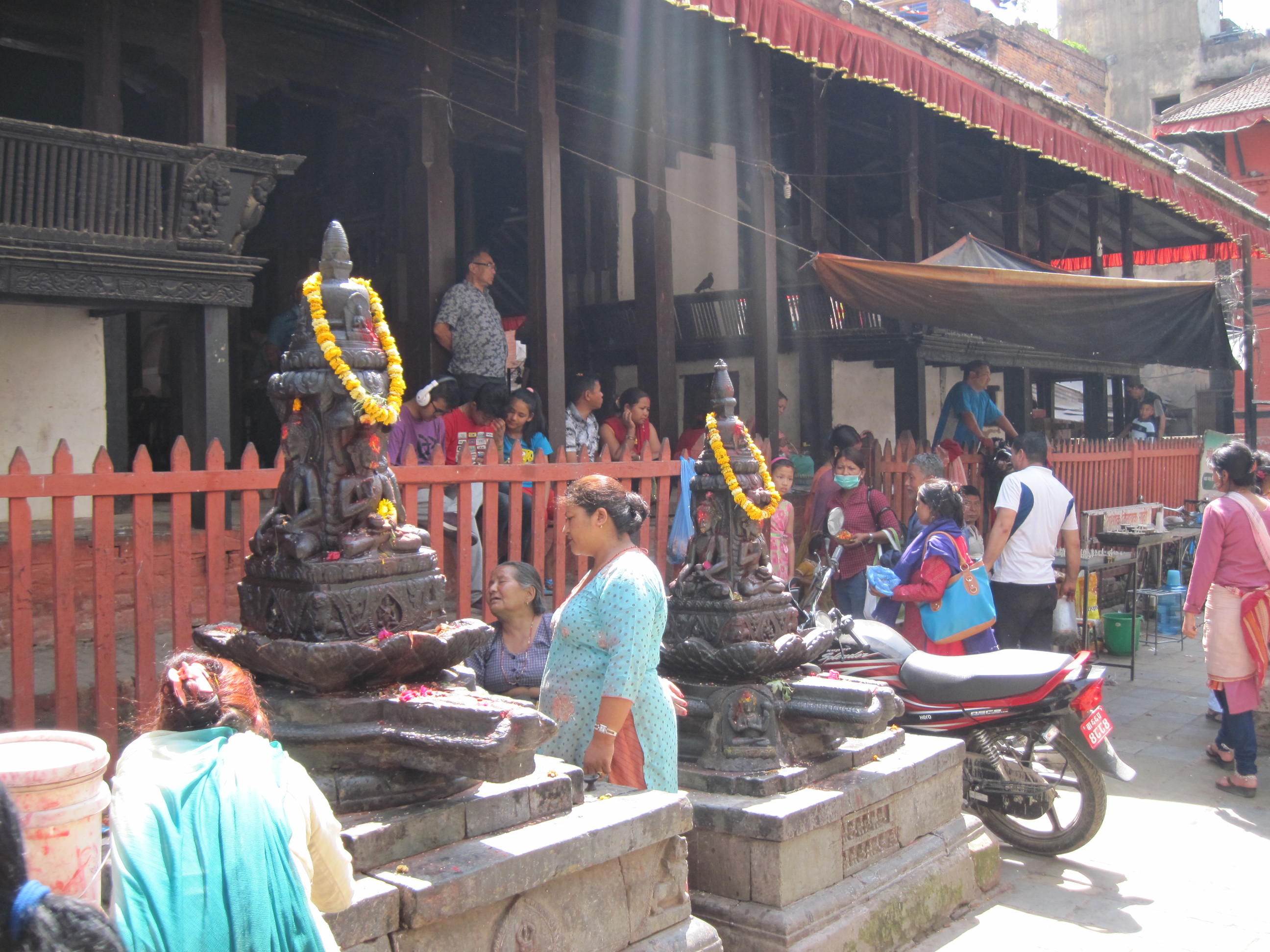
This temple, built in the 12th century, is what gave Kathmandu its name. To us it felt a little bit more like a pavilion, with a large awning sheltering an open space with a few shrines.

Outside of Kasthamandap

Outside of Kasthamandap

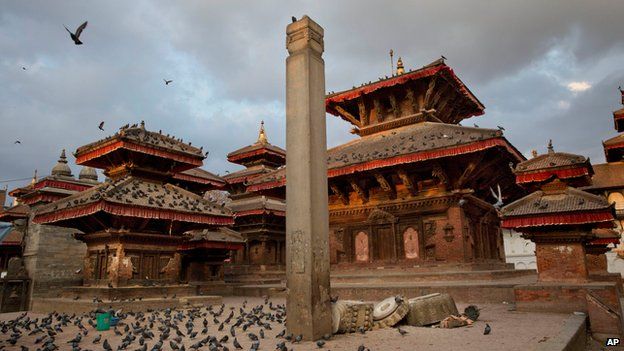
From news reports, it appears that Kasthamandap has been completely destroyed.

Kasthamandap

Not our picture – photo source http://www.theguardian.com/world/2015/apr/27/nepal-earthquake-destroys-kathmandu-valleys-architecture-buildings-heritage. Note the same two statues as in our before picture.


Maju Deval

This tall Hindu temple dominated the center of Durbar Square. We joined the crowds of locals at the top and used it as a nice platform to rest our legs and watch the buzz of activity in the square.

The Maju Deval was completely destroyed in the earthquake, and only the platform remains.

King Pratap Malla’s Column

Near the entrance to the square’s museum was a small area with more temples and a large column with a statue on the top. The statue is a representation of the famous Nepali king from the 17th century.

The column with the statue of King Pratap Malla on top

The column with the statue of King Pratap Malla on top

During the earthquake, the statue fell off its pedestal, but it appears that the surrounding temples are standing.

Hanuman Dhoka

In the center of the Durbar Square area is the Hanuman Dhoka complex, which contains the buildings that make up the Royal Palace. We visited the museum here, which was a collection of dusty artifacts from the last kings of Nepal (before the monarchy was dissolved). Inside the complex were a few nice courtyards.

It’s a little hard to figure out what happened to this complex during the earthquake. It sounds like there was major damage, but it is still standing. A few of the towers collapsed though. You can see some of the same scenes in this video:

Swayambhunath

We took an afternoon to walk out to this Buddhist temple located on a hill overlooking the city. The final climb up the steps was pretty strenuous, but definitely worth it! The iconic face of Buddha stares down at you from the stupa above. There are many other pieces of sculpture with both Buddhist and Hindu themes. On both the walk up and down we saw a few of the monkeys that give the temple its nickname of the “Monkey Temple.”

Swayambhunath was damaged during the earthquake. The large stupa itself looks ok, but many of the buildings surrounding are in ruins.


Where We Ate

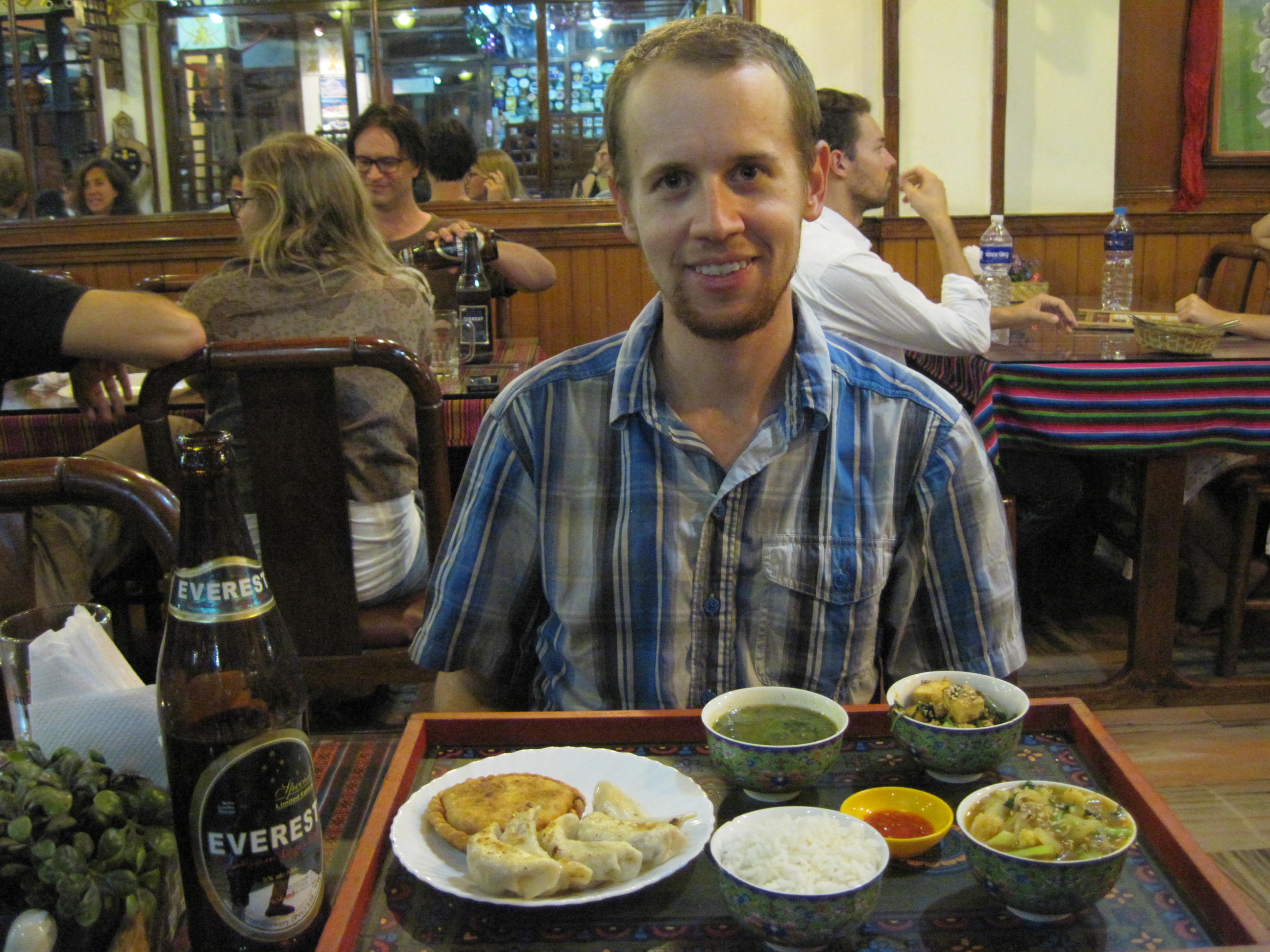
As in Myanmar, part of the fun of visiting Nepal was retracing the steps of Della’s parents on their round-the-world trip. Their favorite restaurant in Kathmandu was Utse’s, a Tibetan restaurant. We were happy to see that it was still there and was even in the Lonely Planet. We went there for dinner and enjoyed our Tibetan meal. We went back to check on it after the quake; the building seemed intact but they were not yet open for business.

Enjoying the Tibetan set plate with delicacies such as steamed momos

Enjoying the Tibetan set plate with delicacies such as steamed momos

Another dining highlight was a bit of a splurge for us. We had a nice dinner at the Thamel House, located in a charming old building. What drew us here was the free dance show that went on throughout our meal. This time we got a Newari set meal, and got to sample local specialties such as dal bhat and other curries. When we walked by after the quake, it seemed like the building was in good shape and they were re-opened already.

Final Thoughts

If you had asked us before the earthquake, we probably would have said that we found Kathmandu to be a bit dusty, crowded and chaotic, but at the same time a fascinating place to explore years of history and an intriguing culture. But now with the damage that the quake did to some of the sights we saw, we just hope that this city can recover and rebuild to allow others to see and experience this treasure for themselves.

We will continue to tell the story of our earthquake experience in Nepal. We were extremely fortunate to survive and to be able to come home to the USA. Our stories are now over, but those in Nepal are not that fortunate. Huge numbers of people have lost their homes and their livelihoods. Please take some time to donate (any amount, large or small, can help) to help this beautiful country recover. We’ve collected list of organizations that you might consider here

The Nepal Earthquake: How to Help

We haven’t blogged in a while because we were trapped while trekking the Langtang Valley when the large earthquake hit Nepal on April 25. That is many stories for another time though. Right now, we want to use this platform to ask everyone to please consider contributing to the causes that are trying to help the country recover.

We’ll try to collect information on different charities as we learn about them.

Some Recommendations

  • Rasuwa Relief – A group working specifically in the Rasuwa region which includes some of the towns we traveled through. Extensive information about their efforts can be found on their facebook group.
  • Langtang Disaster Relief Fund – A new group started by a survivor from Langtang village. Funds go directly to the Langtang villagers to try to rebuild.
  • Sustainable Steps Nepal – Relief for now and the future of Nepal
  • Langtang Village of Nepal Relief Fund – started by friend of a friend in Denver who has connections to Nepal. Langtang Village was higher on our trek and was completely destroyed by a mud/snow landslide. Please also note that there is an in-person fundraising event planned as well.
  • Colorado Nepal Alliance / Shoes for Sherpas – two projects from our home state that do good work in Nepal. We have a friend on the board as well
  • Mountainchild
  • Gift of the Givers – this is a South African organization that is working in Nepal. They did a lot of work to support the two South Africans who were stuck at Bamboo Village with us. They are continuing their search and rescue and support efforts
  • From a friend: “I heard from a college professor (my major advisor) who has a current Nepali student from Kathmandu, with family there. I believe he knows they are okay, but he and his sister are fundraising for two relief organizations that aren’t on most people’s radar: Women’s Entrepreneur Association of Nepal (WEAN) and Baseri Village Relief Team (Dhading), through an Indiegogo campaign.”
  • Nepal Youth Foundation and iDE – Two charities that were recommended by a Denver-area church

From Our Own

Recommendations from a Friend With Connections in Nepal

  • DIRECT REBUILDING IN ONE REMOTE VILLAGE.  http://www.gofundme.com/t494ck   “Closest to my heart is this tiny campaign.  It was organized by Phurchhoki Sherpa, whose family I lived with both before she was born and after.  She is the first of her village to attend college in the U.S. and is here now, having just graduated.  I could not be prouder. Her American friends wanted to give money to rebuild her house, but she decided instead to ask for help in restoring the village school and Buddhist temple.  The money she receives will go directly to the village where villagers will use it along with the labor of their own hands to rebuild.  Please consider even a small donation as the money will go a long way.”
  • IMMEDIATE RELIEF/HEALTHCARE.  “These recommendations come from a young Nepalese doctor connected to my uncle (also a doctor, and who has worked on relief efforts in Haiti). Health is going to be one of the biggest challenges very quickly, as both in Kathmandu and in rural areas normal means of sanitation are badly compromised. This doctor is recommending two smaller organizations that, in her words, ‘skip both big names and our Nepali government… so that maximum money reaches the needy.’– “The America Nepali Medical Foundation is directly collaborating with major hospital in and around Kathmandu valley and is arranging medical care to reach ground zero.”  http://americanepalmedicalfoundation.com— “NAOO is our Nepalese group here in Cleveland. it will collaborate with local organisation and youth group to provide relief package and basic necessity supplies like tent and drinking water. few of our members have already left for Nepal to map the initial steps.”  http://new.naoo.org/?page_id=161
  •  IMMEDIATE DISASTER RELIEF IN KATHMANDU AND LESS REMOTE AREAS.  “I am recommending Charity: Water.  They have an excellent reputation internationally and have been in Nepal several years working to provide drinking water systems.  They have connections/experience with disaster relief also and are expanding their focus in the wake of the earthquake, but I believe their experience of water issues will be invaluable.  Water is a precondition for food, health, sanitation — everything — and water systems are stressed or broken in many places. “
  • LONG HAUL REBUILDING.  : “dZi Foundation I think I have been hearing more about this organization than any other.  It is relatively small, and it has a stellar reputation for employing Nepalis and for working in areas that have been unreached by conventional development efforts.  More information about their philosophy and present program of action in the wake of the earthquake is here.  I highly recommend them.”

Large Charity Lists

Some organizations have put together lists of reputable charities

Small Comforts: Cool Weather!

There are a few small comforts that we run into now and then that really make us feel better while traveling…

We’ve been traveling in SE Asia since January, and with a few exceptions (most notably the first part of our trip in Myanmar), we have been hot. Now, I don’t mean hot the way our hometown of Denver is hot. It can get pretty high on the temperature scale, but thankfully, home doesn’t deliver on the humidity.

Since we hit Singapore back in late January, we have been dealing with off the charts heat and humidity. We went through what was locally described as unseasonably hot weather in Luang Prabang, Chiang Mai, and in the middle parts of Vietnam.

We had even planned our trip throughout the region with heat in mind. We purposefully left Vietnam for our last stop because we knew that central and northern Vietnam would be cooler. When we hit Hoi  An and Hue and we were still sweating through our shirts, we were a bit disappointed.

However, when we got to Hanoi, we finally got the weather we needed. Normally we are not thrilled with cloudy, dreary weather. But we got it every single day in Hanoi and we loved every second of it!

This was us in Hue. Yes… we were a bit gross…

CAM03507

This was us in Hanoi. Cool, cloudy weather, yay!

IMG_0314_edt

Zumba Round the World: Hanoi

It had been ages since we had been to a real Zumba class! We visited one in Dallas when we were home for the holidays, but not since then. We’d had a chance to experience a few other aerobics classes in Phnom Penh, Sukhothai, and Bangkok, but we were itching for another real Zumba class experience.

When we arrived in Hanoi and searched the Zumba website, we knew we might be in luck. However, the class we actually went to was found just as we were walking around the city. There was a gym called XFitness only a few blocks from our hotel and it had a sign for Zumba in the window!

IMG_0373

We found out that we could buy a day pass for 110,000 dong (around $5.00), which is quite expensive for Vietnam standards but not too bad for a Zumba class by US standards. The gym was fancy with luxurious locker rooms and even a sauna, so we decided to come for a 6:20 class on the following day.

We were quite exhausted after a long day on our feet sightseeing in Hanoi so were feeling a little lazy about getting to the class. But, like most things, we knew we would be glad once we were there, so we pushed ourselves out the door, through the rainy weather, up the elevator to the 7th floor for XFitness, and into the class.

The class was excellent! It was very high energy and included a lot of reggaeton and popular music. There were actually two instructors. We never really could figure out who was the main instructor and who was learning… or maybe this class just normally has 2! They were both young women with great moves and a lot of energy.

We both had to work hard to keep up with the class, but Eric was pleased that he was not the only guy there! We think we were a bit of a novelty in the class, which is strange because Hanoi seemed to be a very cosmopolitan city. But most people seemed quite surprised to see us there and weren’t sure what to make of it.

We thanked one of the instructors afterwards, but she didn’t seem to speak too much English. Another woman told us that it was a new job for that instructor, so we congratulated her on a job well done and headed out to clean up in the locker rooms. (We didn’t make use of the sauna though!)

Overall, we had a great time and were quite excited to finally get into another Zumba class!