Bus Ride: Kathmandu to SyabruBesi

If you’d like to contribute to help the people of Nepal recover from the devastating earthquake, please visit our page collecting some worthy causes.

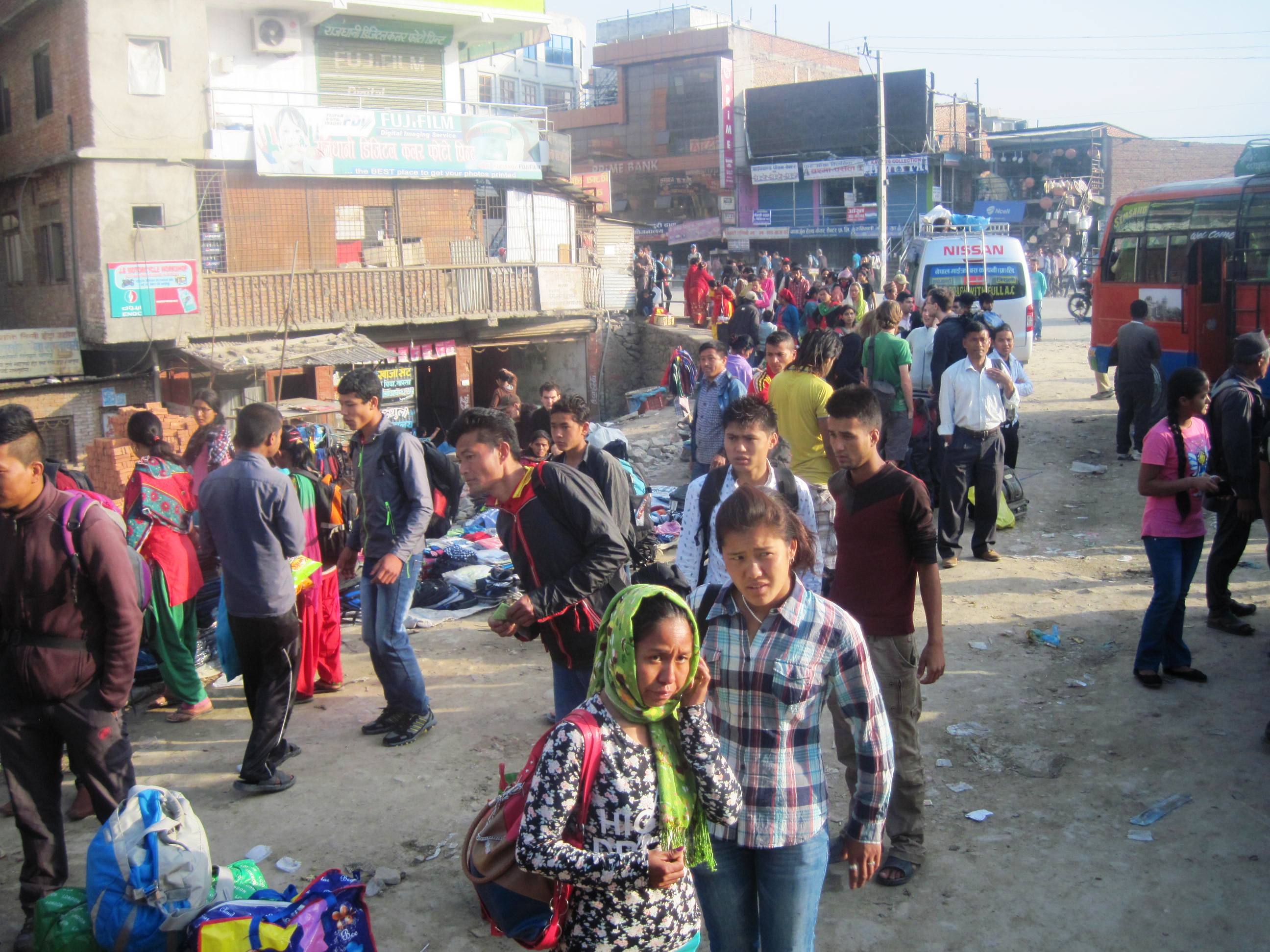
It was 6:30 am on the morning of April 24, 2015. We had just been dumped out of our taxi at the Kathmandu “bus station” where we would catch our Super Deluxe Bus to Syabrubesi, which was the start of our 8 day trek through the Langtang Valley.

At the time, we were overwhelmed by the cacophony of noises and abundance of smells at the bus station. Finding our bus was a challenge. At the time, the bus ride seemed like a fun, long and uncomfortable adventure. Now we know it was the beginning of a fateful journey that not everyone survived.
IMG_1122

That morning, we had woken before dawn to do our final preparations for our trek. We had to wake the manager of our hotel to check out and leave our bags. We found a taxi which zipped us off to the “bus station” as the sun was rising. We were glad that we had been told to travel there the day before to purchase our tickets as it saved us some time and confusion. Even so, we didn’t know quite where to head.

There were many buses there, though not a lot of identifiable signage. We knew we had purchased the Super bus, which we had been told would be a faster ride. We did see several other tourists in the area and asked most of them where they were heading and which bus they were waiting for. Later, we would come to know most of these tourists extremely well.

IMG_1123

Finally, through some help from local vendors we saw our bus trundle in to the “station.” We were surprised to see that the roof rack was completely full. We jumped onto the bus and took our assigned seats, A1 and A2, right at the front. We were even more grateful that we had purchased the day before as the rest of the passengers started to file onto the bus. Those who joined us were a group of 6 independent trekkers, a group of three Israeli trekkers and their guide, a single Israeli trekker, and two Israeli families (3 young children each!!), their guide and 3 porters. The aisle was full of bags which made it a climb to get to the seats behind. It also meant that all of us had to ride with all of our bags on our lap. Somehow there had been some errors made in the selling of the tickets and there weren’t enough seats. As you can probably imagine, this made for a pretty uncomfortable ride.

Despite it all, we were excited. This was going to be a big adventure and we were anxious to get our first views of the majestic Himalayas that would be our home for the next several days. The driver pumped up the music, and we were off.

The Super Deluxe ticket that we purchased had promised a faster ride than the local bus. So, were a bit annoyed when we had to stop over and over again. First for a bathroom break, then for “lunch” at about 10 am, where we were asked to make photo copies of our TIMS cards. Then 2 more times for checks of our paperwork by the Nepal army and the Armed Police Force- luckily, the photocopies sufficed for these.

We stopped in the town of Dhunche and unloaded the bus. It turned out that the roof and aisle had been full of food and supplies destined for this village.

We stopped again at the entrance of Langtang National Park where our paperwork was checked by the park staff. Only 15 min later, we stopped yet again, for our paperwork to be checked by the police. We wondered how many different forces were in Nepal and how many more times our paperwork could possible be checked. Especially since the bus had been traveling all day on a one lane road on the side of mountains. There didn’t seem to be a lot of changes that could happen between each check.

We arrived in SyabruBesi at around 2:00 pm where we were dropped off at the beginning of town. We expected to be attacked by touts hoping to lead us to hotels… But there was no one. In fact, we entered a hotel and could not find a manager of any sort to check us in, so we left.

We did eventually settle on SuryaPeak Guest House because it had a balcony with a nice view over the town and the beginning of the Langtang Valley. We paid 2 dollars that night for accommodation. We read on the balcony, enjoying the crisp mountain air. We went down for an early dinner and our guesthouse prepared us fresh momos and a large plate of dal baht. We had been concerned that we hadn’t been drinking enough water, so we decided to go for a “medium” pot of tea. We were shocked with the “medium” pot seemed to hold about two liters!

It’s hard to really explain this part of our journey now. So many things that seemed important at the time, like the long and uncomfortable bus ride, the scary views out the windows, and the silly mistake of ordering too much tea seem so inconsequential now.

The bus ride introduced us to some people who would become very important to us over the next few days. It also introduced us to Or Assraf (standing on the far left of our picture below) who would start his trek the same day we would start ours. He would be trekking alone and would experience the earthquake somewhere on the trail. He wouldn’t be as lucky as we were. He would be missing for several days following the quake and later his body would be found at the bottom of a cliff. We did not know him well, probably only said a few words to him on the journey, but we will never forget him. We can’t imagine the fear he must have felt during the earthquake that he must have experienced all alone. Our hearts go out to his friends and family who spent a week in trepidation and had their fears confirmed a few days ago. Or was only one of the more than 7000 people who died during this tragedy, but his memory will always be with us.

IMG_1121


We will continue to tell the story of our earthquake experience in Nepal. We were extremely fortunate to survive and to be able to come home to the USA. Our stories are now over, but those in Nepal are not that fortunate. Huge numbers of people have lost their homes and their livelihoods. Please take some time to donate (any amount, large or small, can help) to help this beautiful country recover. We’ve collected list of organizations that you might consider here

Use these links to read the rest of our Nepal Earthquake story:


Kathmandu: Before the Quake

If you’d like to contribute to help the people of Nepal recover from the devastating earthquake, please visit our page collecting some worthy causes.

Usually after we visit a city we like to write a nice summary post about where we stayed, what we did and where we ate. We’d still like to discuss some of these things with regards to Kathmandu, but it feels weird to talk about the city without mentioning that just a few days after our visit a 7.8 magnitude earthquake hit and did a lot of damage in the city and the country as a whole. So we’ll try to balance our discussion of our time in Kathmandu with what we know of what happened to the sights after the quake.

We arrived in Kathmandu late on the evening of April 20, on a Dragonair flight from Hong Kong. (We really enjoyed using the personal entertainment device on the flight and were able to watch Into the Woods and four episodes of Downton Abbey).

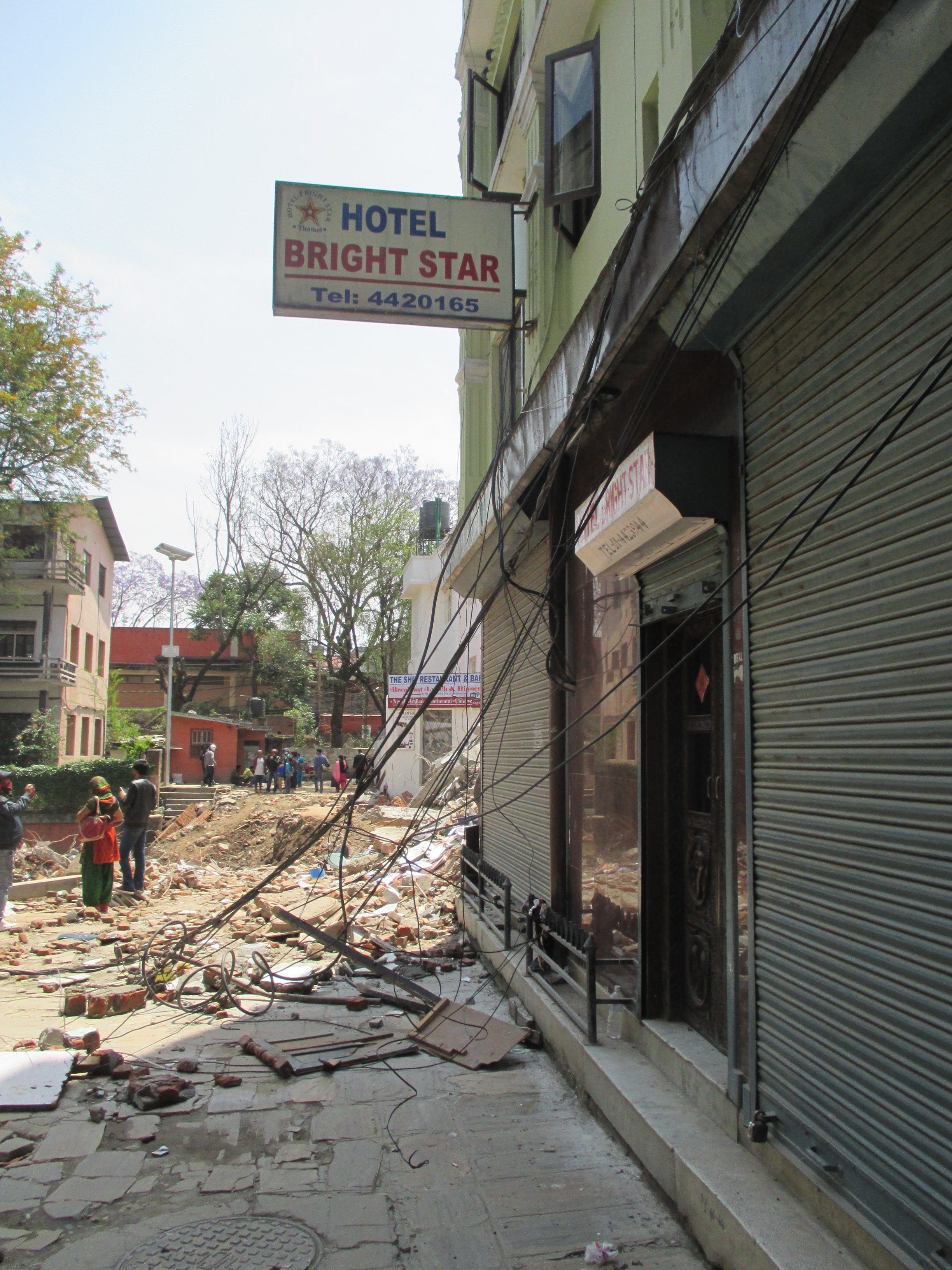
Hotel Bright Star

We didn’t get in until almost midnight, but the owner of our hotel, the Hotel Bright Star, had stayed up to check us in. We had a small room on the top floor – the stairs were a nice preview of what we expected to be a lot of uphill hiking on our trek.

This was only a preview of the generosity that the owner showed us during our three days in Kathmandu. He provided plenty of good advice, and walked us halfway to the tourist office (so we wouldn’t get lost) to pick up our trekking permits.

Hotel Bright Star on its quiet street

Hotel Bright Star on its quiet street

That made it that much harder to see him again after the quake. We had left two bags at the hotel while trekking, and we went back into town on May 1 to pick them up. He said on the phone that he and his family were ok, but when we got there it was clear how close they had come to disaster.

The hotel next door had collapsed during the quake, and all that was left was a pile of bricks and tangled wires. The owner, clearly shaken, told us that 10 people had died inside. We ran inside our hotel to get our bags, and it was clear that it was the first time that he had been back in. He didn’t want to linger, and neither did we; one of the walls of the lobby on the side of the collapsed building was bulging inwards.

The same view after the quake, with the hotel just beyond in rubble

The same view after the quake, with the hotel just beyond in rubble

He said the rest of his family had been safely moved to Pokhara, but he would remain staying in a building down the street until all of the left baggage had been picked up. Hopefully the people who left their bags will return soon…

The Old Quarter

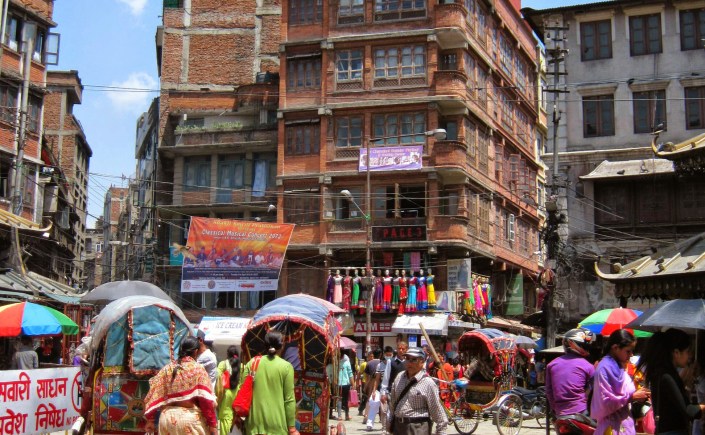
On our first day in Kathmandu we did a self-guided walking tour (led by Lonely Planet) through the old part of Kathmandu. We quickly decided that Nepal was way different from any other country that we had visited on the entire trip! Bright colors all over the place, smells both good and bad in the air, people hawking items, bicycle rickshaws asking for rides, centuries-old temples in every nook and cranny… it was almost overwhelming!

After the quake, we only ventured back to the more touristy part of the Old Quarter, called Thamel. There wasn’t much physical destruction, but the change in the atmosphere of the streets was palpable. Half of the shops were closed up, and the foot and vehicle traffic was maybe half of what it once was. The sense of calm as compared to before was eerie.

Durbar Square

The main historic attraction in Kathmandu is the UNESCO World Heritage-listed Durbar Square, a collection of temples and palaces that was one the home of the Nepali royalty. We spent a whole afternoon exploring the different sights.

The earthquake did a great amount of damage to Durbar Square. We didn’t make it back to see for ourselves, but the pictures we have found online show the devastation.

Kasthamandap

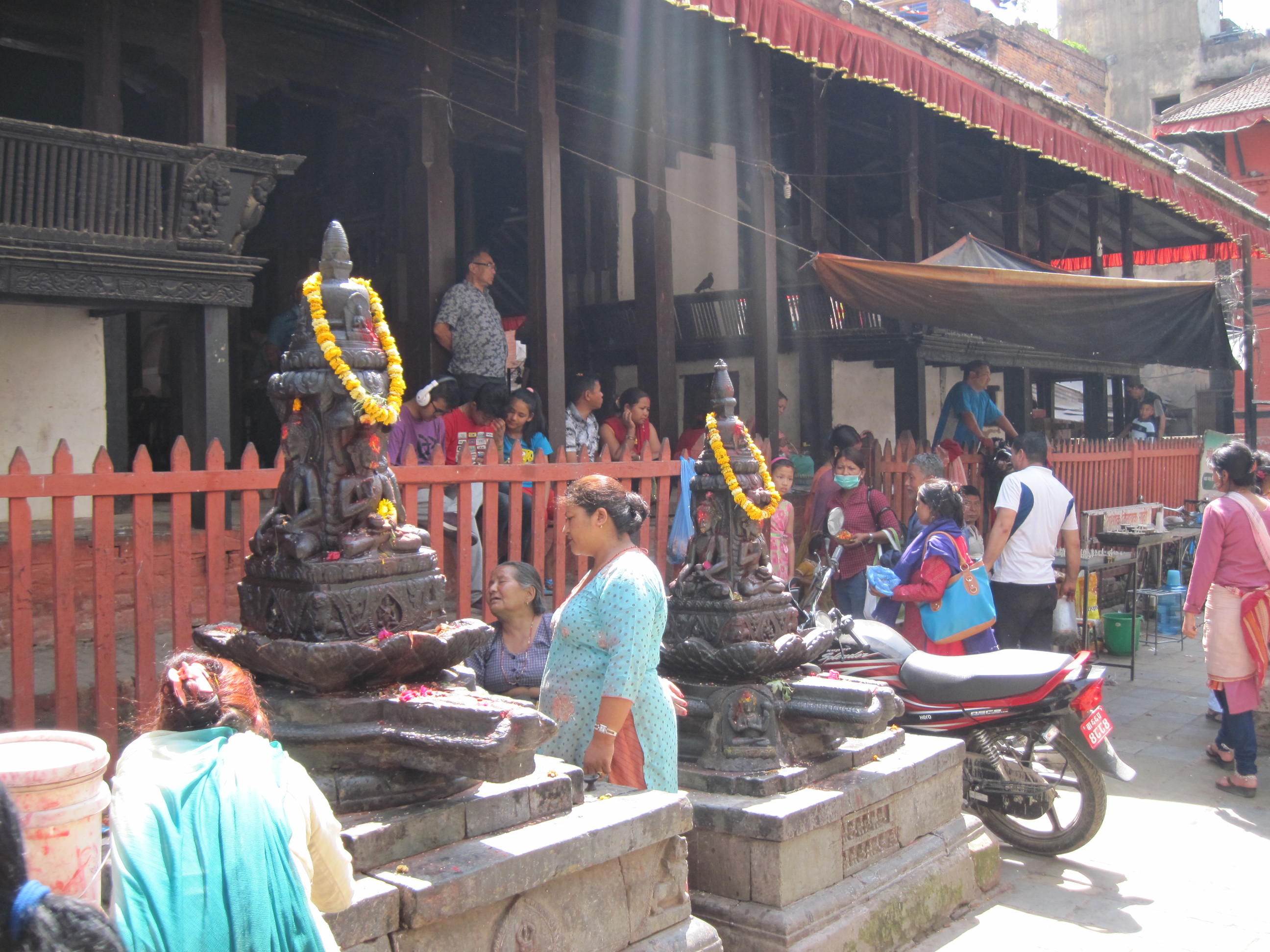
This temple, built in the 12th century, is what gave Kathmandu its name. To us it felt a little bit more like a pavilion, with a large awning sheltering an open space with a few shrines.

Outside of Kasthamandap

Outside of Kasthamandap

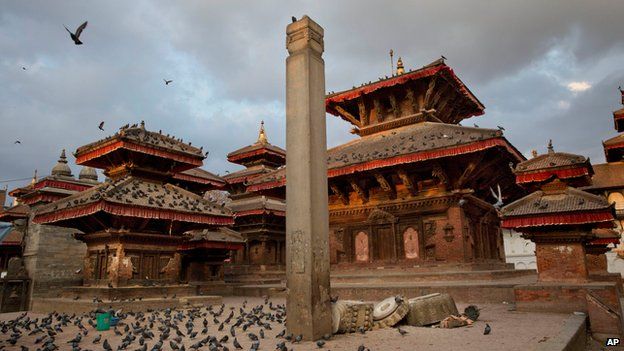
From news reports, it appears that Kasthamandap has been completely destroyed.

Kasthamandap

Not our picture – photo source http://www.theguardian.com/world/2015/apr/27/nepal-earthquake-destroys-kathmandu-valleys-architecture-buildings-heritage. Note the same two statues as in our before picture.


Maju Deval

This tall Hindu temple dominated the center of Durbar Square. We joined the crowds of locals at the top and used it as a nice platform to rest our legs and watch the buzz of activity in the square.

The Maju Deval was completely destroyed in the earthquake, and only the platform remains.

King Pratap Malla’s Column

Near the entrance to the square’s museum was a small area with more temples and a large column with a statue on the top. The statue is a representation of the famous Nepali king from the 17th century.

The column with the statue of King Pratap Malla on top

The column with the statue of King Pratap Malla on top

During the earthquake, the statue fell off its pedestal, but it appears that the surrounding temples are standing.

Hanuman Dhoka

In the center of the Durbar Square area is the Hanuman Dhoka complex, which contains the buildings that make up the Royal Palace. We visited the museum here, which was a collection of dusty artifacts from the last kings of Nepal (before the monarchy was dissolved). Inside the complex were a few nice courtyards.

It’s a little hard to figure out what happened to this complex during the earthquake. It sounds like there was major damage, but it is still standing. A few of the towers collapsed though. You can see some of the same scenes in this video:

Swayambhunath

We took an afternoon to walk out to this Buddhist temple located on a hill overlooking the city. The final climb up the steps was pretty strenuous, but definitely worth it! The iconic face of Buddha stares down at you from the stupa above. There are many other pieces of sculpture with both Buddhist and Hindu themes. On both the walk up and down we saw a few of the monkeys that give the temple its nickname of the “Monkey Temple.”

Swayambhunath was damaged during the earthquake. The large stupa itself looks ok, but many of the buildings surrounding are in ruins.


Where We Ate

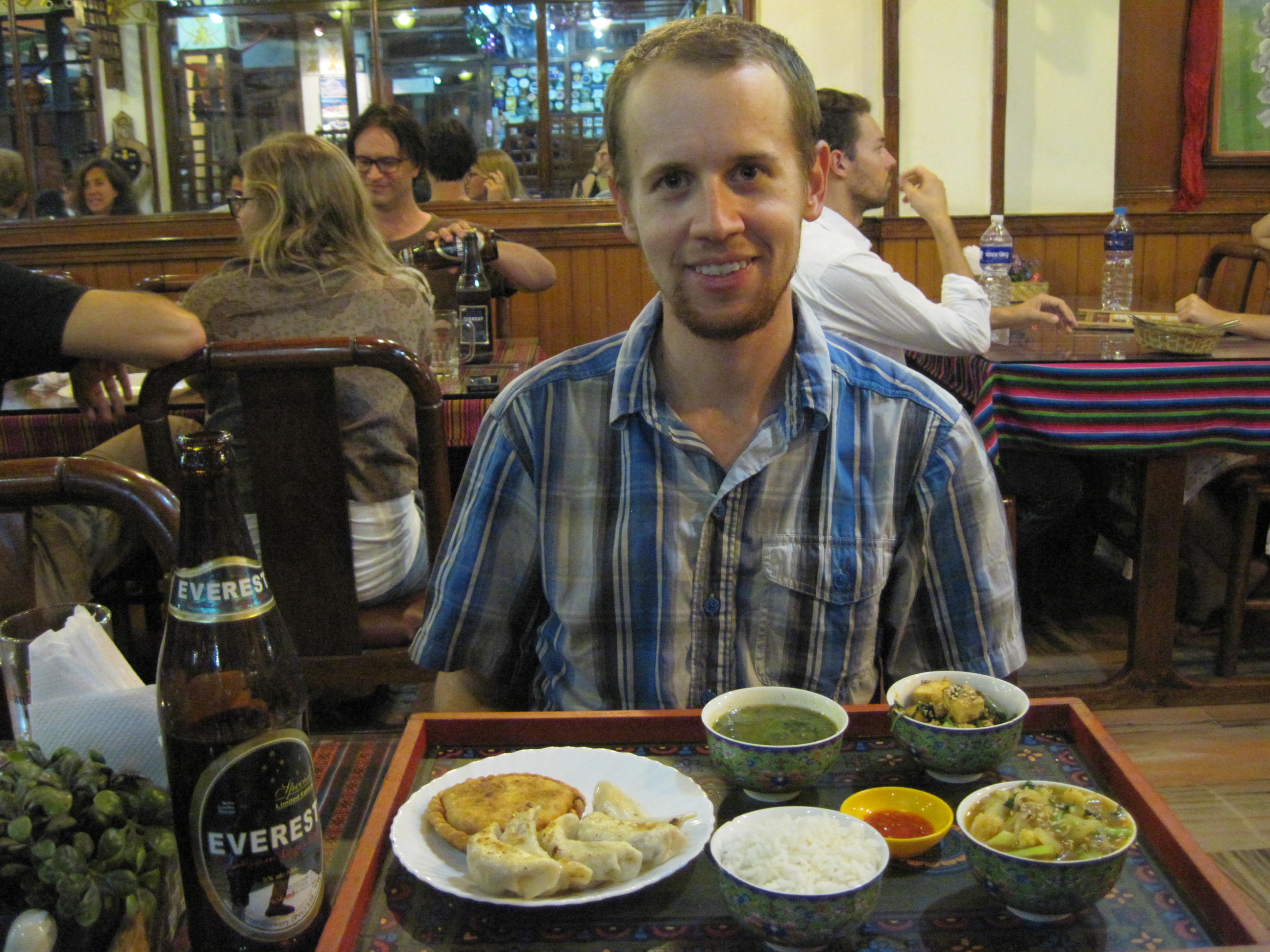
As in Myanmar, part of the fun of visiting Nepal was retracing the steps of Della’s parents on their round-the-world trip. Their favorite restaurant in Kathmandu was Utse’s, a Tibetan restaurant. We were happy to see that it was still there and was even in the Lonely Planet. We went there for dinner and enjoyed our Tibetan meal. We went back to check on it after the quake; the building seemed intact but they were not yet open for business.

Enjoying the Tibetan set plate with delicacies such as steamed momos

Enjoying the Tibetan set plate with delicacies such as steamed momos

Another dining highlight was a bit of a splurge for us. We had a nice dinner at the Thamel House, located in a charming old building. What drew us here was the free dance show that went on throughout our meal. This time we got a Newari set meal, and got to sample local specialties such as dal bhat and other curries. When we walked by after the quake, it seemed like the building was in good shape and they were re-opened already.

Final Thoughts

If you had asked us before the earthquake, we probably would have said that we found Kathmandu to be a bit dusty, crowded and chaotic, but at the same time a fascinating place to explore years of history and an intriguing culture. But now with the damage that the quake did to some of the sights we saw, we just hope that this city can recover and rebuild to allow others to see and experience this treasure for themselves.

We will continue to tell the story of our earthquake experience in Nepal. We were extremely fortunate to survive and to be able to come home to the USA. Our stories are now over, but those in Nepal are not that fortunate. Huge numbers of people have lost their homes and their livelihoods. Please take some time to donate (any amount, large or small, can help) to help this beautiful country recover. We’ve collected list of organizations that you might consider here

The Nepal Earthquake: How to Help

We haven’t blogged in a while because we were trapped while trekking the Langtang Valley when the large earthquake hit Nepal on April 25. That is many stories for another time though. Right now, we want to use this platform to ask everyone to please consider contributing to the causes that are trying to help the country recover.

We’ll try to collect information on different charities as we learn about them.

Some Recommendations

  • Rasuwa Relief – A group working specifically in the Rasuwa region which includes some of the towns we traveled through. Extensive information about their efforts can be found on their facebook group.
  • Langtang Disaster Relief Fund – A new group started by a survivor from Langtang village. Funds go directly to the Langtang villagers to try to rebuild.
  • Sustainable Steps Nepal – Relief for now and the future of Nepal
  • Langtang Village of Nepal Relief Fund – started by friend of a friend in Denver who has connections to Nepal. Langtang Village was higher on our trek and was completely destroyed by a mud/snow landslide. Please also note that there is an in-person fundraising event planned as well.
  • Colorado Nepal Alliance / Shoes for Sherpas – two projects from our home state that do good work in Nepal. We have a friend on the board as well
  • Mountainchild
  • Gift of the Givers – this is a South African organization that is working in Nepal. They did a lot of work to support the two South Africans who were stuck at Bamboo Village with us. They are continuing their search and rescue and support efforts
  • From a friend: “I heard from a college professor (my major advisor) who has a current Nepali student from Kathmandu, with family there. I believe he knows they are okay, but he and his sister are fundraising for two relief organizations that aren’t on most people’s radar: Women’s Entrepreneur Association of Nepal (WEAN) and Baseri Village Relief Team (Dhading), through an Indiegogo campaign.”
  • Nepal Youth Foundation and iDE – Two charities that were recommended by a Denver-area church

From Our Own

Recommendations from a Friend With Connections in Nepal

  • DIRECT REBUILDING IN ONE REMOTE VILLAGE.  http://www.gofundme.com/t494ck   “Closest to my heart is this tiny campaign.  It was organized by Phurchhoki Sherpa, whose family I lived with both before she was born and after.  She is the first of her village to attend college in the U.S. and is here now, having just graduated.  I could not be prouder. Her American friends wanted to give money to rebuild her house, but she decided instead to ask for help in restoring the village school and Buddhist temple.  The money she receives will go directly to the village where villagers will use it along with the labor of their own hands to rebuild.  Please consider even a small donation as the money will go a long way.”
  • IMMEDIATE RELIEF/HEALTHCARE.  “These recommendations come from a young Nepalese doctor connected to my uncle (also a doctor, and who has worked on relief efforts in Haiti). Health is going to be one of the biggest challenges very quickly, as both in Kathmandu and in rural areas normal means of sanitation are badly compromised. This doctor is recommending two smaller organizations that, in her words, ‘skip both big names and our Nepali government… so that maximum money reaches the needy.’– “The America Nepali Medical Foundation is directly collaborating with major hospital in and around Kathmandu valley and is arranging medical care to reach ground zero.”  http://americanepalmedicalfoundation.com— “NAOO is our Nepalese group here in Cleveland. it will collaborate with local organisation and youth group to provide relief package and basic necessity supplies like tent and drinking water. few of our members have already left for Nepal to map the initial steps.”  http://new.naoo.org/?page_id=161
  •  IMMEDIATE DISASTER RELIEF IN KATHMANDU AND LESS REMOTE AREAS.  “I am recommending Charity: Water.  They have an excellent reputation internationally and have been in Nepal several years working to provide drinking water systems.  They have connections/experience with disaster relief also and are expanding their focus in the wake of the earthquake, but I believe their experience of water issues will be invaluable.  Water is a precondition for food, health, sanitation — everything — and water systems are stressed or broken in many places. “
  • LONG HAUL REBUILDING.  : “dZi Foundation I think I have been hearing more about this organization than any other.  It is relatively small, and it has a stellar reputation for employing Nepalis and for working in areas that have been unreached by conventional development efforts.  More information about their philosophy and present program of action in the wake of the earthquake is here.  I highly recommend them.”

Large Charity Lists

Some organizations have put together lists of reputable charities

Small Comforts: Cool Weather!

There are a few small comforts that we run into now and then that really make us feel better while traveling…

We’ve been traveling in SE Asia since January, and with a few exceptions (most notably the first part of our trip in Myanmar), we have been hot. Now, I don’t mean hot the way our hometown of Denver is hot. It can get pretty high on the temperature scale, but thankfully, home doesn’t deliver on the humidity.

Since we hit Singapore back in late January, we have been dealing with off the charts heat and humidity. We went through what was locally described as unseasonably hot weather in Luang Prabang, Chiang Mai, and in the middle parts of Vietnam.

We had even planned our trip throughout the region with heat in mind. We purposefully left Vietnam for our last stop because we knew that central and northern Vietnam would be cooler. When we hit Hoi  An and Hue and we were still sweating through our shirts, we were a bit disappointed.

However, when we got to Hanoi, we finally got the weather we needed. Normally we are not thrilled with cloudy, dreary weather. But we got it every single day in Hanoi and we loved every second of it!

This was us in Hue. Yes… we were a bit gross…

CAM03507

This was us in Hanoi. Cool, cloudy weather, yay!

IMG_0314_edt

Zumba Round the World: Hanoi

It had been ages since we had been to a real Zumba class! We visited one in Dallas when we were home for the holidays, but not since then. We’d had a chance to experience a few other aerobics classes in Phnom Penh, Sukhothai, and Bangkok, but we were itching for another real Zumba class experience.

When we arrived in Hanoi and searched the Zumba website, we knew we might be in luck. However, the class we actually went to was found just as we were walking around the city. There was a gym called XFitness only a few blocks from our hotel and it had a sign for Zumba in the window!

IMG_0373

We found out that we could buy a day pass for 110,000 dong (around $5.00), which is quite expensive for Vietnam standards but not too bad for a Zumba class by US standards. The gym was fancy with luxurious locker rooms and even a sauna, so we decided to come for a 6:20 class on the following day.

We were quite exhausted after a long day on our feet sightseeing in Hanoi so were feeling a little lazy about getting to the class. But, like most things, we knew we would be glad once we were there, so we pushed ourselves out the door, through the rainy weather, up the elevator to the 7th floor for XFitness, and into the class.

The class was excellent! It was very high energy and included a lot of reggaeton and popular music. There were actually two instructors. We never really could figure out who was the main instructor and who was learning… or maybe this class just normally has 2! They were both young women with great moves and a lot of energy.

We both had to work hard to keep up with the class, but Eric was pleased that he was not the only guy there! We think we were a bit of a novelty in the class, which is strange because Hanoi seemed to be a very cosmopolitan city. But most people seemed quite surprised to see us there and weren’t sure what to make of it.

We thanked one of the instructors afterwards, but she didn’t seem to speak too much English. Another woman told us that it was a new job for that instructor, so we congratulated her on a job well done and headed out to clean up in the locker rooms. (We didn’t make use of the sauna though!)

Overall, we had a great time and were quite excited to finally get into another Zumba class!

Using Points to Fly Cheaply Around Asia

In the past we’ve tried to use our frequent flyer points for as many flights as possible, but within Asia we have actually struggled to find ways to fly for free. The points we have just didn’t help for flying to the places that we would have liked to go. But recently we’ve been able to figure a few out!

Phong Nha to Hanoi for $6.58

This one was a last-minute decision. To get from the caves of Phong Nha to Hanoi in northern Vietnam was not as easy as we had originally anticipated. We thought that there would be multiple transport options, but as it turned out, the only bus from the village was a night bus, and the train (from the closest city of Dong Hoi) would take 11 hours and either involve an overnight stretch or take an entire day. All sounded like grueling options.

We were really struggling to choose the best of these limited options, and then we thought outside of the box. Using the wikipedia page for Hanoi’s airport (a top tip for figuring out what you can do), we saw that there was a direct flight on Vietnam Airlines from Dong Hoi to Hanoi. We ran an award flight search on Air France, and saw that we could use their Flying Blue miles to fly on this flight (since Air France and Vietnam Airlines are partners) – for $3.29 in fees plus 10,000 Flying Blue miles per person.

Even with a private transfer to Dong Hoi airport, this worked out as cheaper than the train (which we had been leaning towards) and got us there significantly earlier. To get the Air France Flying Blue miles, we were able to transfer our existing points from American Express Membership Rewards that we had gotten as a signup bonus for a couple of different American Express cards.

IMG_0185

On a propeller plane!


Hanoi to Hong Kong for $64

With Vietnam Airlines being a Sky Team alliance partner with Air France, our flights within and from Vietnam were prime targets to use the Flying Blue miles on. We were also able to snag a ticket to Hong Kong on a Vietnam Airlines flight using the Flying Blue miles as well. We got the necessary 10,000 Flying Blue miles each by transferring some more of our American Express Membership Rewards points. The fees were $31.90 per person.

IMG_7266

Hong Kong to Kathmandu for $79

Hong Kong’s airport is the hub for two major airlines that are a part of the oneworld alliance, so we figured that using points for one of those alliance partners would work well for our flights to or from there. We were able to use this to our advantage to get a flight from Hong Kong to Kathmandu in Nepal.

We found a reward flight on the Hong Kong-based airline Dragonair that we were able to book using our British Airways Avios points. We were able to get the required number of Avios by combining some Avios we had left over from signing up for the British Airways credit card with even more of our American Express Membership Rewards points that we could transfer in. The final cost was 10,000 Avios and $39.47 in fees per person.

Airline Alliances and Transfer Partners

These three examples just go to show how flexible you have to be when booking an award flight. Knowing which airlines partner with other airlines through alliances is huge – we greatly benefited from Vietnam Airlines being in an alliance with Air France and Dragonair with British Airways. Here’s a good infographic explaining the different alliances.

Having points in a program that can be transferred to multiple partners is also a great benefit. We didn’t have to earn Air France miles or British Airways Avios directly; instead, we could just use our American Express points for both. For more information on transferable points, check out this resource.

We have a few more award flights lined up that we are excited to share with you soon!

Fantastic Caves in Phong Na, Vietnam

We had read a couple articles informing us that not so long ago, people had discovered one of the biggest caves in the world in Phong Nha National Park in Vietnam. While we knew we weren’t going to be able to afford the $3000 fee to explore that cave, it did start us looking into the region. We discovered that it was a beautiful place full of large and interesting caves. We’ve had quite a few fun adventures in caves, so we were sold! We left Wayne and Peggy in Hue with plans to meet them again in Hanoi.

Getting There

Many people just do day trips to the caves, but we thought it was a bit too far for a comfortable day trip, plus we thought the area had enough to do to warrant an overnight stay.  We purchased a tourist minibus straight from Hue to the town near Phong Nha. The minibus was just fine, quite comfortable. It wasn’t even full, which feels like a rarity.

We stopped for our bathroom break at an interesting place that we had never heard of. It was a local Catholic church called Our Lady of La Vang that has a neat origin story involving the Virgin Mary appearing to settlers in that region. It was heavily damaged – we assumed from the war with America. However, they had rebuilt a new building for the church attached to the old steeple. In addition, there is a huge statue of Mary nearby. It also appeared that you could purchase large bottles of holy water to take away with you. We didn’t, but a Vietnamese family on our bus did!

Where We Stayed

We stayed at the main hostel in town, the Easy Tiger. It was fine, but was a large hostel with only dorm rooms. We never enjoy staying in dorm rooms – although as far as dorms go, these weren’t too bad: comfortable beds with only 4 to a room.

We had been hoping to stay at a place that we had read about called the Phong Nha Farmstay which was a lovely guesthouse out in the country, but unfortunately they were full. The book also made it sound like the town was super small with not a lot of services, so we jumped on booking the Easy Tiger as soon as we could. When we arrived though, we saw that the town was actually booming and there would have been plenty of other places to stay. Probably where we could have gotten a private room for even cheaper than what we paid for the dorm. So, next time we’ll know!

The Easy Tiger did have free breakfast and a large common area/restaurant which was nice. This did cause us to end up being more social and meeting more other travelers than we had done in a while!

What We Did

The Easy Tiger also provided some of the more interesting tours of the region. There were lots offered and we spent a significant part of our first day making decisions relating to the tours (and how we were actually going to leave Phong Nha and get to Hanoi… but that is a different story!) After agonizing for what seemed like hours, we picked the cheapest tour which also took us to the most amount of caves.

We started the tour at 8:45 the following morning. We were picked up by minibus and whisked off into the national park. The park is absolutely gorgeous. The mountains are covered in brilliant green jungle. We were also excited because for the first time in ages, it wasn’t glaringly hot. Still humid, but a much more comfortable temperature.

We enjoyed some of the stops along the way where our guides explained more about the formation of the park (large limestone karsts) and more about what happened in this area during the American War. It was heavily bombed as the Ho Chi Minh Trail ran through. For those who don’t know, the Ho Chi Minh trail was a path that the North Vietnamese used to supply their fighters in the South during the war. The trail was over 2000 km long and made its way through Laos and Cambodia before arriving in South Vietnam. The US bombed the trail constantly so it was a huge amount of work for the North Vietnamese Army and volunteers to continually rebuild it.

We learned that many of the volunteers working on this section of road were young – in their 20s – and many of them died doing this work. Our first main stop was called the 8 Lady Cave. It currently houses a temple to remember 8 youths who died here. They climbed into the cave for shelter during US bombing, but then the entrance caved in. Apparently they lived in the cave for 9 days before they died.

Our next stop was significantly less solemn. We headed to Paradise Cave which used to have the title of the longest cave in Asia. There is currently 1 km open to the general public. The cave was lovely with large formations – both stalactites and stalagmites. Perhaps the most distinctive thing we saw though was some sort of Asian music star filming a music video in the cave!

After a delicious, large lunch, the group headed to the next stop which was called the Dark Cave. This part of the day involved many steps. First we had to find working life jackets and headlamps. We say “had to find” because it was a bit difficult. Most of the life vests did not have working buckles to hold them on. Eric found one of the few that had three working ones while Della’s had only 1 and a half. Della ended up having to trade with the guide to get a working head lamp…

IMG_0183_edt

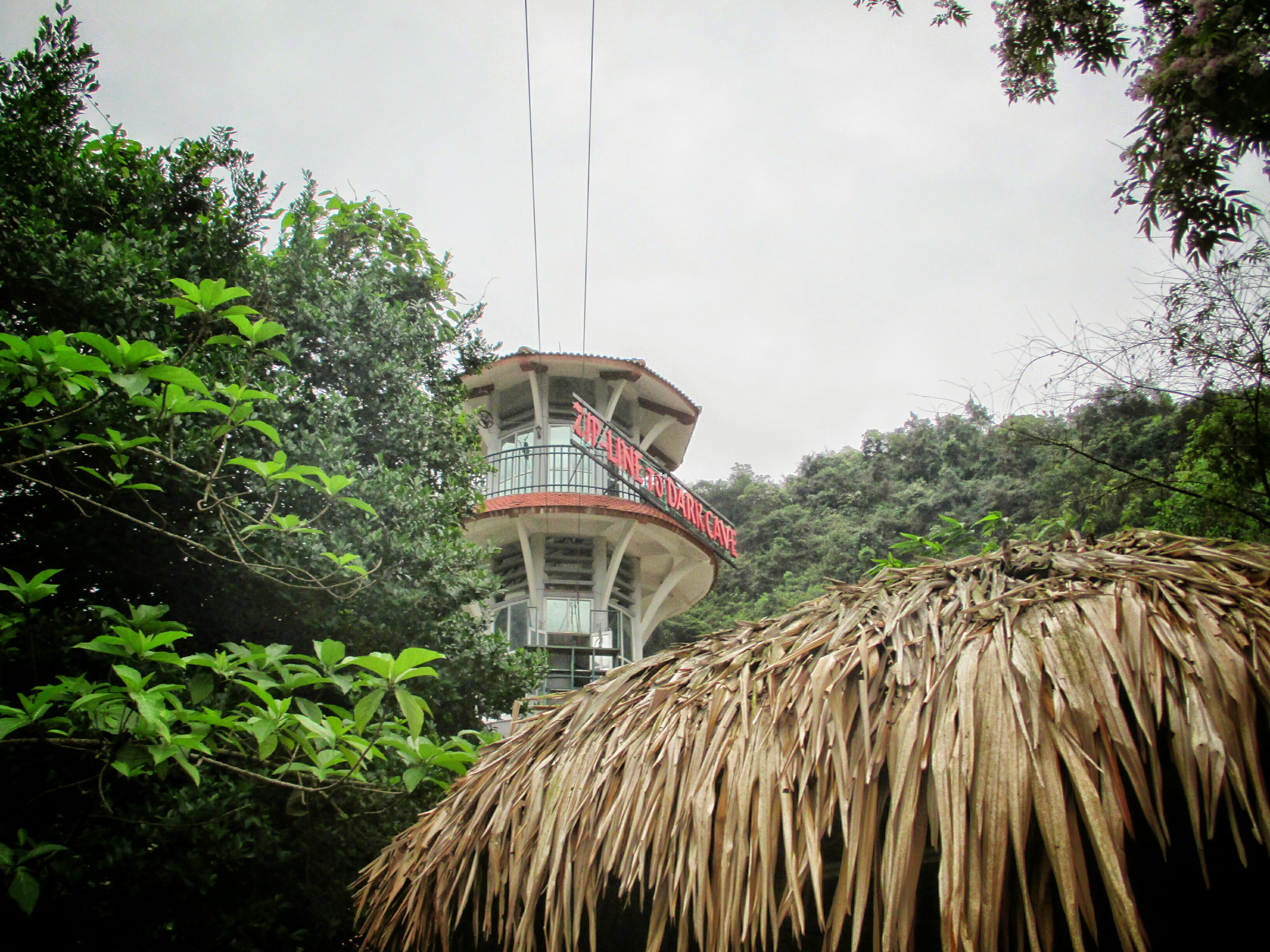
After we “geared up” we headed to a zipline! Della was a little unsure given the quality of the other gear, but the zipline seemed to be in much better condition than the life vests. We took a long zip across the river with no problems. Once on the other side, we slipped into the water for a quick swim to the cave entrance. We flipped on our headlamps and entered the Dark Cave.

IMG_7058_edt

The walk was a bit difficult as we were in bare feet having to climb over sharp limestone formations. However, after a short time it got a bit better as we started to walk in mud. Then the mud got deeper, over our feet, up to our ankles, up to our knees!

Before we knew it we were walking in mud waist deep! After a final climb over a rock and slip and slide, we were actually swimming in the mud! Now this was something we had never experienced before. It was heavy, making it a bit harder to move than you’re used to. But at the same time, it made you feel incredibly light because you could literally float on top of it as soon as you picked up your feet. Once the whole group was in the mud pool, our guide instructed us to turn off our lights. It’s hard to describe exactly what this felt like. In the pitch black, with the mud messing with our sense of gravity, we imagine it felt like we were floating in outer space. It was truly a unique and wonderful experience… too bad we have no pictures of it to share! You’ll just have to go and do it for yourself.

After our mud swim, we came back into the main section of the cave and rinsed ourselves in the stream running through. We then took an enjoyable swim through the cave in the dark. Finally, we headed back out where we jumped on to kayaks to bring us back across the river. But our day was not done! We all had one last chance to do a quick zip line out to drop into the river. It was an exhilarating way to end an excellent day.

The river we ziplined over twice and the kayaks we used to cross once

The river we ziplined over twice and the kayaks we used to cross once

What We Ate

Nothing we ate in Phong Nha was exciting. Our first night we found a small restaurant where we had uninspiring soup and rice. The second evening, we ate with some of our new friends from the tour at the hostel. We had pizza for the first time in months. It was OK…

Final Thoughts

We only stayed in Phong Nha for 2 nights, but it is a place that deserves a lot longer than that. The area is absolutely stunning and we wish we could have spent more time exploring it. The cave tour we did was pricy, but great. There are also several other cave tours offered that we wish we could have tried. Perhaps we’ll have to come back here in the future!

Colorful Hues of Hue, Vietnam

After the hustle and bustle of Ho Chi Minh City and the touristy but lovely lanterns of Hoi An, we headed to the ancient city of Hue (actually pronounced like “Hway”- which does indeed negate our title rhyme). This was another UNESCO site that we had been itching to visit. The city is located on the Perfume River and was the capital of Vietnam under the Nguyen emperors from 1802 to 1885.

Getting There

We had read that the coast from Hoi An up to Hue was one of the prettiest trains rides in all of Vietnam. We couldn’t pass that up and booked the trip. It was indeed lovely! We were expecting a 4 hour ride but arrived in only 2 (we must have misread some information) so we were quite surprised when we pulled into the station. A quick taxi ride and we were at our hotel.

Where We Stayed

We stayed at the Sunny Hotel. We quite enjoyed this hotel – it had really friendly and helpful staff and a wonderful view from our room. However, the view came because we were on the 5th floor… and there was no lift! Definitely got a bit of exercise during our stay. The room was comfortable but there was a small downside. We discovered little parades of ants wandering our wall and had a visit from a cockroach our first evening. However, once that was resolved, we were quite comfortable. We also enjoyed the location which was on a small alley/street with many options for eating.

What We Did

We only had two full days in Hue, so did our best to make the most of them… despite the sweltering unseasonable heat. We arrived early our first day, so Peggy and Wayne went out to explore the river and a pagoda. However, Della was feeling quite sick having caught a bad chest cold. She decided to relax in the room for the afternoon and Eric opted to join her, hoping to catch up a bit with the blog.

The next day, however, we set out for a full sightseeing experience. We headed to the Imperial Citadel which was a short walk from our hotel. We enjoyed the foot crossing of the bridge over the large Perfume River on our way.

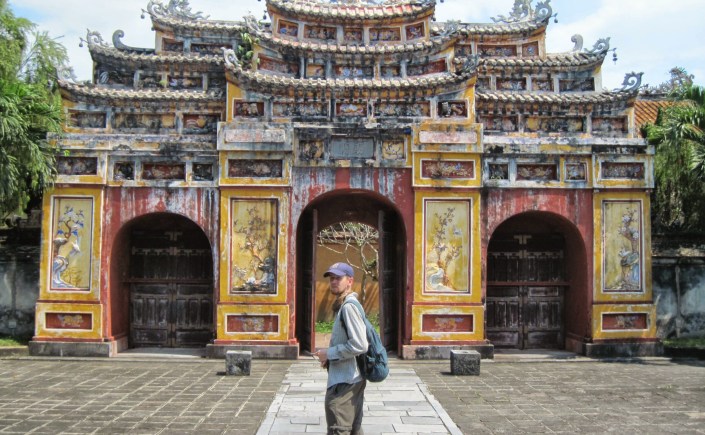
We then headed over the moat and first through the 6m high walls of the Citadel. Within the Citadel is another set of walls and the impressive Ngo Mon Gateway into the Imperial Enclosure, where all of the main activities took place. From there we explored the large site which had been largely destroyed during the French and American wars. However, there is a lot of ongoing restoration work.

We explored the Thai Hoa Palace which was used for official receptions and important ceremonies before heading to the Hall of the Mandarins. “Mandarins” were any government official. We found it interesting to read that they were chosen by testing alone. They would go through schooling and official tests were set up every few years. As the mandarins passed each test, they would move to a higher level. The final test was given by the emperor himself and would determine whether a mandarin would work or not.

The Emperor’s Reading Room was small, but very lovely. We enjoyed the formal Royal Theater, where we were able to escape from the scorching sun for a few minutes. The Co Ha Gardens were lovely to stroll through.

The Forbidden Purple City was once reserved for the personal use  and residence of the emperor, but there is not much left now. Some of the the most beautiful parts of the entire enclosure were the Truong San Residence and the Dien Tho Residence for the wives and mothers of the emperor. It was here where we found a small coffee shop to relax and escape the heat for awhile.

Our final stop was the Thai To Miew Temple Complex which houses shrines to each of the emperors. We enjoyed learning a little bit about the personalities of each emperor. We were especially amused as one was described as working late into the night because he “was slow.” We interpreted that one way, but found out the next day that it really meant something more like cautious and deliberate with his work.

By this point, the heat had sapped almost all of our energy. Della especially, but also Wayne and Peggy, were still recovering from illness so we headed back to the hotel for a much needed siesta.

The next day, we rented bikes and headed outside the city of Hue. There are many extravagant tombs of Nguyen emperors dotting the countryside nearby. We decided, again because of the heat, to head to the closest tomb, the Tomb of Tu Duc, which was about 6 km outside of the city. We debated the idea of hiring a car to take us to more of the tombs (in air-conditioned comfort) but decided against as each tomb had a steep entrance fee and we weren’t sure we needed to see more than one.

The bike ride was slightly nerve-racking at first as we navigated our way through the busy, motorbike filled roads. But, we made it safely and breathed a huge sigh of relief as we passed into the countryside and once again found ourselves making our way through lovely, green rice paddies.

Emperor Tu Duc was the emperor we mentioned above as being “slow.” But learning more about him through visiting his tomb led us to change our interpretation of the term from the day before. He designed his tomb himself, for use before and after his death. He apparently lived a life of excess and spent lavishly. The construction of the tomb actually caused a coup plot, but it ultimately did not succeed. Near his planned tomb was the Stele Pavilion which houses a 20-ton stone drafted by the emperor himself. Apparently, on it, he freely admits his mistakes and is quite reflective about his life.

Apparently, despite everything that went into building the tomb, Tu Duc is not actually buried there. His real burial site is unknown; he and his wife ended up only using the site while they were living. There is a lake which holds a small island where Tu Duc did some of his hunting, a temple where the emperor and empress worshiped, a pavilion where Tu Duc wrote poetry and entertained his concubines, and even a theater. All of the buildings are mostly restored and quite lovely.

Again, drained by the heat, and not looking forward to the heart-pounding ride back to town, we took a different way back. This was slightly longer, but kept us farther away from the big city streets for longer and allowed us a meander along the river. This was a good choice and we enjoyed a quick snack in a park before arriving back to the hotel.

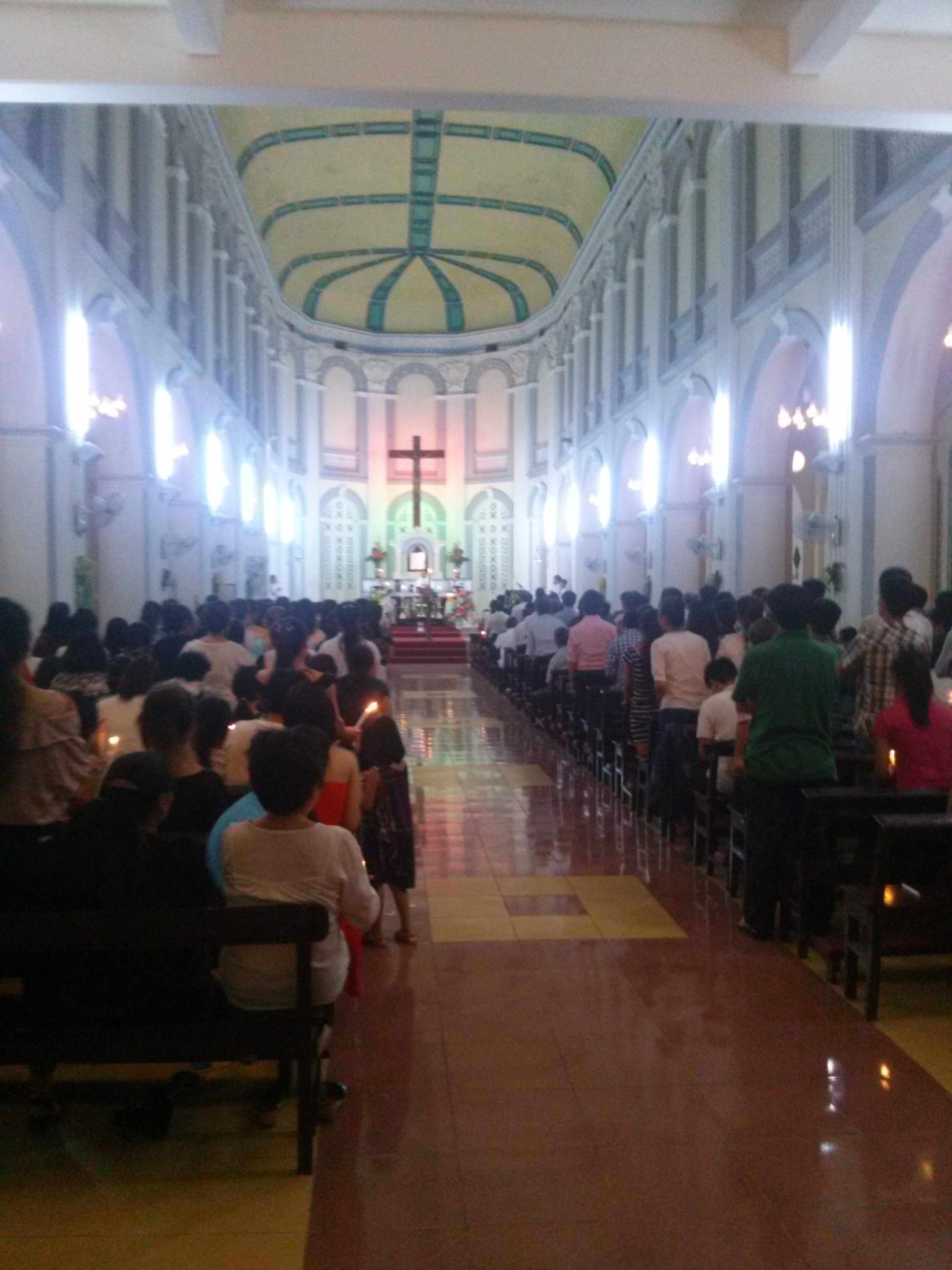
We also celebrated Easter in Hue. By celebrated, we mean that Della and Eric slept in a bit and Wayne and Peggy attempted to visit a church. However, the posted times of the services seemed to be wrong and they were only able to catch the last 10 minutes of the service.

The end of Easter mass

The end of Easter mass

What We Ate

The food in Hue is fit for a king! Or, rather, the traditional foods of Hue were some of the emperor’s Tu Duc’s favorites. We also enjoyed them. The first we tried were a kind of rice pancake, called Banh Khoai. They would serve it with rice paper wrappers and you would roll the pancake in with bean sprouts and other greenery. We also tried a smaller version which was a tiny bite sized pancake with a morsel of flavor called Banh Beo. Eric also made sure to try a soup we had first had in Saigon called Bun Bo Hue.

Two of our more memorable meals ended up with us taking away something that wasn’t food! We ate at a restaurant called Lac Thien after our day exploring the Imperial Citadel. We enjoyed both Banh Khoai and Banh Beo and beer, of course, because it was so hot. The staff was very sweet and particularly enjoyed showing us how to open our beer with a different kind of opener. We actually were familiar with them as they were used widely in Myanmar, but it was a lot of fun to see them again. The owner is deaf so we weren’t able to chat exactly, but he communicated so much energy, kindness, and delight it was lovely. He also signed one of the beer openers and gave it us to keep! The second restaurant was lunch after our long, hot bike ride to the Tomb of Tu Duc. We ate at the Mandarin Restaurant which was quite good. Here, the owner is a photographer, so we were surrounded by lovely images of Vietnam while we ate. When we left, the staff gifted us with two postcards with the owners photographs!

Our final dinner was eaten on the waterfront of the Perfume River. The whole area becomes quite lively after dark with street musicians and a large food market. We expected the restaurants there to be expensive, but we found one with quite reasonable prices. We enjoyed the cool breeze and the lovely lighting of the bridges over the river.

Final Thoughts

We really enjoyed our time in Hue. We found that it didn’t really feel as touristy as we were expecting. The evening on the river front was enjoyed mostly by locals, almost no foreigners at all. Through discussions with travelers after we left, we found that most tourists make Hue a day trip either on their way to or away from Hoi An. We were so glad that we stayed a few days and got to experience more that the city had to offer. The tourist sites were beautiful, marred only by the outrageous heat. Hue is worth a bit of time!


The Lantern-Lit Streets of Historic Hoi An, Vietnam

Hoi An, our second stop in Vietnam was a large contrast from our first stop of Saigon: instead of wide lanes clogged with motorbikes and fronted by modern buildings, there were narrow streets that were pedestrian only and featured quaint old buildings that looked like they haven’t changed in hundreds of years. We spent three days exploring the atmospheric streets of Hoi An and the scenic sites of the surrounding region.

Getting There

For most ways of travel, to get to Hoi An, one first has to get to the major town of Danang, where there is an airport and train station. We debated between taking a cheap flight that would arrive late or taking an overnight train, and in the end chose the train partially for a slight cost savings and partially just for the novelty of an overnight train.

Based on the advice from the very helpful Seat 61 blog, we hoped to book beds in the “soft sleeper” class, which have 4 bunks to a cabin. But, by the time we tried to book, all of these were taken, so we had to settle for bunks in the “hard sleeper” class, which have 6 bunks to a cabin. We had to take the middle bunk, which wasn’t ideal.

Our train pulled out of the station promptly at 7:30, and we headed north. Our bunks were not as spacious as we would have hoped; there wasn’t enough room to sit completely up, so we just had to lay down. Our cabin was full, with two older gentlemen in the bottom bunks and a young married couple in the top bunks. Unfortunately none of them spoke English so we couldn’t really discuss the logistics of moving around and going to bed in the tight space.

They went to bed fairly early, but we had reading lights so we could read for a while longer. We got some fitful sleep, but then were woken up early when the gentlemen in the lower bunks decided to have a full strength conversation at 5:30 in the morning.

We arrived in Danang on time at 12:30. Della’s parents had arranged their travels from Siem Reap (Cambodia) so that they were also in Danang and we could continue our trip through Vietnam with them. We caught a cab to the hotel where they were waiting.

They had arranged for a private van to transport us the 30 minutes to Hoi An. They also set it up so that the driver stopped for us to sightsee at the Marble Mountains, a tourist attraction in between. We went up the most popular of the mountains, and visited a few of the Buddhist pagodas and caves found on top.

Where We Stayed

We stayed at a recently opened guesthouse called the Viet House Homestay just outside of the Old Town. The family that ran the place was very nice and made sure that we were enjoying our stay. The rooms were nice and large, and the included breakfast was cooked to order. We also enjoyed the location, as it was within walking distance of Old Town but also on a more local street with some very affordable restaurants.

What We Did

Explore Old Town – The town of Hoi An was once a major center of trade, and now definitely shows the influence of the different cultures that were the trading partners: China and Japan. There are also many French influences. It is scenic just to walk through the streets and admire the sights, but to really get a feel for the history you need to purchase a ticket to go into some of the historic structures. Each Old City ticket gives you five vouchers to visit a choice of more than 20 buildings, so we made sure to structure our visit to see the five that seemed most interesting.

Our first stop was the Handicraft Workshop, where we made sure to arrive in time to catch the first showing of the twice-daily arts performance. This was a nice overview of different Vietnamese arts, including music, dance , opera, and a special bingo game in which the winning combinations are sung out.

We also went to two assembly houses. These structures were built by groups of Chinese immigrants from the same part of the country to be used as a place to gather for social events and a place to pray to their gods. We visited two: the Assembly Halls of the Chaozhou  Chinese Congregation and the Fujian Chinese Congregation. The former was smaller, but with nice wood carvings and a party going on as were were visiting. The latter was pretty elaborate and fronted with a nice pink gate.

Hoi An also has many private residences which can be visited for one of the vouchers on the Old City ticket. We first went to a small one, the Quan Thang house. We didn’t see the fancy carvings that the guidebook promised, but we did enjoy chatting with the proprietor and having the place to ourselves. Our final stop was the Lonely Planet top choice, so we knew we wouldn’t be the only ones inside. It was quite pretty inside, and we were able to eavesdrop on a tour and get a little bit more information about what we were seeing.

It wasn’t a part of our ticket, but we definitely wanted to make sure and visit the iconic Japanese Covered Bridge, built in the 1590s to link the Japanese side of town with the Chinese.  We went on our first night, and then returned after sightseeing one afternoon to make sure we got good pictures.

Bike Ride to An Bang Beach

Our plans to do a guided bicycle tour fell through, but after consulting a map we decided we could just rent bikes and head to some of the sights ourselves. The Viet House provided two bikes for free, and then our host suggested a place across the street with cheap options to rent more.

We followed a vague plan that was a scenic route towards the beach. As we got away from the city, we saw large rice paddies and shrimp farming. Everything was an impressive shade of green. Our maps program led us down what turned out just to be a tiny path through shrimp fields, but we made it though just fine.

At An Bang Beach, we found a place that had chairs under an umbrella, called the Banyan. In hindsight, there were plenty of places down the beach that were probably cheaper, but the Banyan was a comfortable, convenient place for us to base ourselves for an afternoon of relaxation. The water wasn’t as warm as in Thailand but was still refreshing.

Day Trip to My Son – Before the Vietnamese people moved south into the area, the dominant power was the kingdom of Champa. At the site of My Son, there are the remains of a large number of temples built by the Cham people. The temples are primarily dedicated to the Hindu god Shiva, and there are many examples of linga and yoni that are shrines to him. The Cham built their temples using bricks with no mortar in between, and we found it impressive how well the structures and carvings had held up. Parts of the site, though, were seriously damaged during the war when the US bombed the area to try and destroy the Viet Cong forces using it as a headquarters. We were glad to be able to add another UNESCO World Heritage site to our list, but the heat and humidity in the jungle setting was so oppressive that they detracted from the experience a bit.

We booked a cheap tour through a travel agent we found in Hoi An. Our transport to the site was a 30 minute minivan ride, but for the way back we “splurged” and paid a little bit extra to return by boat. This was a little misleading, as we drove back about two-thirds of the way before getting on a boat for the final stretch. The boat did make an extra stop at an island that is a center of woodcarving. This would have been more impressive if we hadn’t already seen the process in every other Southeast Asian country we have visited.

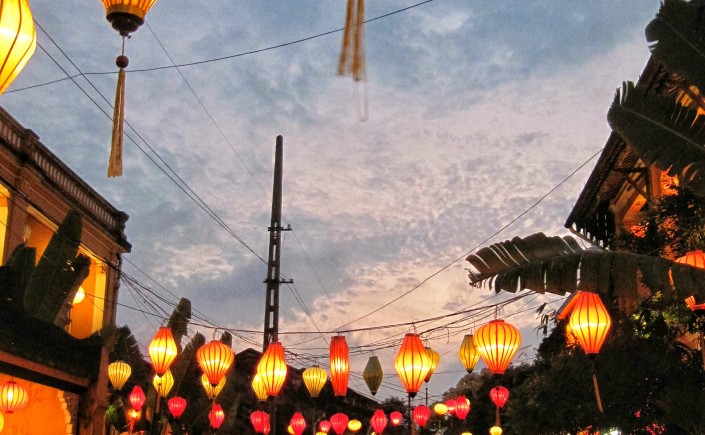
Lantern Festival – On the night of every full moon (well, really the 14th day of every lunar month), the old town of Hoi An throws a Lantern Festival. The streets are lit just by lanterns (most normal lights are turned off), businesses put out shrines for their ancestors, and on a few corners there are special music and theatrical performances. The most impressive part is the launching of lit candle boats onto the river for good luck. You can actually do this every night, but on the night of the Lantern Festival it is ramped up and the river is filled with the illuminated rafts. We felt a little guilty contributing to the pollution but still decided to do it once. Honestly, we were a little underwhelmed by the festival itself. The atmosphere wasn’t that much different in the Old Town than on the other nights, and the hassle of the crowds was harder to deal with.

Where We Ate

Hoi An specializes in a few  good dishes that aren’t found anywhere else in the country, notably cau lau, a dish made with a unique type of noodles and served with roasted pork, and “white rose,” a small shrimp dumpling. We made sure to sample these at multiple restaurants in the area. Our first night in town we headed to a slightly fancy place in the Old Town that presented a more refined take on these Hoi An classics. It was a bit pricey though, so the other nights we ate at the cheap restaurants on the same street as the Viet House, including one that was strictly vegetarian so had slightly different versions of the dishes.

In Hoi An we also had our first chance to sample “fresh beer,” a classic beverage that is unique to the country. The beer is called fresh because it has just recently been brewed and is served without preservatives. It has less alcohol than normal beer and less carbonation, but is very cheap. We paid 5000 Vietnamese dong (about 25 cents) at one place, and then at the restaurants near us it was only 3000 dong (about 15 cents)!

Final Thoughts

The town of Hoi An is quite charming, with great history and beautiful architecture, and we loved the streets lit up by the colorful lanterns at night. On the other hand, it felt a bit like an amusement park version of Vietnam, with more tourists on the streets than locals and quite a few vendors wherever you turned. Our favorite day was probably when we took our bikes out to the beach and got to see more of the everyday life of people in the area.

Saying Hello to Vietnam in Ho Chi Minh City (a.k.a Savoring Saigon)

Our final stop on our tour of Southeast Asia is the country of Vietnam. There’s quite a bit to see in the long, skinny country. We had heard a variety of opinions from fellow travelers about the country: some loved it, but other disliked it and said they wouldn’t go back. We were excited to see where we would fall on this spectrum. Also, as Americans, we were interested to learn more about the war that affected our parents’ generation so deeply, and to see how we would be received in this country.

We chose to start from the south and work our way to the north in the hopes of finding cool weather. Our first stop was the most populous city and the base of US operations during the war, Ho Chi Minh City.
You may be confused, thinking that Saigon was where all the action occurred. Well, they are actually the same city! The name was officially changed once Southern Vietnam was liberated (or taken over, depending on your point of view) by Northern forces and the country was reunified. Many people in the city still informally refer to it as Saigon, so we found ourselves doing the same.

Getting There

We were coming from Ko Lanta, our beach destination in Thailand. We were able to find a flight from the Krabi Airport to Saigon (via Bangkok), which simplified things. Our trip away from Ko Lanta wasn’t nearly as frustrating as our trip there, but it still had its bad moments.

Booking a minivan transfer to the airport was way easier than figuring out how to get from the airport. Every travel agent in town offered the same service, with vans leaving once an hour. We were the first ones picked up and therefore had to spend almost an hour picking up other travelers. Once the van was stuffed, we headed towards Krabi. The lines for the ferries went quickly, and we made it in plenty of time to check in.

Our check-in was a little unique, since we were boarding a domestic flight to Bangkok but ultimately would be going to an international destination. Our airline, Air Asia, gave us special stickers to wear to show that we needed to be taken through extra steps. We were stamped out of Thailand in the Krabi airport, and ended up in a waiting area for international flights. When it was time to board our plane, an Air Asia rep found us and took us to the domestic terminal. What was funny was that our transport to there was a full-size bus… for just the two of us and the rep! And the bus only went about 100 yards.

The rest of our private coach to the gate

The rest of our private coach to the gate

In Bangkok’s Don Muang Airport, we again had a special escort that took us through a side door into a transfers area, where they checked our documentation, did another security scan, and then dumped us into the main international terminal. We didn’t have much baht (Thailand currency) left, so we had one last pad thai each, and then shared some fries from McDonalds (please don’t judge, there was no cheap local food available..).

Our plane was scheduled to take off at 7:30, then around 7:00 we saw lightning flash outside and it started pouring rain. We were excited to see the moisture falling from the sky after so many dry, dusty days, but we were worried about flight delays. Sure enough, a few minutes later, every gate in the area made announcements about delays. Ours ended up not boarding until almost 9:00. We could see large pools of standing water on the tarmac, but takeoff went smoothly.

In the Saigon airport, we had to wait to get our visas. We had used the Visa on Arrival service from Hotels in Vietnam, and all the paperwork they provided worked great. We did still have to wait about 30 minutes for the visas to be processed. At this point it was 11:30 or so.

We were very glad that we had pre-booked a driver to pick us up from the airport, because the few taxis in the ranks looked like the scammy ones we had read about online. Our driver was very relieved to see us. He didn’t speak very much English, but later we found out that he had been waiting since our original arrival time. We had emailed the hotel to let them know about the delay, but apparently the driver had heard that it was on time and didn’t trust them.

When we finally got to our hotel, the clerk roused himself from a nap, checked us in, and then we all headed to bed. Another long travel day in the books!

Where We Stayed

We booked a double room at Giang Son Hotel 2 in the middle of the backpacker area. Our room was a little small, but we really enjoyed the AC and bathroom after “roughing it” at our beach bungalow. The front desk staff seemed very competent and friendly. The included breakfast was good as well.

What We Did

We were especially excited to see the sights around Saigon because we had both recently read the book Saigon by Anthony Grey, a historical fiction novel which used many different real-life locations around the city.

HCMC (Ho Chi Minh City) Museum – Our first day, still a little tired from the late night, we just decided to visit one museum. We headed to the city’s history museum hoping to get a good overview for what we would see on subsequent days. It is housed in an impressive colonial building that has seen a variety of uses from its construction in 1885: it has been the residence of the French colonial governor, offices for the South Vietnamese government, and now a museum. The ground floor houses a few exhibits on the history of the city and the culture of its residents, while the second floor is all dedicated to the revolution in Saigon, first against the French, then the South Vietnamese government (supported by the Americans). We also found a small door leading down to a bunker in the basement, which the leaders of one of the South Vietnamese governments had built to use to escape in case of a coup.

Saigon Old City Walk – We followed the self-guided walking tour route laid out in the Lonely Planet to see some of the sights of old Saigon. Some of the highlights were the bustling Ben Thanh market, the modern Bitexco Financial Tower, the Majestic Hotel by the riverfront, the large square with the Opera House and two other historic hotels, and the People’s Committee Buildings (which is weirdly next to a fancy shopping mall). The tour ended at the Notre Dame Cathedral and the main Post Office, where we made sure to meet each other at noon to test out a potential rendezvous plan.

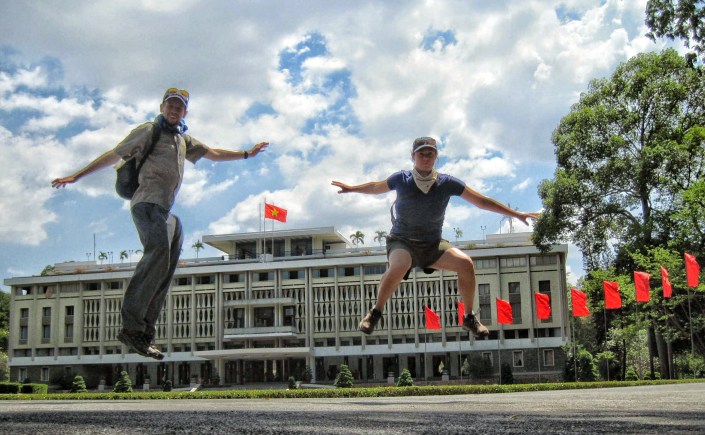
Reunification Palace – On April 30, 1975, the Communist forces of the Vietnam Liberation Front crashed a tank through the gates of this complex, the home of the South Vietnamese government. The leaders inside surrendered, and the country was reunified. Interestingly, they have left the building almost exactly as it was at this moment, so it functions as somewhat of a time capsule for the era. There are a multitude of ornate reception rooms, the President’s residence, and on the upper floors a lounge, a movie theater, a helipad, and a dance floor. The basement is maybe the most fascinating part – here there was a giant bunker complex where you can still see the old radios and maps that were used by the South Vietnamese as the Viet Cong forces grew closer.

War Remnants Museum – This sobering and sometimes disturbing museum shows the effects of the “American War” on the countryside and people of Vietnam. It definitely portrayed the American actions in the war in a negative light, from the massacres of innocent civilians and the long-lasting effects of the deployment of Agent Orange. On the other hand, it did not describe any of the war crimes committed by the Viet Cong side, so it felt like we only heard part of the story.

Cu Chi Tunnels Tour – The Viet Cong were successful against the American forces in part because they engaged in guerrilla warfare. One key part of these tactics was a network of tunnels that they built which enabled them to launch sneak attacks and then disappear quickly. We took a half-day tour up to the Cu Chi Tunnels, where a section of these tunnels has been preserved. The tour took us past some exhibits on the wartime activities in the tunnels and examples of the booby traps that were also a part of the guerrilla strategy. The experience itself felt a bit rushed, but we did ultimately get to crouch-walk through about 20 meters of tunnels (which are only about 3 feet tall).

Explore Cholon, Saigon’s Chinatown – This neighborhood in Saigon was originally founded as a separate settlement by Chinese immigrants and still maintains a heavy Chinese influence. We rode a city bus over and spent some time wondering its streets. Our first stop was the large Binh Tay Market. We were amazed by the size of this place; at one point we thought we were in the center, and then realized that we we still in one corner! We also visited two Taoist pagodas, where we got our first look at a type of religious structure that we hadn’t yet seen. Our final stop was at the Cha Tam Catholic Church, where South Vietnamese President Nguyen Dinh Diem and his brother hid during the coup against them.

Attend the HCMC Tourism Festival – We were excited to discover that a large festival was going on in the park just across the road from our accommodations. The purpose of the festival was to promote tourism in the region, and it was definitely aimed at the local population. Still, we enjoyed visiting the different booths, recognizing many of the places we were planning to visit soon. Also, on the first night we got to see a nice dance performance where each number portrayed a different one of the UNESCO World Heritage sites in Vietnam.

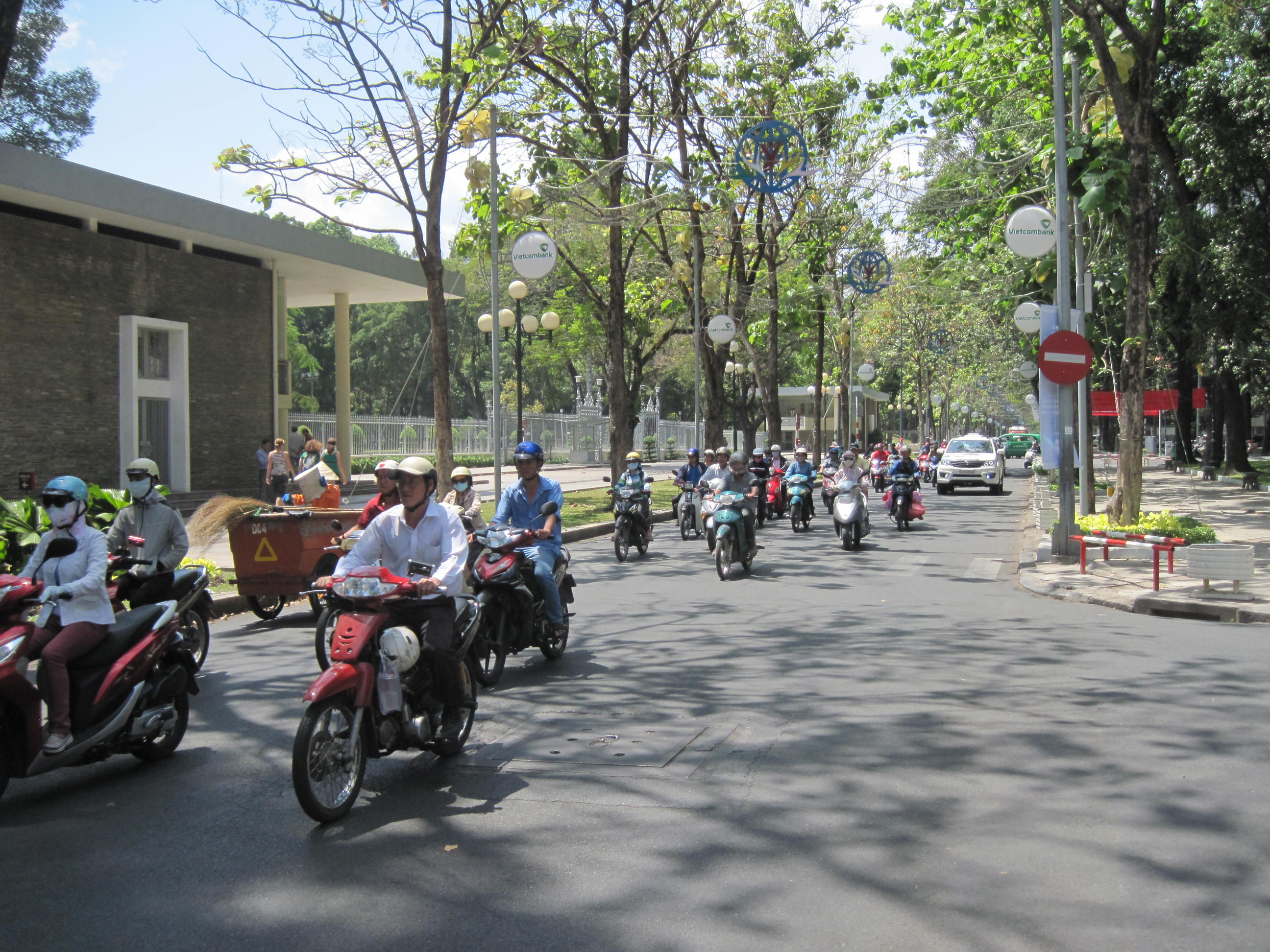
Survive the Traffic – Saigon has a reputation for crazy traffic, and it definitely lived up to this. Crossing larger roads was quite an adventure, especially in a few cases where there was no light. We were very grateful in two of these instances when a local person led the way for us and we were able to get across safely. Even the sidewalks are not safe – sometimes in cases of heavy traffic the motorbikes would drive along them!

IMG_9550

Where We Ate

We enjoy eating Vietnamese food back home in Denver, so we were pretty excited to get our first taste of the cuisine in the country itself. One of our favorite things to eat is the famous beef noodle soup called pho, and fittingly this was the first meal we enjoyed. We ate at a local chain and are very happy to report that it was quite good! We also ate at another local chain near our accommodations for dinner one evening.

Another good feature of the festival beyond the dance performance was that it had many food booths set up that allowed us to sample some different cuisine. One night we each got soups that were unlike anything we had had before (they had some random meat parts and herbs in them), and another night we had a more conventional soup and a vermicelli bowl. We were also excited to order draft beer here for just 50 cents a glass!

The day we went to the Cu Chi tunnels, our tour guide us talked into ordering a local special savory pancake called banh xeo. It was very tasting – a large pancake made with rice flour, and stuff with pork, shrimp and bean sprouts.

IMG_6650

We never really dipped our feet into the Saigon street food scene because it was just so hot outside, and we preferred the air-conditioned comfort of inside dining. Even with that restriction, we found two local restaurants with nice cool interiors where we were able to enjoy some local specialties.

IMG_6604

At most of these meals, we ordered an appetizer of fresh spring rolls, which was especially exciting for Della since they are one of her favorite things. We even were able to find some in a street stall outside the Bin Tayh Market – our one (delicious) exception to not eating street food!

IMG_9659_edt

Final Thoughts

We were unsure about how much we would enjoy Saigon, but we actually quickly decided that we liked it! The city was vibrant but not overwhelming, the sites were easy to explore, and the cuisine was excellent. Saigon served as a great introduction to Vietnam and hopefully the first of many fun places to see there.